
How Long Does It Take to Get a Clearance Certificate From HMRC?

Last Updated – 02-11-2026
If you are applying for tax clearance from HM Revenue & Customs (HMRC), one of the most important questions is how long the process will take and whether delays could affect your business transactions, tax planning or estate administration.
HMRC normally responds to non-statutory clearance applications within 28 calendar days.
However, VAT non-statutory clearance requests are currently taking approximately 12 weeks, while complex applications may take longer if additional information or specialist tax advice is required.
For Inheritance Tax clearance certificates, the processing target is different. HMRC aims to process 80% of IHT30 applications within 15 working days, and official figures show that 93% were processed within this timeframe during April to June 2026.
These processing periods should not be confused with guaranteed approval deadlines.
HMRC may accept an applicant’s tax interpretation, reject it, request further evidence or decline to provide clearance where the application does not meet the relevant requirements.
Understanding which clearance procedure applies, what documentation HMRC expects and when to follow up can help individuals, company directors, accountants and estate executors avoid unnecessary delays.
How Long Does HMRC Take to Issue Different Types of Tax Clearance?
There is no single processing time for every form of HMRC clearance. The applicable deadline depends on the type of application and the tax legislation involved.
| Type of HMRC clearance | Published processing timeframe | Important consideration |
| General non-statutory clearance | Usually 28 calendar days | Complicated cases may exceed this |
| VAT non-statutory clearance | Approximately 12 weeks | Longer than the general response standard |
| Inheritance Tax IHT30 certificate | Target of 15 working days for 80% of applications | Processing target, not a guarantee |
| Statutory transaction clearance | Depends on the particular clearance procedure | Check the relevant statutory route |
| Complex non-statutory application | No guaranteed completion date | Specialist reviews or additional evidence can delay a response |
The 28-day standard is particularly relevant to businesses seeking clarification on how tax legislation applies to a proposed transaction.
HMRC’s internal guidance, ONSCG2300, explains that the usual period is 28 calendar days rather than 28 working days.
For planning purposes, business owners should avoid treating this period as automatic permission to complete a transaction. A response may contain questions or a different interpretation of the applicable tax rules.
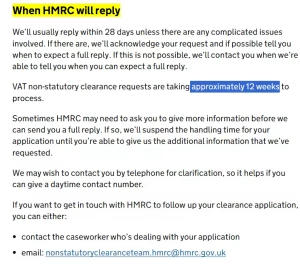
HMRC confirms that general non-statutory clearance requests normally receive a reply within 28 days, while VAT requests take approximately 12 weeks.
What Is an HMRC Clearance Certificate and Why Might You Need One?
An HMRC clearance certificate or clearance letter provides a degree of certainty about a particular tax matter. However, the expression “tax clearance certificate” is often used to describe several different HMRC procedures.
In practice, these documents have different legal functions.
A non-statutory clearance normally sets out HMRC’s interpretation of tax legislation in relation to specific facts or a proposed transaction. It is not a general certificate confirming that a business has paid every tax it owes.
A statutory clearance relates to a particular legislative provision, often involving corporate transactions, share exchanges or reorganisations.
An IHT30 clearance certificate, by comparison, confirms that Inheritance Tax liabilities covered by the certificate have been settled, subject to specific statutory exceptions.
Business owners may consider applying for clearance when a proposed transaction has significant tax consequences and the correct treatment is genuinely uncertain.
For estate executors, obtaining IHT clearance can provide reassurance when finalising a deceased person’s financial affairs.
The distinction is particularly relevant when administering an estate after the death of a spouse or parent.
Issues involving transferable allowances, property valuations and outstanding liabilities can affect the final tax position, as explained in the rules surrounding inheritance tax when the second parent dies.
How Does HMRC’s Non-Statutory Clearance Service Work?
HMRC’s Non-Statutory Clearance Service allows taxpayers and their advisers to request written guidance about genuinely uncertain tax legislation.
The service may be relevant where an individual or business has examined the published legislation and guidance but cannot confidently determine how the rules apply to their circumstances.
However, HMRC does not operate the service simply to confirm every taxpayer’s preferred treatment.
Applicants must demonstrate that they have attempted to resolve the uncertainty through existing guidance and explain why clarification remains necessary.
When Hmrc Will Consider an Application?
HMRC generally expects three conditions to be satisfied:
- The applicant has reviewed the relevant legislation, guidance or contacted the appropriate helpline.
- The available information does not adequately resolve the tax question.
- There is genuine uncertainty about how the legislation applies to the applicant’s particular circumstances.
For example, a company considering a substantial restructuring may wish to establish the correct tax treatment before implementing the transaction.
The application should explain the proposed arrangement, the relevant statutory provisions and the precise interpretation requiring clarification.
When Hmrc Will Refuse to Provide Advice?
HMRC may decline applications involving tax avoidance arrangements, requests for general tax planning advice or matters already covered by an appropriate statutory clearance procedure.
It can also refuse applications where the taxpayer simply wants confirmation of an interpretation that is already clear.
This distinction matters because an unsuccessful application can delay a planned transaction without providing any additional certainty.
An adviser should therefore identify the correct clearance route before preparing the application.
What Documents Are Required to Apply for HMRC Clearance?
The documentation required depends on the relevant tax and the clearance procedure.
Unlike a passport or business licence application, there is no universal checklist requiring every applicant to provide a passport, proof of residence, criminal record declaration and evidence of company solvency.
Instead, HMRC expects sufficient information to understand the transaction and the tax uncertainty.
| Information | Why HMRC needs it |
| Applicant’s name and contact details | To identify the taxpayer and respond |
| Relevant tax references | To connect the request to the correct taxpayer |
| Description of the transaction | To understand the commercial circumstances |
| Relevant tax legislation | To identify the provisions requiring interpretation |
| Applicant’s interpretation | To understand the proposed tax treatment |
| Details of the uncertainty | To determine why clearance is necessary |
| Supporting contracts or calculations | To verify relevant transaction details |
| Adviser authorisation, where applicable | To communicate with an authorised representative |
For general non-statutory clearance, Annex A of HMRC’s guidance is normally relevant. Other annexes cover Business Investment Relief, Business Property Relief, VAT and certain offshore disclosure matters.
Supporting information should be proportionate to the transaction. Including unnecessary documents does not automatically accelerate the process.
How Can You Apply for a Clearance Certificate From HMRC?
The application process begins by identifying the specific clearance required.
Step 1: Identify the Correct Clearance Route
Determine whether the transaction requires statutory clearance, non-statutory guidance or a formal Inheritance Tax clearance certificate.
The application procedures are not interchangeable.
Step 2: Prepare the Application
Describe the facts clearly, including the parties involved, commercial purpose, relevant tax implications and applicable legislation.
Explain the specific uncertainty and why existing guidance does not resolve it.
Step 3: Submit the Application
For non-statutory clearance, HMRC instructs applicants to use the email address specified in the appropriate annex of its published guidance.
Large businesses with a Customer Compliance Manager may have separate submission arrangements.
Step 4: Respond to Hmrc Enquiries
HMRC may acknowledge the application before requesting additional documentation or clarification.
Under guidance updated on 31 July 2026, applicants must provide requested additional information within 30 days of the date on HMRC’s letter.
If the information is not received within that period, HMRC may close the application without completing its consideration.
Step 5: Review the Written Response
HMRC may agree with the proposed interpretation, disagree with it, request further details or explain why the application has not been accepted.
Where clearance is provided, the applicant should retain the written response alongside the relevant tax records.
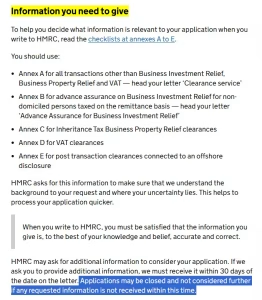
HMRC’s updated guidance states that requested additional information must normally be received within 30 days of the request letter.
Why Can HMRC Clearance Take Longer Than 28 Days?
The published processing standard is based on normal cases. Certain applications involve additional checks or require technical input from more than one HMRC specialist.
Several factors can extend the process.
Incomplete or Inconsistent Information
Missing transaction details can prevent HMRC from reaching an informed conclusion.
For example, a company requesting clearance on a restructuring may provide the proposed ownership arrangement but omit information about connected parties or the underlying commercial purpose.
HMRC may need to establish these facts before considering the tax consequences.
Complex Legislation
Some transactions involve overlapping provisions of Corporation Tax, Capital Gains Tax, Inheritance Tax or VAT legislation.
The caseworker may need advice from specialist teams, extending the response period beyond the usual target.
Additional Information Requests
HMRC’s internal procedures explain that its 28-day handling period begins when the application is received.
When further information is requested, the handling period is suspended until an adequate response is received. It then resumes rather than starting a completely new 28-day period.
For example, suppose HMRC receives an application and requests further details after 10 calendar days.
If the applicant takes another 14 days to respond, the overall elapsed period can exceed 28 days even though HMRC has not exhausted its normal processing allowance.
Specialist Reviews and Transaction Changes
Where a proposed transaction changes materially while HMRC is examining it, the original application may no longer accurately describe the circumstances.
An applicant may need to supply updated information or make a fresh request, depending on the significance of the changes.
Maintaining a clear audit trail of the transaction and correspondence can reduce the risk of misunderstandings.
How Long Does an HMRC Inheritance Tax Clearance Certificate Take?
An Inheritance Tax clearance certificate is commonly associated with form IHT30.
The certificate is used to confirm that the Inheritance Tax due on the assets covered has been paid and, subject to statutory exceptions, discharge the relevant taxpayers from further liability.
In September 2026, Treasury minister James Murray confirmed that HMRC’s service standard was to process 80% of IHT clearance applications within 15 working days.
He also reported that 93% of IHT30 applications were processed within 15 working days during the first quarter of the 2026/27 financial year, indicating performance above the published target during that period.
However, this is the processing period for an IHT30 application. It does not mean an estate can be fully administered within three weeks of the death.
Before applying, executors generally need to establish the complete estate position, resolve relevant valuation matters and ensure that the tax position is sufficiently final.
Applications submitted prematurely may be delayed because HMRC cannot confirm that the relevant liabilities have been settled.
What Does the Iht30 Application Form Look Like?
The official HMRC IHT30 application asks for the relevant Inheritance Tax reference, dates of returns and amendments, and details of the person or estate concerned.
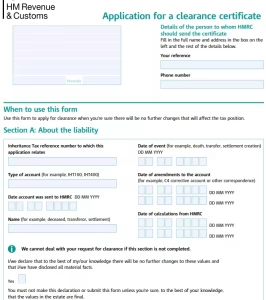
HMRC’s official clearance application, including Section A and the requirement to confirm that estate values are final. Source: HMRC, IHT30 form.
The form makes clear that applicants must be satisfied, to the best of their knowledge, that no further changes will affect the estate’s tax position.
That requirement can be difficult to meet when an estate contains disputed valuations, unresolved gifts, outstanding relief claims or assets that have yet to be identified.
Estate executors should also consider whether lifetime gifts have been correctly disclosed. The treatment of gifts and inheritance tax liabilities can materially affect the estate’s final tax calculation.
Does a Solicitor Have to Sign the Iht30 Form?
The relevant person liable for the tax, such as an executor, administrator or trustee, must make the appropriate declaration.
Professional agents generally cannot sign the form on behalf of the liable person merely because they are managing the application.
The second page also contains the section completed by HMRC when issuing the certificate.
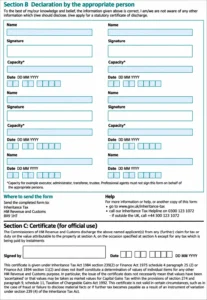
Declaration, executor signatures, HMRC postal address and the official certificate section.
Carol Haworth, writing as a Practical Law Private Client specialist, has explained that professional executors generally prefer to obtain clearance before final distribution, whereas family members acting as executors may weigh the additional time and expense differently.
This reflects an important practical point: the value of formal clearance depends partly on the complexity of the estate and the executor’s exposure to future claims.
Do You Need HMRC Clearance Before Distributing an Estate?
Not every estate requires a formal IHT30 certificate before beneficiaries can receive their inheritance.
Where an estate qualifies as an excepted estate, the rules may provide statutory discharge without a separate IHT30 application, subject to the relevant conditions and exceptions.
HMRC may also issue a closing assurance letter that has the same effect as a formal clearance certificate for the liabilities covered.
In September 2025, Treasury minister Dan Tomlinson confirmed in a parliamentary response that beneficiaries do not universally need an IHT30 certificate before assets can be distributed.
Nevertheless, executors must ensure that the estate’s outstanding liabilities have been appropriately addressed and that sufficient funds are retained for unresolved obligations.
Adam Scott, a partner at Trethowans, raised concerns during HMRC’s temporary IHT30 processing difficulties in June 2025, describing the position as leaving executors in a state of legal and financial uncertainty.
His concerns were particularly relevant to estates containing substantial property assets, multiple beneficiaries or unresolved tax matters.
Those comments describe the 2025 interruption and should not be interpreted as evidence that HMRC was still suspending IHT30 processing in October 2026.
For complicated estates, professional advice can help determine whether a final distribution is appropriate, whether an interim distribution is safer or whether additional clearance should be obtained.
Can You Speed Up an HMRC Clearance Application?
There is no guaranteed fast-track procedure for every HMRC clearance request. However, applicants can reduce avoidable delays through careful preparation and prompt communication.
Some practical measures include:
- Check the correct procedure: Make sure the application is being sent to the HMRC team responsible for the relevant tax matter.
- Provide complete details: Explain the transaction, legal provisions and uncertainty clearly.
- Respond promptly: Submit additional information as soon as possible and within HMRC’s specified deadline.
- Keep correspondence organised: Retain copies of applications, acknowledgement emails and supporting documentation.
- Avoid unnecessary amendments: Where possible, finalise the relevant transaction details before applying.
- Use professional advice when appropriate: A qualified tax adviser can identify omissions and technical issues before submission.
Applying earlier can also help where a proposed business transaction is subject to a contractual completion date.
However, applicants should not assume that submitting the same request repeatedly will accelerate processing. Duplicate applications could instead create administrative confusion.
What Should You Do if HMRC Has Not Responded After 28 Days?
If the normal handling period has passed, the first step is to establish whether the application is still being considered or whether HMRC has requested additional information.
For non-statutory clearance, applicants can contact their assigned caseworker or use the clearance team email address:
nonstatutoryclearanceteam.hmrc@hmrc.gov.uk
When following up, include the original submission date, relevant taxpayer details and any reference HMRC has supplied.
A concise follow-up should request confirmation that the application is being processed and ask whether HMRC requires further information.
Where HMRC has already identified complex issues, the applicant should request an updated estimated response date.
Importantly, waiting for tax clearance does not normally suspend existing tax filing or payment deadlines.
Businesses must still comply with their obligations, including submitting applicable Self Assessment tax returns on time.
If a clearance decision is received after a return has been filed, an amendment may be possible within the relevant statutory time limits.
Does HMRC Charge a Fee for a Clearance Certificate?
The standard HMRC non-statutory clearance guidance does not specify a general application fee.
Consequently, businesses should not assume that a mandatory HMRC clearance application fee applies to every transaction.
However, obtaining professional assistance can generate additional expenditure.
| Potential cost | Explanation |
| HMRC non-statutory clearance application | No general application fee specified in the published service guidance |
| Accountant’s assistance | Depends on the work required |
| Specialist tax advice | Varies with transaction complexity |
| Legal documentation | May involve professional drafting or review |
| Additional accounting or valuation work | Depends on the supporting evidence required |
Professional charges should be agreed with the adviser before work begins.
A particularly complicated corporate transaction may justify specialist tax advice because an incorrect interpretation could have consequences far greater than the cost of preparing a clearance application.
Is an HMRC Clearance Certificate Compulsory for Every Business?
No. UK businesses are not universally required to obtain a tax clearance certificate before they can begin trading.
The normal responsibilities of a business may include registration with HMRC, Corporation Tax compliance, VAT registration where required, PAYE administration and submission of applicable returns.
These obligations are separate from requesting a tax clearance.
For example, a new limited company carrying out straightforward commercial activities would not normally need a general HMRC tax clearance certificate simply to start operating.
A company planning a specific restructuring may wish to obtain statutory clearance concerning the tax treatment of that transaction.
Equally, someone seeking to demonstrate that their tax records are up to date should not automatically apply through the Non-Statutory Clearance Service, which is intended to address genuine uncertainty about tax law.
Frequently Asked Questions
Can HMRC issue clearance in less than 28 days?
Yes. An application may be answered sooner, but HMRC’s general published response standard for non-statutory clearance is 28 calendar days.
Is the HMRC clearance deadline 28 working days?
No. The general non-statutory clearance standard is 28 calendar days. The separate IHT30 processing target refers to 15 working days.
What happens if HMRC asks for more information?
The non-statutory clearance handling clock is suspended while HMRC awaits an adequate response. Applicants must normally supply requested information within 30 days of the request letter.
Can HMRC refuse a clearance application?
Yes. HMRC can decline applications that do not satisfy the service requirements, including requests for general reassurance, tax planning advice or confirmation of arrangements involving tax avoidance.
Can I apply for HMRC clearance online?
The submission method depends on the clearance procedure. Non-statutory clearance applications are generally sent to the relevant HMRC email address, while IHT30 uses its prescribed form.
Can I distribute an inheritance without an IHT30 certificate?
An IHT30 certificate is not mandatory for every estate distribution. However, executors must appropriately address tax liabilities and other outstanding obligations before making final distributions.
What happens if HMRC disagrees with my tax interpretation?
HMRC normally explains its position. You may still self-assess according to your own interpretation, but doing so can create exposure to additional tax, interest or penalties if that interpretation proves incorrect.
What is your reaction?