£100 Energy Payment: Who Qualifies, When It Will Be Paid and How It Works?

The £100 energy payment is a new Household Energy Payment announced in the Autumn Budget to help households cope with higher energy costs.
Up to 20 million households in England they are expected to receive £100, with payments starting from January 2027. The main scheme covers homes in Council Tax bands A to D.
For most eligible households already paying Council Tax by Direct Debit, there should be no separate claim to make.
The money is due to be paid directly into the bank account connected with the Council Tax account. Households using another Council Tax payment method will instead be contacted by their local council and invited to apply.
The scheme is based on Council Tax rather than income alone, which means your property band, whether the property is your main home and who is responsible for Council Tax are particularly important.
What Has the Government Confirmed About the £100 Payment?
The Household Energy Payment forms part of a wider package announced to address rising household energy costs.
The government has allocated approximately £2.6 billion to the scheme and says up to 20 million English households could receive the payment.
Here is the position currently confirmed:
| Scheme Detail | Current Position |
| Payment Amount | £100 |
| Main Eligibility Area | England |
| Council Tax Bands | A, B, C and D |
| Payment Start | January 2027 |
| Expected Reach | Up to 20 Million Households |
| Direct Debit Households | Payment Should Be Automatic |
| Other Council Tax Payment Methods | Council Will Invite Eligible Households To Apply |
| Second Homes | Not Eligible Under The Main Scheme |
| Empty Properties | Not Eligible Under The Main Scheme |
| Bands E To H | Not Included In The Standard £100 Payment |
| Additional Local Support | £100 Million Discretionary Fund |
The payment is being administered through local authorities and the Council Tax system rather than being credited directly by electricity or gas suppliers.
That makes knowing which authority manages your account important. Householders uncertain about their billing authority can check who Council Tax is normally paid to before the payment period begins.
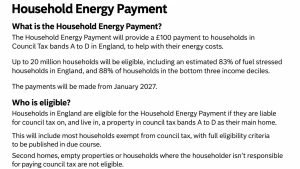
GOV.UK confirms the £100 Household Energy Payment for eligible Council Tax band A to D homes, with payments starting from January 2027.
Who Qualifies for the £100 Energy Payment?
The central eligibility rule is relatively straightforward. A household in England should fall within the standard scheme where the property:
- Is In Council Tax Band A, B, C Or D
- Is The Householder’s Main Home
- Has A Qualifying Council Tax Liability
- Meets The Final Scheme Rules
The government has also said most households that are exempt from Council Tax will be included, although complete criteria for exempt households are still due to be published.
This means the amount you currently pay in Council Tax is not necessarily the deciding factor. Some households receive reductions, discounts or exemptions but could still fall within the payment rules.
Understanding the distinction between a Council Tax discount and complete exemption can therefore be useful. The site has separate explanations covering Council Tax discounts and Council Tax exemptions.
However, households should not assume eligibility purely because their bill is currently £0. The government has specifically said that fuller eligibility criteria will follow, so unusual circumstances should be checked against the final rules once published.
When Will the £100 Energy Payment Be Paid?
Payments are scheduled to begin from January 2027.
That wording matters. The government has not announced one single date on which every eligible household in England will receive £100.
Local councils will administer the scheme, meaning payment timing may differ between authorities and between households.
You should therefore avoid treating 1 January 2027 as a guaranteed payment date.
Households accustomed to Council Tax instalments may also notice that January is normally near the end of a standard ten-instalment Council Tax schedule.
Those wanting to understand how normal Council Tax payment schedules operate can see which months can have no Council Tax instalment due.
The energy payment itself is separate from the amount you normally owe in Council Tax.
How Will You Receive the £100?
How you currently pay Council Tax will make a significant difference to the process.
If You Pay Council Tax By Direct Debit
Eligible households in bands A to D that pay Council Tax by Direct Debit should not need to make a separate application.
The government says the £100 will be paid directly into the bank account associated with the Council Tax payment.
This makes it sensible to check that your council has your correct account information, particularly if you have recently changed banks or changed who pays the Council Tax bill.
If You Do Not Pay By Direct Debit
Not using Direct Debit does not automatically prevent you from receiving the payment.
Instead, your council is expected to contact you and invite you to apply directly.
This distinction is important because people paying by standing order, payment card, bank transfer, cash or another method should not expect the same automatic bank transfer process.
Normal Council Tax payment options vary by local authority. A wider explanation of how Council Tax payments are handled by councils can help clarify why different households may follow different processes.
Do not submit bank details through an unexpected text or social media link claiming to offer early access to the payment.
How Can You Check Whether Your Home Is in Band A to D?
Council Tax bands in England run from A to H, but only properties in bands A, B, C and D are covered by the standard £100 Household Energy Payment.
You can normally see your band near the top of your latest Council Tax bill.
If you cannot find the bill, the official GOV.UK Council Tax service lets you search for a property using its address or postcode. It can also be used to find information about challenging a band where there is evidence that it may be incorrect.
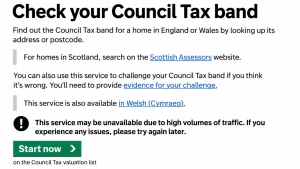
GOV.UK Council Tax band checker allows households in England and Wales to find their property band using an address or postcode.
Check Your Council Tax Band on GOV.UK
Council Tax bands are based on property valuation rules rather than the household’s present income. A household can therefore have a low income but live in a higher-band property, or have a relatively high income while occupying a band A to D home.
For more background on how Council Tax bands and local bills operate, see what Council Tax pays for and how bands affect bills.
Can Renters Receive the £100 Energy Payment?
Renting a home does not by itself rule someone out.
The key question is who is responsible for Council Tax at the qualifying property.
A tenant renting and occupying a normal property will often be responsible for the Council Tax account. In that situation, the fact that the person rents rather than owns the property does not automatically remove them from the scheme.
There are exceptions.
For example, Council Tax liability can be different for:
- Certain Houses In Multiple Occupation
- Properties Where The Landlord Is Liable
- Student Accommodation
- Some Supported Accommodation
- Other Properties With Special Council Tax Arrangements
The government has stated that households where the householder is not responsible for paying Council Tax are outside the standard eligibility rule.
Anyone unsure whether a tenant or landlord is responsible should establish the Council Tax liability before assuming that the tenant will receive the £100.
What Happens If You Receive a Council Tax Discount or Pay Nothing?
Receiving a Council Tax discount is not the same thing as living outside the Council Tax system.
A single-person discount, Council Tax Reduction or another reduction can lower the bill without necessarily changing the underlying band of the property.
Government guidance says most Council Tax-exempt households will also be included, but it has not yet published the full detailed eligibility rules covering every exemption.
Therefore:
- Do Not Assume A Reduced Bill Makes You Ineligible
- Do Not Assume Every £0 Bill Automatically Qualifies
- Check The Property Band
- Check Who Is Responsible For The Account
- Wait For Final Rules Where An Exemption Creates Uncertainty
Households receiving benefits may already be managing several different forms of support.
The £100 scheme should not be confused with ordinary Universal Credit payments or other welfare arrangements. Current benefit changes are covered separately in the site’s guide to Universal Credit changes.
What If Your Property Is in Council Tax Band E to H?
A household in band E, F, G or H is not included in the standard automatic £100 scheme announced for England.
However, this does not necessarily mean there will be no help available.
The government is providing a further £100 million to English local authorities for discretionary energy support. Individual councils will decide their own eligibility criteria and publish details locally once arrangements are ready.
That support could become especially important for households that are struggling financially but live in properties outside bands A to D.
Discretionary financial assistance is different from an automatic national entitlement.
Similar council-administered support can depend on household circumstances, available funding and local rules. The broader distinction is also relevant to other forms of discretionary financial support available to benefit claimants.
Households in bands E to H should therefore monitor their own council’s website, rather than assuming another council’s discretionary criteria will apply to them.
Will Scotland, Wales and Northern Ireland Get the Same £100 Payment?
The English scheme should not be treated as a UK-wide payment with identical eligibility rules.
The standard Household Energy Payment applies to qualifying homes in England.
Scotland, Wales and Northern Ireland will receive additional funding through the devolved funding arrangements, but their governments will decide how comparable support should be provided locally.
That means someone living outside England should wait for the relevant devolved government to confirm:
- Payment Amount
- Eligibility
- Payment Method
- Application Rules
- Payment Dates
Do not rely on the English A-to-D rule as confirmation of entitlement elsewhere.
Why Was the £100 Energy Payment Introduced?
The payment was announced against the backdrop of renewed pressure on household energy costs during 2026.
The government says global energy prices have risen sharply and that the Household Energy Payment is intended to provide short-term support while wider reforms aim to reduce bills over a longer period.
The Budget sets aside around £2.6 billion for the scheme.
The government expects the payment to reach up to 20 million households, including an estimated 83% of fuel-stressed households in England and 88% of households in the bottom three income deciles.
This makes the payment broad rather than being restricted only to people receiving means-tested benefits.
What Other Energy Support Could Households Receive?
The £100 Household Energy Payment is only one part of the energy-support package.
The government has also confirmed that households receiving certain means-tested benefits may qualify for the £150 Warm Home Discount.
In addition, electricity VAT has temporarily been reduced to 0%, with the measure extended until July 2027.
Further measures include plans for:
- Energy Debt Relief For Qualifying Vulnerable Households
- Changes To Gas Standing Charges
- Additional Council Discretionary Support
- Comparable Funding For Devolved Governments
People receiving benefits should not assume that receiving one form of help automatically prevents them from receiving another unless the relevant scheme rules say so.
Those managing different benefit dates may also find it useful to understand how ordinary DWP payment dates can change around bank holidays.
How Can You Avoid £100 Energy Payment Scams?
The government has issued a particularly important warning about fraudulent claims.
If an eligible household pays Council Tax by Direct Debit, it does not need to apply separately for the standard payment.
If a household does not pay by Direct Debit, its local council should invite it to apply. The government says nobody other than the council should contact households asking them to claim the rebate.
Be cautious if you receive an unexpected message that:
- Claims You Must Apply Immediately
- Asks For Card Details
- Requests An Application Fee
- Demands Your Online Banking Password
- Promises An Early £100 Payment
- Links To A Website That Is Not Your Council
- Creates Pressure By Claiming The Payment Will Expire Within Hours
If unsure, do not use the contact details contained in the message. Find your council independently and check with it.
Councils already handle many payments and refunds directly, so it can also help to understand how legitimate money returned to a bank account can work.
The site’s guide to how long refunds can take to reach a bank account provides broader context, although the £100 energy scheme will follow its own timetable.
What Should You Do Before Payments Start?
Most people do not need to rush to complete an application now.
Instead, there are a few sensible checks households can make before January 2027:
- Check Your Council Tax Band: Confirm whether the property is in band A, B, C or D.
- Check Which Council Holds Your Account: Make sure you know which local authority administers your Council Tax.
- Check Your Payment Method: Establish whether you currently pay by Direct Debit or another method.
- Keep Your Details Current: Tell your council if you move home or your relevant Council Tax details change.
- Watch Official Council Updates: Non-Direct Debit households should wait for information from their council.
- Ignore Unsolicited Claim Links: Do not give financial details to someone claiming to offer early access to the £100.
People who move home around the payment period may need particular care because Council Tax responsibility changes with the property and date of occupation.
The Council Tax system itself is explained further in the 2026/27 guide to who pays Council Tax and how liability works.
Conclusion
The £100 energy payment will provide direct help to qualifying households in England living in Council Tax bands A to D, with payments beginning from January 2027.
Direct Debit households should normally receive the money automatically, while households using other payment methods will be invited by their council to apply.
The most useful steps now are to check your Council Tax band, make sure your council holds accurate information and rely only on official government or council communications.
Full rules covering some exemptions and less common household circumstances are still expected before payments begin.
Frequently Asked Questions
Is the £100 energy payment per person or per household?
It is a household payment, so a qualifying property receives £100 rather than each adult living there receiving £100.
Do I Need to Apply for the £100 Energy Payment?
If you pay Council Tax by Direct Debit and meet the eligibility rules, you should not need to apply. Other eligible households will be invited to apply by their council.
When Will the £100 Energy Payment Be Paid?
Payments will start from January 2027, but the government has not announced one universal payment date for every household.
Can Renters Get the £100 Energy Payment?
Potentially, yes. What matters is the property’s Council Tax band and who is responsible for Council Tax rather than whether the resident owns the home.
Will Pensioners Get the £100 Energy Payment?
Pensioners are not automatically excluded. A qualifying household in England can receive the payment where the property and Council Tax circumstances meet the scheme rules.
Will I Get £100 If My Council Tax Bill Is £0?
Possibly. The government says most Council Tax-exempt households will be covered, but full eligibility rules for exemptions are still due to be published.
Do Council Tax Bands E to H Get the £100 Payment?
Not through the standard scheme. However, councils will receive additional discretionary funding that can be used to support households facing serious energy-cost pressure.
Can I Get the £100 Payment and the Warm Home Discount?
The schemes are separate, and the government says people receiving means-tested benefits may also qualify for the £150 Warm Home Discount if they meet its rules.
What Should I Do If Someone Texts Me Asking Me to Claim the £100?
Do not provide bank details through an unexpected message. Direct Debit households do not need to apply, and other households should only follow instructions they have verified as coming from their local council.
What is your reaction?