Self Assessment Tax Return: Complete UK Guide to Filing, Deadlines, Tax Payments and HMRC Rules

Last Updated – 02-11-2026
A Self Assessment Tax Return is how millions of UK taxpayers report income, claim eligible tax relief and calculate the tax they owe to HM Revenue and Customs (HMRC).
It is particularly important for self-employed workers, landlords, business partners and people receiving income that has not already been fully taxed through PAYE.
For the 2025/26 tax year, which ran from 6 April 2025 to 5 April 2026, the online Self Assessment deadline is 31 January 2027.
The paper return deadline is 31 October 2026, while first-time filers should normally have registered by 5 October 2026.
According to HMRC figures released in October 2026, approximately 12 million people are expected to submit their returns before the January deadline.
Filing early allows taxpayers to identify outstanding liabilities, review allowable expenses and prepare for any required payments on account.
Whether you are completing your first return or updating an existing tax declaration, understanding the process can help you avoid penalties, reporting mistakes and unexpected financial pressure.
What Is a Self Assessment Tax Return?
A Self Assessment tax return is an annual declaration used by HMRC to calculate Income Tax and other liabilities that cannot always be collected automatically through PAYE.
Most employees have Income Tax deducted directly from their wages. However, people with self-employment earnings, property income or certain investments may need to report these separately.
Self Assessment generally involves declaring your income, deducting allowable business expenses and reliefs, calculating the tax due and paying HMRC.
The main individual tax return is known as SA100, although additional supplementary pages may be required for particular types of income.
A Self Assessment return is not the same as a limited company’s Corporation Tax return. Company directors may have personal Self Assessment obligations, but the company’s tax reporting is handled separately.
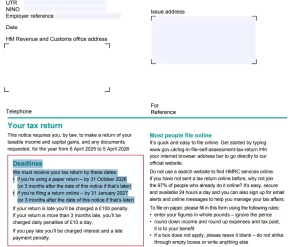
HMRC’s official SA100 form explains the information required and the deadlines for the 2025/26 Self Assessment tax return.
Who Needs to Complete a Self Assessment Tax Return?
Not everyone receiving income in the UK needs to submit a tax return. The obligation depends on the source of income, whether tax has already been collected and whether HMRC has issued a notice requiring a return.
The following table summarises common circumstances.
| Taxpayer category | Self Assessment requirement |
| Self-employed sole trader | Normally required when gross trading income exceeds £1,000 |
| Business partnership member | Generally required |
| Landlord receiving rental income | May be required, depending on income and exemptions |
| Person receiving substantial savings interest or dividends | May be required depending on the amount and tax already collected |
| Individual with taxable capital gains | Required in relevant circumstances |
| Person with foreign taxable income | May be required |
| Individual liable for the High Income Child Benefit Charge | Required if the charge is not collected through PAYE |
| Employee paid entirely through PAYE | Usually unnecessary unless another filing condition applies |
Self-Employed Workers and Freelancers
Sole traders earning more than £1,000 in gross trading income during a tax year usually need to register for Self Assessment.
This applies to occupations such as freelance designers, consultants, tradespeople, online sellers carrying on a trade and independent contractors.
The £1,000 threshold refers to gross trading income before deducting expenses, rather than net profit. Occasional sales of personal possessions are not automatically considered trading income.
For anyone establishing a new enterprise, understanding how to register a business in the UK is relevant because business registration and individual tax reporting are separate responsibilities.
Landlords and Property Owners
Rental income may need to be declared when it has not already been taxed.
Property owners should check whether the £1,000 property allowance, Rent a Room relief or other rules apply. Mortgage interest, repairs and other property expenditure have their own specific tax treatment.
Employees With Additional Income
An employee who receives wages through PAYE may still need to complete Self Assessment if they have another source of taxable income.
For example, someone who works full-time but operates a profitable freelance business may have both employment income and self-employment income to report.
High salary alone is not necessarily sufficient to trigger a return where all income is taxed through PAYE. The previous automatic income-based threshold for PAYE-only taxpayers has been removed.
High Income Child Benefit Charge
The High Income Child Benefit Charge can apply where an individual or their partner receives Child Benefit and the higher earner’s adjusted net income exceeds £60,000.
The charge increases between £60,000 and £80,000 and reaches the equivalent of the full Child Benefit amount at £80,000.
Eligible taxpayers can now arrange to pay the charge through PAYE in certain circumstances, potentially removing the need to file a return solely for that reason.
Anyone uncertain about their obligation should use HMRC’s Self Assessment eligibility guidance, particularly where several sources of income are involved.
What Are the Self Assessment Tax Return Deadlines?
Self Assessment deadlines are based on the tax year ending on 5 April, not the calendar year ending in December.
For the 2025/26 tax year, the important dates are:
| Requirement | Deadline |
| End of relevant tax year | 5 April 2026 |
| First-time Self Assessment registration | 5 October 2026 |
| Paper Self Assessment tax return | 31 October 2026 |
| Online return for PAYE tax-code collection option | 30 December 2026 |
| Online return submission | 31 January 2027 |
| Payment of outstanding 2025/26 tax | 31 January 2027 |
| First 2026/27 payment on account, if required | 31 January 2027 |
| Second 2026/27 payment on account, if required | 31 July 2027 |
HMRC must receive a paper return by the applicable deadline. Posting it on the final day is not enough.
If you miss the October paper deadline, submitting your return online by 31 January can generally avoid a late-filing penalty. However, there are special rules for certain returns.
People registering after 5 October 2026 may receive a different filing deadline, normally three months from HMRC’s notice. The standard 31 January payment deadline still applies.
Myrtle Lloyd, HMRC’s Chief Customer Officer, said in its 23 October 2026 announcement:
“The Self Assessment deadline is 100 days away so now is the ideal time to get ahead and file your tax return early.”
Her advice is particularly relevant to small business owners because early filing establishes the amount payable without requiring immediate payment.
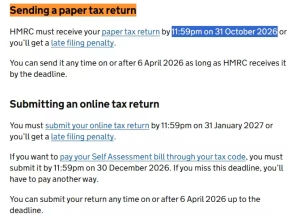
HMRC confirms the 31 October 2026 paper deadline and 31 January 2027 online filing and payment deadlines.
How Do You Register for Self Assessment for the First Time?
Before submitting a return, first-time taxpayers normally need to register with HMRC. Registration also applies to people who previously stopped filing and need to reactivate their Self Assessment account.
The registration process depends on whether you are self-employed, working through a partnership or reporting other types of personal income.
Registration Process
- Determine whether you need Self Assessment using HMRC’s eligibility criteria.
- Select the registration route appropriate to your circumstances.
- Provide your personal information, National Insurance number and business details, where relevant.
- Complete the identity and account verification requirements.
- Receive or recover your 10-digit Unique Taxpayer Reference (UTR).
- Arrange online access and activate the required Self Assessment service.
The UTR identifies your individual tax record and is different from your National Insurance number or company registration number.
In September 2026, HMRC announced improvements to its registration system, including pre-populated customer information and clearer online guidance.
If your October registration deadline has already passed, register as soon as possible rather than waiting until January. Late notification can have consequences if tax remains unpaid.
What Documents Do You Need for a Self Assessment Tax Return?
Preparing financial records before starting the form is one of the most effective ways to reduce errors.
| Document or record | Why it is required |
| Unique Taxpayer Reference | Identifies your Self Assessment record |
| National Insurance number | Confirms personal tax information |
| HMRC online sign-in details | Allows access to digital filing |
| P60 or P45 | Shows employment income and tax deductions |
| P11D | Reports certain employment benefits |
| Bank statements | Help reconcile income and expenditure |
| Sales invoices | Provide evidence of business turnover |
| Expense receipts | Support allowable business deductions |
| Rental income records | Show property earnings and costs |
| Dividend and interest statements | Identify relevant investment income |
| Pension and Gift Aid records | Support eligible tax relief claims |
| Capital gains records | Establish disposal proceeds and allowable costs |
Employees who changed jobs during the year should pay particular attention to their P45 and P60 information.
Understanding the difference between P60 and P45 documents can help prevent employment income or previously deducted tax being reported incorrectly.
Self-employed taxpayers should retain business records for at least five years after the relevant 31 January submission deadline. For a normally filed 2025/26 return, this means keeping records until at least 31 January 2032.
You do not ordinarily need to upload receipts with your return, but HMRC may request evidence later.
How Do You File a Self Assessment Tax Return Online?
HMRC provides an online submission service that lets eligible individuals complete and submit their returns without necessarily employing an accountant.
The process generally follows these stages.
Step 1: Sign in to HMRC
Open the official Self Assessment online filing service.
Sign in using the method available to your HMRC account and complete any required identity verification.
You may need your Government Gateway details, UTR and access to your registered verification method.
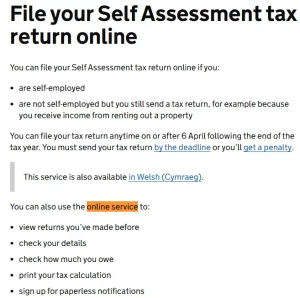
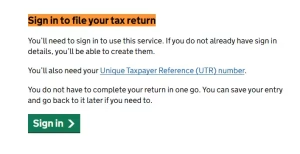 The official HMRC filing service allows eligible taxpayers to submit returns, review previous submissions and check their tax calculations.
Step 2: Choose the Correct Tax Year
For a return due on 31 January 2027, select the tax year from 6 April 2025 to 5 April 2026.
Choosing the wrong year can result in figures being reported against an incorrect period.
Step 3: Complete Your Personal Details
Check your name, address, National Insurance number and relevant taxpayer details.
Update any inaccurate information before moving to the financial sections.
Step 4: Report All Relevant Income
Declare the income required for your circumstances, potentially including employment pay, business turnover, rental earnings, savings interest, dividends and foreign income.
Tax deducted through employment must also be recorded correctly so it is not charged twice.
Step 5: Claim Eligible Expenses and Reliefs
Enter allowable business expenditure and applicable tax reliefs.
Possible reliefs include certain pension contributions, charitable donations, business expenses and capital allowances.
Step 6: Review the Tax Calculation
The online service calculates tax based on the figures supplied.
Review the amount due, any payments on account and deductions already recorded by HMRC.
Step 7: Submit and Retain Confirmation
Check the declaration, submit the completed return and save the submission confirmation.
A completed draft is not the same as a submitted tax return. HMRC’s guidance reminds taxpayers to ensure they have actually pressed the submission button.
Some individuals, including certain non-residents and taxpayers with more complex income arrangements, cannot use HMRC’s standard online filing service and must use appropriate commercial software or another permitted filing method.
What Expenses Can You Claim on a Self Assessment Tax Return?
Allowable expenses can reduce taxable business profit where expenditure meets the relevant HMRC rules.
For sole traders, common expenses include office costs, business insurance, professional fees, advertising, certain travel expenses and eligible equipment purchases.
| Expense | Typical treatment |
| Office supplies | Usually allowable where used for business |
| Business telephone costs | Business-use proportion may be claimed |
| Professional accountancy fees | Normally allowable for business-related services |
| Advertising and marketing | Generally allowable for business promotion |
| Business insurance | Usually allowable |
| Eligible business travel | Claimable subject to restrictions |
| Home-working costs | Business portion or simplified expenses where eligible |
| Equipment purchases | May qualify for revenue deductions or capital allowances |
| Personal shopping | Not allowable |
| Client entertainment | Generally not deductible for Income Tax purposes |
Expenses used partly for business and partly for personal reasons must normally be apportioned.
Trading Allowance Versus Actual Expenses
The £1,000 trading allowance provides an alternative to claiming actual trading expenses.
For example, consider a freelancer with:
- Gross trading income: £8,000
- Actual allowable expenses: £2,200
Using actual expenses would produce taxable trading profit of £5,800, whereas using the £1,000 trading allowance would produce £7,000.
In this example, claiming actual allowable expenses gives the lower taxable profit.
Taxpayers cannot normally deduct the £1,000 trading allowance and the same business expenses together.
Our assessment is that accurate expense categorisation matters more than claiming the highest possible number of deductions. Unsupported claims can create additional liabilities if HMRC later challenges them.
How Do You Complete the SA100 and Supplementary Tax Return Pages?
The main SA100 form covers personal details, certain income sources, pension contributions, Gift Aid and other relevant tax information.
Additional forms are used where the main return does not contain all the required fields.
| Form | Purpose |
| SA100 | Main individual Self Assessment return |
| SA102 | Employment income |
| SA103 | Self-employment income |
| SA104 | Partnership income |
| SA105 | UK property income |
| SA106 | Foreign income |
| SA108 | Capital gains |
| SA109 | Residence and related tax matters |
The exact forms required depend on the circumstances of the taxpayer.
For example, a landlord who also receives employment income may need employment and property sections, whereas a sole trader may require self-employment pages.
Capital gains can require separate calculations. International property transactions may be more complex because UK taxation, residence status and overseas tax treatment can interact.
For taxpayers reporting an overseas disposal, the rules governing Capital Gains Tax on foreign property may therefore be relevant.
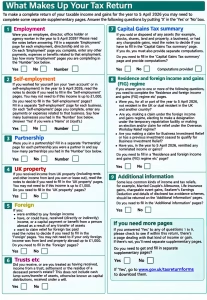
HMRC’s SA100 form identifies the sections that may need separate supplementary tax return pages.
How Much Tax Will You Pay Through Self Assessment?
Your tax liability depends on taxable income, available allowances, applicable tax bands and other circumstances.
For England, Wales and Northern Ireland, the standard non-savings Income Tax rates for 2025/26 are generally:
| Income band | Tax rate |
| Up to £12,570 | 0% Personal Allowance, where available |
| £12,571–£50,270 | 20% basic rate |
| £50,271–£125,140 | 40% higher rate |
| Above £125,140 | 45% additional rate |
Scottish taxpayers have different rates and bands for non-savings, non-dividend income. Personal Allowance tapering also affects higher earners, generally reducing the allowance by £1 for every £2 of adjusted net income above £100,000.
For self-employed taxpayers, Class 4 National Insurance may also apply. Savings, dividends and capital gains have their own tax rules, so the table should not be used to calculate every type of liability.
Example Calculation for a Sole Trader
Consider an individual in England with annual trading turnover of £40,000 and allowable business expenses of £10,000.
| Calculation | Amount |
| Gross turnover | £40,000 |
| Allowable expenses | £10,000 |
| Trading profit | £30,000 |
| Personal Allowance | £12,570 |
| Income subject to basic-rate tax | £17,430 |
| Income Tax at 20% | £3,486 |
| Class 4 NI at 6% on £17,430 | £1,045.80 |
| Illustrative total | £4,531.80 |
This simplified calculation assumes there is no other income, no additional reliefs and that the person is subject to the standard rules for England.
It excludes any voluntary Class 2 contributions, student loan repayments or other charges.
It also excludes payments on account, which affect when the liability must be paid rather than the underlying annual tax calculation.
What Are Payments on Account in Self Assessment?
Payments on account are advance payments towards the following tax year’s Income Tax and relevant National Insurance liabilities.
They are generally required where the previous Self Assessment liability is at least £1,000, unless more than 80% of the relevant tax was collected outside Self Assessment.
Each payment is usually equivalent to 50% of the previous year’s qualifying liability.
Example of a First-Year Self Assessment Bill
Suppose a first-time filer has a £3,000 qualifying tax liability for 2025/26 and has made no payments on account.
| Payment | Amount | Due date |
| 2025/26 balancing payment | £3,000 | 31 January 2027 |
| First 2026/27 payment on account | £1,500 | 31 January 2027 |
| Second 2026/27 payment on account | £1,500 | 31 July 2027 |
This means £4,500 could be due on 31 January 2027, even though the previous year’s tax liability was only £3,000.
The additional £1,500 is an advance payment, not an extra tax on the same income.
Jotika Teli, a certified public accountant who authored a May 2026 analysis of Self Assessment payments on account, highlights the importance of reviewing instalments when income falls.
Her analysis also explains that reductions based on underestimated liabilities can result in interest charges.
The practical implication is that taxpayers should base any reduction request on reliable forecasts rather than simply seeking a smaller immediate payment.
How Can You Pay Your Self Assessment Tax Bill?
HMRC allows payments through several methods, including online banking, bank transfer, debit card and Direct Debit, subject to the available payment service and processing times.
Taxpayers should use their correct Self Assessment payment reference, normally based on their UTR.
Paying Through Your Paye Tax Code
Some taxpayers with a Self Assessment bill of less than £3,000 can have the amount collected automatically through PAYE.
This generally requires an existing PAYE income source and submission of the online return by 30 December 2026.
Other HMRC eligibility and deduction limits also apply.
Where permitted, this option spreads the tax collection across later salary or pension deductions instead of requiring a separate lump-sum payment.
What Happens if You Miss the Self Assessment Deadline?
HMRC can impose separate penalties for late filing and late payment.
These charges can apply even where the taxpayer eventually submits the correct return.
Late Filing Penalties
| Delay | Potential penalty |
| Immediately after the filing deadline | £100 |
| More than 3 months late | £10 per day, up to £900 |
| More than 6 months late | Additional £300 or 5% of tax due, whichever is greater |
| More than 12 months late | Further £300 or 5% of tax due, whichever is greater |
Late Payment Penalties
Separate penalties can apply at 30 days, six months and twelve months after the payment deadline, commonly calculated at 5% of the unpaid amount at each stage.
Interest can also accrue on outstanding tax.
A reasonable-excuse appeal may be possible, depending on the circumstances. Filing promptly and communicating with HMRC is usually preferable to allowing additional penalties to accumulate.
What Should You Do if You Cannot Afford Your Tax Bill?
If paying the entire amount is difficult, the most important action is to contact HMRC rather than ignore the liability.
Some taxpayers qualify for a Time to Pay arrangement, allowing an outstanding amount to be repaid through agreed instalments.
Eligibility depends on the amount owed, outstanding returns, other tax liabilities and the individual’s financial circumstances.
Interest may continue to apply, even where an instalment arrangement is approved.
For business owners, it is also useful to separate money reserved for taxation from ordinary operating cash.
Regularly setting aside a proportion of receipts can help prevent the tax bill from interfering with payroll, supplier commitments and essential business expenditure.
How Does Making Tax Digital Affect Self Assessment?
Making Tax Digital for Income Tax is changing how qualifying sole traders and landlords record and report financial information.
The rules are being introduced in stages according to qualifying gross income from self-employment and property.
| Qualifying income | Mandatory start date |
| More than £50,000 in 2024/25 | 6 April 2026 |
| More than £30,000 in 2025/26 | 6 April 2027 |
| More than £20,000 in 2026/27 | 6 April 2028 |
Qualifying income is generally measured before expenses, and the relevant income sources are combined where appropriate.
Affected individuals must use compatible software to maintain digital records, provide quarterly updates and complete their annual tax reporting through the MTD process.
The annual 31 January deadline remains important.
For example, a sole trader who entered Making Tax Digital in April 2026 must still submit their traditional 2025/26 Self Assessment return by 31 January 2027. The first annual tax return through MTD software will generally relate to the 2026/27 tax year.
People outside the mandatory MTD rules generally continue using the existing Self Assessment process.
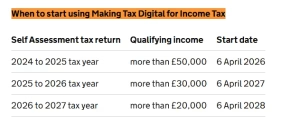
HMRC’s phased Making Tax Digital timetable changes the reporting requirements for qualifying self-employed workers and landlords.
Can You Change a Self Assessment Tax Return After Submitting It?
Yes. HMRC permits taxpayers to amend previously submitted returns within the applicable amendment period.
For the 2025/26 tax year, the standard deadline for amendments is 31 January 2028.
Online filers normally need to wait 72 hours after submitting the original return before making changes.
Possible corrections include omitted income, incorrectly claimed expenses, inaccurate pension contributions or calculation errors.
An amendment can lead to a higher tax bill or a refund.
If the ordinary amendment window has closed, different procedures apply, potentially including written notification or a claim for overpayment relief.
Can You Get a Tax Refund Through Self Assessment?
A refund may arise when the amount of tax already paid exceeds the final liability.
This can happen because of excessive PAYE deductions, incorrect previous calculations, qualifying tax reliefs or other adjustments.
The final Self Assessment calculation reflects tax already deducted or paid.
Taxpayers who normally have all their tax deducted through PAYE may instead receive a P800 tax calculation.
Understanding HMRC P800 refund dates and processing is therefore useful for distinguishing PAYE reconciliations from Self Assessment repayments.
What Are the Most Common Self Assessment Tax Return Mistakes?
Many errors arise from incomplete records or misunderstanding the difference between income, profit and tax already paid.
Common issues include:
- Reporting net profit instead of gross business turnover in the turnover field.
- Failing to include taxable income from another employment or business.
- Claiming personal expenditure as a business expense.
- Incorrectly applying both the trading allowance and actual business expenses.
- Omitting savings interest, dividends or foreign income that must be reported.
- Forgetting to check payments on account.
- Using the wrong tax year or failing to submit a completed draft.
- Assuming filing the return automatically pays the outstanding tax.
Taxpayers with straightforward circumstances can usually file independently. However, professional tax advice may be beneficial where overseas income, multiple businesses, capital gains, substantial losses or complex relief claims are involved.
Frequently Asked Questions
Can I complete a Self Assessment tax return myself?
Yes. Most eligible individuals can complete and submit their return through HMRC’s online service without hiring an accountant.
Do I need Self Assessment if I earn less than £1,000?
Sole traders with gross trading income of no more than £1,000 generally do not need to file solely for that income, although other tax circumstances can create a filing requirement.
What happens if I miss the 5 October registration deadline?
Register as soon as possible. HMRC may provide a different filing deadline, but the normal tax payment deadline still applies and penalties may arise.
Do I need to file if I have already paid tax through PAYE?
Not necessarily. A return may still be needed where you have additional untaxed income, taxable gains or another filing obligation.
How long does Self Assessment take?
The time required varies with the number of income sources, availability of records and complexity of deductions. Simple returns can be much quicker than those involving multiple businesses or overseas earnings.
Can I file my tax return before January?
Yes. You can normally file after the tax year ends on 5 April. Early submission does not usually bring forward the 31 January payment deadline.
Does Self Assessment include National Insurance?
Yes, Self Assessment can calculate relevant self-employed National Insurance contributions alongside Income Tax. The applicable rules depend on your income and circumstances.
Can HMRC check a Self Assessment return?
Yes. HMRC can review returns and request supporting evidence. Taxpayers must retain appropriate records and correct inaccuracies when identified.
What is your reaction?