
Monzo vs Chase: Which UK Bank Is Better for Savings, Cashback and Everyday Banking?

Choosing between Monzo and Chase is not simply about finding a free bank account.
Both offer modern mobile banking, sfee-free card spending abroad and savings features, but their approaches to money management are noticeably different.
Monzo is generally better for budgeting, salary management, joint accounts and everyday banking flexibility.
Chase has a stronger proposition for eligible cashback earners, new customers seeking a boosted savings rate and people who regularly withdraw cash abroad.
The financial difference can be significant.
Chase currently advertises 2% cashback on qualifying everyday spending, capped at £20 per month, while eligible new customers can access a boosted savings rate of 4.5% AER variable for 12 months.
Monzo counters with more comprehensive budgeting tools, different savings products and flexible account features.
We examined the banks’ published product terms, rates, account restrictions and customer feedback to establish where each provides better value.
Monzo vs Chase: How Do Their Features Compare?
| Feature | Monzo | Chase UK |
| Standard account fee | Free | Free |
| Paid account options | Extra, Perks, Max | No paid current-account tiers |
| Current account interest | 0% | 0% |
| Standard instant-access savings | 2.75% AER variable | 2.25% AER variable |
| Promotional savings | Various savings products | 4.5% AER variable boosted saver for eligible new customers |
| Cashback | Personalised retailer offers | 2% on eligible categories, subject to conditions |
| Cashback limit | Depends on individual offer | £20 monthly |
| Round-ups | Available through Pots | 5% AER variable on round-up balances |
| Spending abroad | No foreign transaction fee | No foreign transaction fee |
| Overseas ATM withdrawals | Fee-free allowances depend on account and region | No Chase withdrawal fee, subject to limits |
| Joint current accounts | Available | Not available |
| Arranged overdraft | Available, subject to approval | Not available |
| Early Bacs salary access | Available | No equivalent advertised early-pay feature |
| Cash deposits | PayPoint and Post Office | Not supported |
| International bank transfers | Supported, with applicable fees | Not supported |
| FSCS deposit protection | Up to £120,000 | Up to £120,000 |
Rates and product terms checked in October 2026. Savings interest rates are variable unless expressly described as fixed. Cashback eligibility and account approval conditions apply.
Our overall assessment favours Monzo for customers seeking one primary account to manage their finances.
Chase becomes particularly attractive when its spending rewards and savings offers align with an individual’s financial habits.
However, neither bank is necessarily the best choice in every category.
Is Chase Better Than Monzo for Cashback?
Chase currently offers the more predictable cashback structure for customers who satisfy its qualification rules.
From 1 June 2026, Chase introduced an offer paying 2% cashback on eligible everyday debit and credit card purchases, with a maximum reward of £20 per month.
Qualifying spending categories include supermarkets, restaurants, cafes, takeaways, everyday public transport, petrol and public electric vehicle charging.
The important detail is that the advertised percentage does not automatically apply to every Chase customer or transaction.
How Chase Cashback Qualification Works?
To qualify for cashback in the following month, customers must meet both conditions during the current month:
- Make at least 15 qualifying payments using a Chase debit card, credit card or Direct Debit.
- Maintain at least £1,000 across eligible Chase saver accounts throughout the month, excluding round-up accounts.
Standing orders, bank transfers and refunds do not count towards the 15-payment requirement. Direct Debits can help meet the transaction requirement but do not themselves earn cashback.
Cashback is awarded only on eligible card purchases, and merchant-category exclusions apply.
The monthly reward cap means spending above £1,000 in qualifying categories will not increase cashback beyond £20.
| Monthly eligible spending | Potential Chase cashback |
| £250 | £5 |
| £500 | £10 |
| £750 | £15 |
| £1,000 | £20 |
| £1,500 | £20 |
| £2,000 | £20 |
These figures assume the customer qualifies and every listed purchase is eligible. The maximum annual reward would be £240 if the full £20 were earned in every month.
Our view: Chase cashback offers meaningful value to households already maintaining savings and making frequent everyday transactions.
The qualification requirements are less attractive for customers who keep their emergency savings elsewhere or only occasionally use their Chase card.

Chase UK’s 2% cashback offer requires customers to meet specific monthly spending and savings conditions.
Does Monzo Offer Better Cashback Deals?
Monzo takes a different approach through personalised partner cashback offers.
Customers can activate available promotions in the Monzo app before shopping with participating retailers. The reward percentage, spending requirements, maximum cashback and expiry date vary by promotion.
Some offers can be used repeatedly, while others apply to a single qualifying transaction.
Unlike Chase’s eligible-category cashback, Monzo does not guarantee the same percentage on everyday purchases across all merchants.
This distinction is important because a high promotional percentage is not necessarily more valuable than a smaller but consistently available reward.
For example, a customer receiving a 10% cashback offer on a planned £50 purchase could earn £5, provided the offer permits it.
But somebody spending £800 on everyday groceries and transport might find Chase’s qualifying 2% structure more useful.
Our assessment is that Monzo’s cashback is better treated as an occasional saving opportunity, rather than a dependable source of monthly rewards.
Cashback winner: Chase for qualifying regular spending; Monzo for potentially attractive personalised offers.
Which Bank Offers Better Savings Rates: Monzo or Chase?
Savings rates are another important difference in the Monzo vs Chase comparison.
Chase currently advertises a boosted easy-access savings account paying 4.5% AER variable for eligible new customers.
The promotional rate consists of its standard 2.25% AER variable rate plus an additional 2.25% AER boost for 12 months.
The boosted account must be opened within the first 31 days of becoming an eligible new Chase customer. The offer may be withdrawn, and the underlying standard rate can change.
Monzo provides a wider selection of savings products, including Instant Access Savings Pots, Select Access Savings Pots, Cash ISAs and fixed-rate savings.
Monzo Savings Rates by Account Plan
| Monzo plan | Instant Access Savings AER | Monthly account fee |
| Free | 2.75% variable | £0 |
| Extra | 3.00% variable | £3 |
| Perks | 3.25% variable | £9 |
| Max | 3.50% variable | From £19 |
Monzo also currently advertises 3.15% AER variable on Select Access Savings for free-plan customers, subject to a £500 minimum deposit and no more than two withdrawals per year to retain the higher rate.
Its fixed-rate savings products may offer a higher headline return, but locking money away is different from having unrestricted easy access. These should therefore be compared separately.
How Much Interest Could You Earn on £10,000?
| Savings account | AER | Illustrative interest over one year |
| Chase boosted saver | 4.50% | £450 |
| Monzo Max Instant Access | 3.50% | £350 |
| Monzo Perks Instant Access | 3.25% | £325 |
| Monzo Extra Instant Access | 3.00% | £300 |
| Monzo Free Instant Access | 2.75% | £275 |
| Chase standard saver | 2.25% | £225 |
Illustrations assume £10,000 is deposited for a full year, the stated AER remains unchanged, and there are no withdrawals. Monzo paid-plan subscription fees and any applicable tax are excluded.
At the advertised rates, someone depositing £10,000 could earn approximately £175 more over 12 months through Chase’s boosted saver than through Monzo’s free Instant Access Savings Pot.
On £5,000, the illustrative difference would be £87.50.
These comparisons highlight why the promotional period matters. Once Chase’s 12-month boost ends, the account reverts to the applicable standard variable rate unless another offer applies.
Our view: Chase currently has the stronger easy-access savings proposition for eligible new customers. Monzo provides more choices for people who want to organise different savings goals or use Cash ISAs.
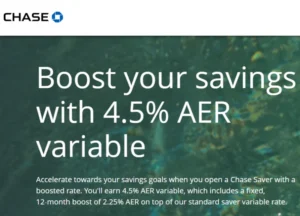
Chase’s boosted savings offer combines a variable standard rate with a promotional uplift available for a limited period.
Are Monzo’s Paid Plans Worth the Monthly Fee?
Monzo has three main paid personal-account tiers: Extra, Perks and Max.
Following its 2026 pricing changes, Extra costs £3 monthly, Perks costs £9 monthly and Max starts at £19 monthly.
The annual cost is therefore £36, £108 and £228 respectively.
The benefits go beyond savings interest. Extra adds advanced budgeting and connected-account features.
Perks includes various lifestyle benefits and savings upgrades, while Max adds insurance and breakdown-cover benefits subject to eligibility and policy terms.
However, paying for an account purely to improve the interest rate requires calculation.
| Plan upgrade compared with Free | Additional Instant Access AER | Annual plan fee | Approximate balance needed to offset fee through extra interest alone |
| Extra | 0.25 percentage points | £36 | £14,400 |
| Perks | 0.50 percentage points | £108 | £21,600 |
| Max | 0.75 percentage points | £228 | £30,400 |
These are simplified comparisons based on unchanged rates and a consistent annual savings balance. They exclude tax, other subscription benefits and individual product limits.
A Monzo Perks subscription could make financial sense for someone who already uses its travel, lifestyle or savings benefits. Someone upgrading solely for the additional savings interest may find the subscription less rewarding.
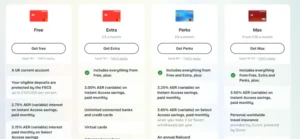
Monzo provides several account upgrades with different budgeting features, savings rates and subscription costs.
Is Monzo Better Than Chase for Everyday Budgeting?
Monzo has an advantage in budgeting functionality because money management is built into much of the account experience.
Its Pots feature allows customers to separate money for rent, bills, savings or upcoming purchases rather than keeping everything in one spending balance.
Monzo also supports spending categories, real-time payment notifications, automated savings, salary sorting and budgeting controls. Certain advanced functions require a paid subscription.
For someone managing monthly income, this structure can make it easier to separate essential bills from discretionary purchases.
Consider a household receiving £3,000 per month. Rather than viewing the full amount as available spending money, its members can allocate £1,200 towards housing, £400 towards groceries, £250 towards transport and smaller amounts towards other financial goals.
The ability to divide money immediately after payday may improve spending discipline, particularly for customers dealing with irregular expenses.
The principle is similar to the approach discussed in managing leisure spending within a household budget, where separating discretionary expenditure can make spending limits clearer.
How Does Chase Handle Budgeting?
Chase allows customers to create multiple current accounts and saver accounts. Each current account has its own account number, and users can choose which current account their Chase card spends from.
This is useful for separating bills, monthly spending and short-term savings.
The difference is that Chase’s approach is generally simpler and less focused on advanced spending analysis.
For customers who prefer straightforward account balances without numerous dashboards or financial prompts, that simplicity may be an advantage.
Our view on everyday use: Monzo offers the more comprehensive money-management toolkit, especially for customers who regularly review spending categories and savings targets.
Chase is better suited to people who prefer a simpler account structure.
Which Bank Is Better for Getting Paid and Managing Bills?
Both Chase and Monzo accept UK salary payments and support Direct Debits and standing orders.
However, Monzo provides a particularly useful feature for people paid through Bacs.
Its Get Paid Early service allows eligible customers to access an incoming Bacs payment from 4pm on the business day before its scheduled arrival.
This does not apply to every salary payment. Faster Payments, for example, do not qualify for the same early-release feature.
Monzo’s Salary Sorter can also allocate incoming money between spending, bills and savings.
Chase supports regular salary deposits and offers multiple current accounts for separating expenses, but does not advertise an equivalent early Bacs salary release feature.
For customers whose finances depend heavily on payday timing, Monzo may therefore provide greater flexibility.
Customers should remember that accessing salary early does not increase their income. It simply changes when qualifying money becomes available.
Monzo vs Chase Abroad: Which Is Better for Travelling?
Both banks are competitive for international debit-card spending.
Neither adds a foreign transaction fee to ordinary overseas card purchases, and both use Mastercard exchange rates.
The larger difference concerns cash withdrawal limits.
| Overseas banking feature | Monzo Free | Chase |
| Card spending abroad | No foreign transaction fee | No foreign transaction fee |
| Exchange rate | Mastercard | Mastercard |
| EEA ATM withdrawals | Unlimited fee-free if Monzo is your main bank; otherwise £400 every 30 days | No Chase withdrawal fee, subject to limits |
| Outside EEA ATM withdrawals | £200 fee-free every 30 days | No Chase withdrawal fee, subject to limits |
| Fee after Monzo allowance | 3% | No Chase withdrawal fee |
| Daily ATM limit | Account limits apply | Usually £500 |
| Additional overseas monthly ATM limit | Based on fee-free allowance and account limits | £1,500 per calendar month |
Chase’s international cash withdrawal policy is attractive for people travelling to countries where cash remains widely used.
Monzo can be equally practical for card-heavy holidays, but customers expecting to withdraw substantial amounts outside the EEA should check their fee-free allowance.
For example, a Monzo Free customer withdrawing £500 outside the EEA during one 30-day period could incur a £9 Monzo withdrawal fee on the £300 above the £200 allowance, assuming no other applicable differences.
Chase would not impose its own withdrawal fee for the same amount within its stated limits, although the ATM operator could charge separately.
Both banks recommend paying in the local currency rather than allowing a merchant or ATM to convert the transaction to pounds.
For customers considering other travel-focused accounts, our comparison of Revolut, Monzo and Starling provides a broader starting point. Some rates and fees in that earlier comparison may need rechecking against current product terms.
Travel winner: Chase for overseas cash withdrawals; a close comparison for debit-card spending.
What Are the Main Limitations of Monzo and Chase?
The strongest banking app is not necessarily the one with the most advertised benefits. Everyday restrictions can become more important than occasional rewards.
Cash and Cheque Deposits
Monzo customers can pay cash into their accounts at participating PayPoint locations and Post Offices.
The standard charge is £1 per deposit. Eligible Perks and Max customers receive three free cash deposits each calendar month.
Monzo also supports depositing eligible cheques through the app, with postal deposits available for larger cheques.
Chase does not currently support cash or cheque deposits into its current accounts.
This makes Monzo more practical for customers who occasionally receive physical cash or cheques.
Anyone unfamiliar with deposit arrangements can explore paying money into a bank account through the Post Office for further context.
Joint Accounts and Overdrafts
Monzo allows two eligible personal account holders to open a joint account.
It also offers arranged overdrafts, subject to eligibility and affordability assessments.
The currently advertised arranged overdraft interest rates are 19%, 29% or 39% EAR variable, depending on the customer’s circumstances.
Chase does not currently offer joint current accounts or arranged current-account overdrafts.
However, Chase now has a separate credit card product available to eligible existing current-account customers, so saying it offers no consumer borrowing products at all would be inaccurate.
Monzo remains the more versatile option for couples managing shared household expenses and customers who require access to an arranged overdraft.
International Bank Transfers
Monzo supports international transfers, with availability and fees depending on the destination, currency and payment route.
Chase currently says its UK accounts cannot send or receive international bank transfers.
That distinction matters for customers receiving money from relatives abroad, making overseas payments or managing international financial commitments.
Are Monzo and Chase Safe Banks in the UK?
Both are regulated UK banks offering protection for eligible deposits through the Financial Services Compensation Scheme (FSCS).
Since 1 December 2025, the standard FSCS deposit protection limit has been £120,000 per eligible person, per authorised institution.
Monzo operates through Monzo Bank Limited, while Chase UK operates as a trading name of J.P. Morgan Europe Limited.
Customers should understand that FSCS protection applies to eligible deposits held with an authorised institution, not separately to every account or savings pot.
Keeping £40,000 in a current account and £70,000 in savings with the same authorised bank does not create two independent £120,000 allowances.
Both banks also offer security features such as card freezing, biometric authentication and in-app account controls.
Monzo provides additional security settings for certain sensitive actions, while Chase’s numberless physical debit card helps reduce exposure of card details printed on the card.
Our assessment is that both are legitimate, regulated banking providers. The choice should focus more on account functionality and personal requirements than assuming one is inherently safer because of its brand or appearance.
Which Bank Has Better Customer Service: Monzo or Chase?
Customer support is difficult to assess solely through marketing claims.
Both banks offer digital assistance and routes to telephone support, but individual experiences can vary depending on the type of problem, urgency and investigation required.
Chase advertises 24/7 support, including telephone and in-app contact.
Monzo provides in-app support, with telephone assistance available for certain circumstances, including problems accessing the app.
Feedback in a Reddit discussion comparing Chase and Monzo shows that customer preferences differ.
Some users favour Chase’s straightforward support experience, while others prefer Monzo’s features despite occasional concerns about response times.
One contributor described continuing to use both accounts and moving savings between them when rates became attractive. Other commenters preferred Monzo’s functionality but acknowledged Chase’s simpler interface.
These are individual customer experiences, not independently verified service-performance statistics. The discussion also predates some of the 2026 cashback changes.
Our editorial view is that customers dealing with frequent or complicated banking issues should assess support accessibility, complaint handling and available contact methods rather than rely solely on app-store ratings.
Is Monzo or Chase Better Value for Money Overall?
The answer depends on what customers actually use.
Moneyfacts finance expert Rachel Springall has emphasised the importance of comparing fees and incentives when selecting current accounts.
In published commentary during 2026, she observed that consumers need to examine different benefits to identify accounts suited to their requirements.
That principle is especially relevant here because Chase’s rewards have eligibility conditions, while Monzo’s premium features involve monthly subscription charges.
A bank account offering £240 in potential annual cashback is less valuable if the customer consistently fails to qualify. Similarly, paying £108 annually for Monzo Perks may be difficult to justify if most included benefits go unused.
Our Overall Review Assessment
| Review category | Preferred bank | Reason |
| Everyday budgeting | Monzo | More detailed money-management tools |
| Cashback | Chase | Higher predictability when qualifications are met |
| Promotional easy-access savings | Chase | 4.5% boosted rate for eligible new customers |
| Savings product variety | Monzo | Instant Access, Select Access, ISAs and fixed-rate options |
| Joint banking | Monzo | Joint current accounts available |
| Cash deposits | Monzo | PayPoint and Post Office access |
| Salary management | Monzo | Get Paid Early and Salary Sorter |
| Overseas cash withdrawals | Chase | No Chase withdrawal fee within account limits |
| International transfers | Monzo | International payment functionality |
| Simple account management | Chase | Multiple current accounts with a comparatively straightforward interface |
Our view after assessing everyday banking use: Monzo is the stronger choice for someone wanting a comprehensive primary current account. Chase has attractive financial incentives that can justify using it alongside another bank.
We would not recommend choosing Chase solely for its promotional savings rate without checking what happens after the initial 12-month period.
Likewise, we would not recommend purchasing a Monzo subscription merely because it advertises a higher savings rate. The subscription costs and other benefits need to be considered together.
Should You Switch From Chase to Monzo or Keep Both?
Opening a Monzo account does not require an existing Chase customer to close their Chase account.
Both banks can be used alongside one another, allowing customers to assign different financial purposes to each account.
For example, a customer might receive their salary into Monzo, organise bills through Pots and maintain some savings or qualifying spending through Chase.
This approach can provide flexibility, but it also involves managing two apps, balances and account notifications.
Customers should also check whether their chosen arrangement will satisfy Chase’s monthly cashback qualification requirements.
Those who want to move their full banking relationship can explore the Current Account Switch Service (CASS), which normally completes an eligible switch in seven working days.
A full CASS switch closes the old account. Customers who want to keep Chase open should instead arrange individual payments and transfers without requesting a full switch.
For people unfamiliar with digital banking account details, understanding how a Monzo sort code identifies the receiving bank can also help when setting up transfers.
Our preference for many customers would be to keep both accounts initially, evaluate their usefulness, and consolidate only if maintaining two accounts becomes unnecessary.
Frequently Asked Questions About Monzo vs Chase
Is Monzo better than Chase in 2026?
Monzo is generally better for customers prioritising budgeting tools, joint accounts, salary features and comprehensive everyday banking.
Chase may be better for eligible customers seeking cashback, promotional savings interest and overseas cash withdrawals.
Does Chase pay more interest than Monzo?
Chase’s boosted easy-access savings rate is currently higher than Monzo’s standard instant-access rate.
However, the Chase offer is restricted to eligible new customers and lasts for 12 months. Monzo offers other savings products, including fixed-rate accounts, which have different access conditions.
Can I have both Monzo and Chase accounts?
Yes. Eligible customers can open and maintain accounts with both banks. This can make it easier to separate everyday banking from savings and cashback spending.
Does Chase offer 2% cashback on everything?
No. Chase’s 2% cashback applies only to eligible UK and Channel Islands purchases in specified categories. Customers must meet the monthly payment and savings requirements, and rewards are capped at £20 per month.
Is Chase or Monzo better for travelling abroad?
Both offer fee-free debit-card spending abroad using Mastercard exchange rates.
Chase is generally more attractive for cash withdrawals because it does not impose its own ATM withdrawal fee, although daily and monthly limits and third-party charges apply.
Is Monzo safer than Chase?
Both are regulated UK banks, and eligible deposits with each are protected under the FSCS scheme up to the applicable £120,000 limit per person and authorised institution.
Neither is automatically safer simply because it has a more established app or larger parent banking group.
Can you deposit cash into Chase or Monzo?
Monzo supports cash deposits through PayPoint and the Post Office, normally charging £1 per deposit unless an eligible plan allowance applies. Chase does not currently accept cash deposits into its UK current accounts.
Does Chase offer an overdraft like Monzo?
No. Chase does not currently offer an arranged current-account overdraft. Monzo does, subject to approval, and the interest rate depends on eligibility and creditworthiness.
Is Monzo Perks worth £9 per month?
It depends on the benefits used. Monzo Perks includes higher savings interest and various lifestyle benefits, but customers who rarely use them may be better suited to the free plan.
Final Verdict
Our comparison finds that Monzo and Chase appeal to different banking priorities.
Monzo is the better all-round everyday banking choice for customers who want budgeting controls, salary automation, joint accounts and access to a broader range of banking functions.
Chase offers stronger targeted financial incentives, particularly its conditional 2% cashback and promotional easy-access savings rate.
The biggest mistake would be to compare only the headline interest rates or cashback percentages without examining their conditions.
For someone who wants one highly functional current account, we would favour Monzo.
For someone with established budgeting habits who wants to maximise eligible savings and spending rewards, Chase may provide more measurable financial value.
Using both accounts can also be a practical option, provided the arrangement remains manageable and the benefits justify the additional administration.
Ultimately, the best bank is the one that supports your usual spending, saving and payment habits rather than requiring you to change those habits merely to qualify for rewards.
What is your reaction?