
How To Avoid Capital Gains Tax On Foreign Property Legally?: UK Rules And Reliefs For 2026/27

UK residents generally have to consider Capital Gains Tax when they sell an overseas property for a profit.
HMRC’s guidance on selling overseas property confirms that UK residents can be liable for CGT on disposals of property abroad.
You may be able to legally reduce or eliminate the tax by:
- Claiming Private Residence Relief If the overseas property genuinely qualified as your only or main home
- Deducting Allowable Costs Including eligible legal fees, estate agent charges and qualifying improvements
- Using Capital Losses Against chargeable gains where HMRC rules allow
- Using The Annual Exempt Amount If you remain entitled to it
- Considering Spouse Or Civil Partner Ownership Before the property is sold
- Claiming Foreign Tax Credit Relief If tax is also paid in the country where the property is located
- Checking FIG Eligibility If you recently became UK tax resident
There is no single method that allows every UK resident to avoid CGT legally. Your residence history, property use, ownership and foreign tax position all affect the result.
Do UK Residents Pay Capital Gains Tax On Foreign Property?
Yes. If you are a UK resident, a gain on an overseas house, apartment, holiday home or investment property can normally fall within UK Capital Gains Tax.
The property’s physical location does not by itself take the gain outside the UK tax system. HMRC states that a UK resident pays CGT when disposing of overseas property.
Does The Country Where The Property Is Located Matter?
Yes, because the country where the property is situated may also impose its own capital gains or property disposal tax.
This can leave the same sale within two tax systems. UK rules and foreign rules may differ over:
- Allowable Expenses
- Tax Rates
- Main Residence Relief
- Property Valuations
- Currency Conversion
- Ownership And Inheritance Rules
Relief may then be available to prevent or reduce double taxation.
Does Bringing The Sale Money To The UK Trigger CGT?
For most UK residents under the current rules, CGT is based on the disposal and resulting gain rather than simply moving the sale proceeds into a British bank account.
This distinction matters because older online information may still refer to the former remittance basis, which was replaced from 6 April 2025 for qualifying new residents.
How Is Capital Gains Tax On Foreign Property Calculated?
The basic starting point is the amount received when the property is sold minus its allowable acquisition cost and qualifying expenses.
A simplified calculation is:
Sale Proceeds − Purchase Cost − Allowable Costs − Qualifying Improvements = Capital Gain
You can then consider available reliefs, capital losses and the annual exempt amount before calculating the taxable gain.
How Do Exchange Rates Affect The Gain?
Foreign property calculations can be more complicated because the relevant amounts need to be considered in sterling for UK CGT purposes.
This means the property’s purchase price and sale price should not simply be converted using one exchange rate at the end.
Currency movements can therefore create a different UK gain from the apparent profit measured in euros, dollars or another local currency.
What Are The Capital Gains Tax Rates For 2026/27?
For individuals, HMRC’s current Capital Gains Tax rates and allowances show CGT rates of 18% and 24% from 6 April 2026.
For the 2026/27 tax year, the annual exempt amount for most individuals is £3,000.

The rate applied to a particular gain depends partly on the individual’s taxable income and the amount of taxable gains.
How Does The £3,000 Annual Exemption Work?
The annual exempt amount applies across your qualifying capital gains for the tax year rather than separately to each property.
For example, if you have taxable gains from both shares and foreign property, the same annual exemption is considered across the overall position.
A person making a qualifying FIG claim does not receive the annual exempt amount for that tax year.
Which Costs Can Reduce Capital Gains Tax On An Overseas Property?
Accurately recording allowable expenditure is one of the most practical ways to reduce capital gains tax on foreign property.
HMRC allows qualifying costs of buying, selling and improving property to be considered when working out a gain.
| Cost | Usually Allowable? | Treatment |
| Original Purchase Price | Yes | Forms the main acquisition cost |
| Purchase Legal Fees | Usually | May be included where directly connected with acquisition |
| Selling Legal Fees | Usually | May qualify as disposal expenditure |
| Estate Agent Fees | Usually | May be deductible when connected with the sale |
| Property Transfer Costs | Potentially | Depends on the nature of the charge |
| Extension | Potentially | May qualify as enhancement expenditure |
| Structural Improvement | Potentially | Must satisfy the relevant CGT conditions |
| Routine Decorating | Usually No | Normally considered maintenance |
| General Repairs | Usually No | Routine upkeep is not normally capital improvement expenditure |
| Mortgage Repayments | No | Repaying borrowing does not reduce the capital gain |
| Normal Running Costs | Usually No | Day-to-day ownership expenses are generally separate |
What Counts As A Capital Improvement?
An improvement normally needs to enhance the property rather than simply maintain its existing condition.
Building an extension may qualify where the required conditions are satisfied. Repainting rooms or replacing something as part of routine maintenance normally does not receive the same treatment.
Keep invoices and evidence showing exactly what work was completed.
Can Private Residence Relief Reduce CGT On Foreign Property?
Private Residence Relief can potentially reduce CGT if the foreign property was genuinely your only or main residence for a qualifying period.
The relief is based on actual residence and the statutory conditions. Merely owning an overseas holiday property or referring to it as a main home is not enough.
What Is The 90-Day Rule For Overseas Homes?
Where a residence is located in a territory in which you are not tax resident, a minimum day-count test can apply.
HMRC’s rules set the minimum at 90 days during the UK tax year for the relevant overseas residence to satisfy the day-count requirement. The qualifying days do not need to be consecutive.
This can be particularly important for UK residents who spend limited periods at a holiday home abroad.
Does The Final Nine-Month Period Qualify?
Where a dwelling has been the owner’s only or main residence at some point, the final nine months of ownership can generally qualify for Private Residence Relief under the current rules.
This replaced older, longer final-period rules that may still appear in outdated property tax articles.
Can Capital Losses Reduce CGT On Foreign Property?
Allowable capital losses can reduce chargeable gains.
Suppose you make a £50,000 gain when selling overseas property but have an allowable £12,000 capital loss.
The loss could potentially reduce the amount of gain that remains before the applicable exemption is considered.
Can You Use Losses From Earlier Years?
Unused allowable losses from previous tax years may sometimes be carried forward and used against future gains.
The losses need to have been validly claimed and must be used according to the applicable CGT rules.
It is worth checking historic investment disposals before calculating CGT on a major overseas property sale.
Can Transferring Foreign Property To A Spouse Reduce CGT?
Transfers between spouses and civil partners who are living together can generally take place on a no-gain, no-loss basis for UK CGT purposes.
This can sometimes create a planning opportunity where one spouse currently owns the entire foreign property.
Does A Spouse Transfer Remove The Existing Gain?
No. A no-gain, no-loss transfer does not normally wipe out the property’s historic capital gain.
Instead, the relevant CGT history broadly passes with the transferred interest. A gain may then arise when the receiving spouse later disposes of the property.
Foreign tax rules also need to be checked because the country where the property is situated could impose its own transfer taxes or charges.
What Happens If You Pay Capital Gains Tax Abroad?
Selling property overseas can result in tax being charged in the country where the property is situated as well as in the UK.
Foreign Tax Credit Relief can potentially reduce the UK tax payable on the same gain.
Can Foreign Tax Completely Cancel The UK CGT Bill?
Sometimes, but not automatically.
HMRC guidance provides that foreign tax credit against CGT is generally restricted so that it does not exceed the lower of the relevant foreign tax and the UK tax charged on the doubly taxed gain.
For example:
- Foreign Tax Due £9,000
- UK Tax On The Same Gain £6,000
- Potential UK Credit Up to £6,000
The excess foreign tax would not normally generate a £3,000 refund from HMRC simply because it exceeded the UK liability.
Can Becoming Non-UK Resident Reduce CGT On Foreign Property?
Genuine non-UK residence can change the tax treatment of overseas assets, but moving abroad immediately before selling is not a guaranteed method of avoiding UK CGT.
Temporary non-residence rules can apply where a former UK resident disposes of assets while abroad and then becomes UK resident again.
Why Does The Length Of Time Abroad Matter?
HMRC notes that someone who was previously a UK resident may still face CGT consequences if they return to the UK within five years of leaving.
Tax residence is determined using the Statutory Residence Test. It is not based only on having a foreign address or spending part of the year outside Britain.
Residence planning before a large property sale should therefore be considered carefully.
Could The Four-Year FIG Regime Apply?
The Foreign Income and Gains regime replaced the previous remittance basis from 6 April 2025.
HMRC’s four-year Foreign Income and Gains regime guidance states that qualifying residents can claim relief on eligible foreign income and gains.
Who Can Qualify For FIG?
You generally need to be within your first four years of UK tax residence after spending at least 10 consecutive tax years as a non-UK resident.
A qualifying foreign property gain could potentially fall within the regime if all relevant conditions are met.
However, FIG is not a general exemption available to long-term UK residents.
What Do You Give Up When Claiming FIG?
A FIG claim can come with a significant trade-off.
HMRC confirms that someone making a qualifying FIG claim does not receive the CGT annual exempt amount for that tax year.
The decision should therefore consider all eligible foreign income and gains rather than one property transaction in isolation.
Worked Example: Selling A Foreign Property As A UK Resident
Consider a UK-resident taxpayer selling an overseas investment property during 2026/27.
Assume Private Residence Relief does not apply and the figures below have already been correctly translated into sterling.
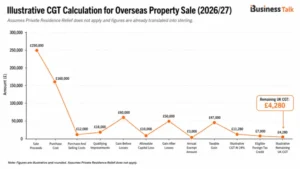
| Calculation | Amount |
| Sale Proceeds | £250,000 |
| Purchase Cost | £160,000 |
| Purchase And Selling Costs | £12,000 |
| Qualifying Improvements | £18,000 |
| Gain Before Losses | £60,000 |
| Allowable Capital Loss | £10,000 |
| Gain After Losses | £50,000 |
| Annual Exempt Amount | £3,000 |
| Taxable Gain | £47,000 |
| Illustrative CGT At 24% | £11,280 |
| Eligible Foreign Tax Credit | £7,000 |
| Illustrative Remaining UK CGT | £4,280 |
What Does The Example Show?
The property increased in value by £90,000 before expenses, but the taxable UK gain is considerably lower after allowable costs, improvements, losses and the annual exemption.
Foreign tax paid can then potentially reduce the remaining UK liability where Foreign Tax Credit Relief applies.
The example is illustrative. Actual CGT depends on the taxpayer’s income, exchange rates, losses, reliefs and foreign tax calculation.
What Records Should You Keep For A Foreign Property Sale?
Accurate documents can help support every legitimate deduction and relief claimed.
Keep records such as:
- Purchase Contract Showing the original acquisition price and date
- Completion Documents Supporting transaction values
- Legal Invoices Covering qualifying purchase and sale costs
- Estate Agent Invoices Supporting disposal expenses
- Improvement Invoices Showing qualifying capital expenditure
- Foreign Tax Documents Showing tax assessed and paid abroad
- Ownership Records Confirming each owner’s share
- Residence Evidence Where Private Residence Relief is relevant
- Exchange Rate Evidence Supporting the sterling calculation
Older records can be particularly important where a foreign property has been owned for many years.
How Do You Report A Foreign Property Sale To HMRC?
A taxable overseas property gain will normally need to be reported through the appropriate HMRC reporting process.
For taxpayers completing Self Assessment, foreign gains and any associated foreign tax relief generally need to be reflected in the relevant return.
Is The UK Property 60-Day Rule The Same For Foreign Property?
No. The 60-day reporting requirement commonly discussed for residential property applies to relevant UK property disposals.
An overseas property disposal should not automatically be treated as though the same UK property reporting rule applies.
Your reporting deadline and method should therefore be checked according to the nature of the foreign gain and your self-assessment position.
What Should You Do Before Selling Foreign Property?
Tax planning is generally more useful before a sale becomes binding.
Before disposing of foreign property:
- Confirm Your Tax Residence: Establish whether you are a UK resident in the relevant tax year
- Estimate The Sterling Gain: Calculate the purchase and sale values correctly
- Collect Allowable Cost Records: Find legal, estate agent and improvement invoices
- Check Private Residence Relief: Review how and when the property was occupied
- Review Capital Losses: Include eligible current and previous losses
- Review Ownership Consider existing spouse or civil partner interests
- Estimate Foreign Tax: Check what will be payable where the property is located
- Check Double-Taxation Relief: Identify whether foreign tax can offset UK liability
- Consider FIG Eligibility: Review this if you recently became a UK tax resident
- Get Advice Before The Sale Particularly where residence or ownership changes are being considered
Conclusion: How To Reduce Capital Gains Tax On Foreign Property Legally
Knowing how to avoid capital gains tax on foreign property legally is mainly about using the reliefs and deductions already available within UK tax rules.
Allowable costs, Private Residence Relief, capital losses, the annual exemption and foreign tax credits can all reduce the amount ultimately payable.
New UK residents should also check whether the four-year FIG regime applies to their foreign gains.
The right approach depends on your residence history, ownership, property use and foreign tax position.
Complex or high-value overseas property sales may justify advice from a UK tax professional and an adviser in the country where the property is situated.
Frequently Asked Questions
Do UK Residents Pay Capital Gains Tax On Foreign Property?
Generally, yes. UK residents can be liable for CGT when they dispose of overseas property at a gain.
How Can I Legally Avoid Capital Gains Tax On Foreign Property?
You may reduce or eliminate CGT through eligible reliefs, allowable costs, losses, exemptions and foreign tax credits.
What Is The CGT Allowance For 2026/27?
The annual exempt amount for most individuals is £3,000 for 2026/27.
Can A Foreign Holiday Home Qualify For Private Residence Relief?
Potentially, but it must satisfy the relevant residence conditions. A 90-day occupation test may apply to overseas homes in certain circumstances.
Can Renovation Costs Reduce Foreign Property CGT?
Qualifying capital improvements may reduce the gain, but routine maintenance and decorating normally do not.
Do I Pay UK Tax If I Already Paid Tax Abroad?
Possibly. Foreign Tax Credit Relief may reduce UK CGT where qualifying foreign tax has already been paid on the same gain.
Does Moving Abroad Before Selling Avoid UK CGT?
Not automatically. UK residence and temporary non-residence rules can still affect gains when someone leaves and later returns to the UK.
What is your reaction?