
When Will I Get My P800 in 2026? | HMRC Tax Refund Dates, Delays and How to Check

If you have paid too much Income Tax during the financial year, you may be wondering, “When will I get my P800 from HMRC?” For thousands of UK employees and pensioners, receiving a P800 tax calculation could mean getting money back that was deducted incorrectly through the Pay As You Earn (PAYE) system.
HMRC sends P800 tax calculation letters between June and March of the following tax year. For the 2025/26 tax year, which ended on 5 April 2026, this means you could receive your P800 between June 2026 and March 2027.
However, the timing depends on when HMRC finishes reviewing your income records, whether your employer has submitted accurate payroll information and whether additional tax details need to be checked.
HMRC confirmed in August 2026 that approximately 45 million PAYE accounts would be reviewed during the annual reconciliation process, with reviews continuing through November 2026. Letters confirming tax overpayments were being prioritised.
If you have not received your P800 by October 2026, this does not automatically mean your refund has been rejected or that HMRC has forgotten about you.
Understanding the difference between the P800 issue date, tax reconciliation and actual refund payment is important because each stage follows a different timetable.
When Will HMRC Send My P800 for the 2025/26 Tax Year?
HMRC generally begins reviewing PAYE tax records after the tax year finishes on 5 April. During this process, it compares the Income Tax collected through employers and pension providers against the amount taxpayers should have paid.
The following table explains the main dates.
| Period | What happens |
| 5 April 2026 | The 2025/26 tax year ends |
| April–May 2026 | Employers finalise annual payroll reporting |
| June 2026 | HMRC’s main annual reconciliation period begins |
| June–November 2026 | HMRC reviews PAYE records and issues P800 calculations |
| December 2026–March 2027 | Further P800 letters may still be issued |
| After receiving your P800 | Follow the refund or payment instructions in your letter |
Although HMRC aims to complete its main reconciliation work between June and November, the official P800 letter-issuing window extends to March of the following tax year.
This distinction matters. A tax calculation being processed does not necessarily mean a letter has already been posted or that a refund is available to claim.
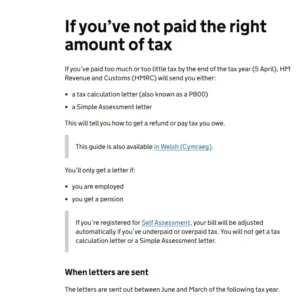
Official HMRC guidance confirming that P800 tax calculation letters are issued between June and March of the following tax year.
What Is a P800 Tax Calculation, and Who Will Receive One?
A P800 is an official tax calculation issued by HM Revenue & Customs when its records indicate that someone may have paid too much or too little Income Tax during a completed tax year.
It is not the same as a P45, P60 or Self Assessment tax return.
The P800 brings together the income, tax deductions, allowances and adjustments HMRC has recorded for the relevant year.
You may receive a P800 if you:
- Changed employers during the tax year.
- Worked for more than one employer.
- Paid tax using an incorrect or emergency tax code.
- Stopped working before the end of the tax year.
- Started receiving a workplace or private pension.
- Received certain taxable benefits.
- Had changes to your Personal Allowance or other tax adjustments.
For example, someone who changed jobs in September 2025 might have been taxed incorrectly if their new employer did not initially have their previous earnings information.
Once HMRC reconciles the complete 2025/26 tax year, it may identify an overpayment and issue a P800 during 2026 or early 2027.
However, not everyone receives a P800. If HMRC believes the correct tax was paid, it generally has no reason to issue one.
People registered for Self Assessment normally have their tax position calculated through their tax return instead.
Why Have I Not Received My P800 Yet?
There are several reasons why a P800 may not have arrived, even when you believe you are entitled to a refund.
1. HMRC Has Not Finished Reviewing Your Tax Records
HMRC processes millions of PAYE accounts during the annual reconciliation period.
These calculations are not necessarily completed for everyone at the same time.
For the 2025/26 tax year, HMRC confirmed that reconciliation would continue through November 2026, while the wider official letter-issuing period extends to March 2027.
Therefore, not receiving a P800 in October does not automatically indicate a processing problem.
2. HMRC Is Waiting for Additional Income Information
Your final tax calculation may depend on information supplied by third parties.
This could include employment earnings, pension payments or taxable savings interest.
Where additional information is required, HMRC may need to wait before finalising the calculation.
The Low Incomes Tax Reform Group, which provides specialist guidance on tax issues, also identifies delayed third-party information as a reason some P800 calculations arrive later than others.
This means two employees who earned similar salaries could receive their calculations at different times.
3. Your Employer Submitted Incorrect Payroll Information
Employers report earnings and tax deductions to HMRC through Real Time Information (RTI).
If the information submitted does not match your actual earnings, HMRC may need updated records before the tax position can be resolved.
Common problems include an incorrect leaving date, duplicated employment information or missing payment details.
If you suspect a payroll mistake, checking your payslips and understanding the differences between your P60 and P45 can help you identify which employment figures should appear in your tax records.
4. Your Address or Personal Details Are Outdated
If HMRC has an old postal address, correspondence may not reach you.
This can become particularly relevant after moving house, changing employment or leaving the UK.
Check that your address and contact details are correct in your Personal Tax Account.
5. HMRC Does Not Believe You Are Owed a Refund
Not receiving a P800 does not necessarily mean there is an administrative delay.
It may simply mean HMRC’s records indicate that you have paid the correct amount of Income Tax.
However, if those records contain missing income information, incorrect allowances or an outdated tax code, an overpayment could potentially go undetected.
This is why people who suspect an error should investigate rather than relying entirely on receiving an automatic calculation.
How Can I Check If My P800 Has Been Issued?
You do not necessarily need to telephone HMRC to investigate your previous-year Income Tax position.
HMRC provides a digital service that allows eligible PAYE taxpayers to check their previous year’s Income Tax after the calculation has been completed.
Step 1: Access HMRC’s Online Income Tax Service
Visit the official Check how much Income Tax you paid last year service.
For 2026, the service covers the tax year from 6 April 2025 to 5 April 2026.
Select “Start now” and sign in using the details requested.
Step 2: Complete Any Identity Verification
HMRC may ask you to verify your identity before displaying personal tax information.
Depending on your circumstances, you may need identification documents such as a passport or driving licence.
Step 3: Review Your Previous-Year Tax Information
Once your calculation is available, check the income and tax details shown.
Compare these against your employer’s records, including your P60, P45 and relevant payslips.
You may also be able to access tax information through the HMRC app.
Step 4: Check Whether Any Further Action Is Required
If HMRC has calculated an overpayment and issued a P800 that permits an online claim, follow the instructions provided.
If there is no completed calculation or you believe the figures are incorrect, you may need to contact HMRC.
Important: The online service does not guarantee that every taxpayer can view an issued P800 letter. It allows eligible users to check calculated Income Tax information and, where permitted, act on the result.
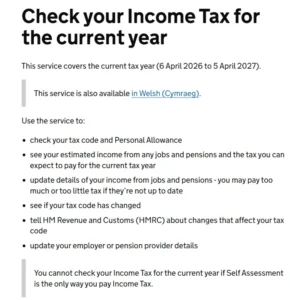
HMRC’s official online service for checking Income Tax paid during the 2025/26 tax year.
How Long After Receiving a P800 Will I Get My Tax Refund?
Receiving a P800 does not always mean that a refund has already been sent.
For many taxpayers, receiving the letter is the beginning of the repayment-claim process.
The payment timetable depends on the method HMRC offers and the method you choose.
| Refund method | HMRC’s stated timescale | Action required |
| Online bank transfer | Within 5 working days | Submit an eligible online refund claim |
| Cheque requested from HMRC | Within 6 weeks | Request a cheque using an available method |
| Automatic cheque specifically confirmed in P800 | Within 14 days of the letter date | No additional claim required |
| Refund not yet calculated | No guaranteed date | Wait for calculation or investigate a suspected overpayment |
These are HMRC’s published service timescales, not guarantees for cases requiring additional investigation.
For someone receiving a P800 in October 2026, a successful online bank-transfer claim could therefore result in payment within five working days, provided there are no complications.
Do P800 Refunds Still Arrive Automatically?
This is one of the most important changes to understand.
HMRC changed the wider P800 repayment process in May 2024, requiring most people who are invited to claim their repayment to take action rather than simply wait for an automatic cheque.
A further update announced in August 2026 extended this approach to the majority of multi-year P800 repayment requests.
Some taxpayers can still receive automatic cheques, but only where HMRC specifically indicates that a cheque will be sent.
In other words, do not assume HMRC will automatically send your refund after 21 days if you ignore the letter. That description of the older process is no longer generally reliable.
Adelle Greenwood, Tax Manager at the Institute of Chartered Accountants in England and Wales (ICAEW), highlighted the importance of taxpayers claiming their own repayments in April 2026. She warned that employees may not realise “it is their personal responsibility to make the claim”.
ICAEW reported that 730,000 PAYE tax refunds had gone unclaimed in the preceding year, averaging £855 each and totalling approximately £624 million.
The figures illustrate why understanding the P800 process matters financially, rather than simply waiting for HMRC correspondence.
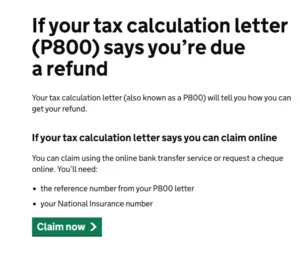 Official HMRC instructions explaining how to claim a P800 refund and the expected payment times for bank transfers and cheques.
What Should I Do If I Still Have Not Received My P800?
If you are expecting a P800 but have received nothing, the appropriate action depends on the tax year and whether you have evidence of an overpayment.
| Your situation | Recommended action |
| Waiting for a 2025/26 P800 in October 2026 | Check your online tax information and confirm your details |
| Believe your 2025/26 tax calculation is incorrect | Compare your records and contact HMRC if necessary |
| No P800 for 2025/26 by March 2027 | Investigate a suspected overpayment directly with HMRC |
| Waiting for a P800 covering 2024/25 | Check with HMRC now rather than continuing to wait |
| Received a P800 but have not claimed a refund | Follow the repayment instructions in your letter |
| Claimed online but payment is overdue | Check the claim details and contact HMRC |
If you believe HMRC owes you money, there is no requirement to wait until the final P800 issue date before investigating.
Reviewing whether HMRC owes you a tax rebate can help you identify potential overpayments relating to incorrect tax deductions, employment changes or unused allowances.
You can also contact HMRC’s Income Tax helpline on 0300 200 3300.
Before contacting HMRC, have your National Insurance number, relevant tax-year information, P60 or P45, and any existing correspondence available.
How Do I Know Whether My P800 Calculation Is Correct?
It is important to check a P800 before accepting a refund or paying an additional tax bill.
HMRC relies on information supplied by employers, pension providers and other sources. If those records are wrong, the resulting calculation may also be incorrect.
The following illustration shows how a repayment might arise.
| Description | Illustrative amount |
| Correct Income Tax liability for the year | £3,750 |
| Income Tax actually deducted through PAYE | £4,100 |
| Potential overpayment | £350 |
| Amount potentially refundable | £350 |
In this simplified example, the employee paid £350 more Income Tax than required.
However, the calculation assumes there are no other adjustments, outstanding tax debts, relief claims or income discrepancies affecting the repayment.
For a more reliable assessment, check the taxable income, tax deducted, allowances and any other adjustments shown on the P800.
The 2026 guidance from ICAEW emphasises that taxpayers should ensure their P800 includes accurate and complete information before submitting a refund claim.
This is especially relevant for people who have multiple jobs, pensions or taxable income sources.
An employee who suspects their Personal Allowance was applied incorrectly should also check whether their tax code is correct, particularly where a code such as BR, 0T or an emergency W1/M1 code has been used.
Remember that a P800 deals with Income Tax. It is not a general reconciliation of National Insurance contributions.
Can I Claim a P800 Refund for Previous Tax Years?
Yes. A taxpayer may be able to claim overpaid Income Tax from earlier tax years, provided the claim is made within the applicable statutory deadline.
For ordinary overpayment claims, the general time limit is four years after the end of the relevant tax year.
The following table shows the usual deadlines.
| Tax year | General refund claim deadline | Position in October 2026 |
| 2021/22 | 5 April 2026 | Normally expired |
| 2022/23 | 5 April 2027 | Still within the general deadline |
| 2023/24 | 5 April 2028 | Still within the general deadline |
| 2024/25 | 5 April 2029 | Still within the general deadline |
| 2025/26 | 5 April 2030 | Still within the general deadline |
Different rules or exceptions can apply in particular circumstances, including some tax-return corrections and statutory relief claims.
Anyone who believes they overpaid tax during 2022/23 should therefore pay particular attention to the approaching 5 April 2027 general claim deadline.
Receiving a P800 for more than one year does not remove the need to check the applicable claim deadline.
What Happens If My P800 Says I Owe Tax Instead of Receiving a Refund?
A P800 does not always result in a repayment.
HMRC may determine that you paid less Income Tax than you should have during the tax year.
This can happen when an employee had more than one income source, received an incorrect allowance or was taxed using an unsuitable code.
Where the underpayment is below £3,000 and the necessary conditions are met, HMRC will normally recover the amount by adjusting the taxpayer’s PAYE tax code.
This typically spreads the additional tax deductions over 12 months from the beginning of the following tax year.
For example, a £240 underpayment collected equally over 12 monthly pay periods would mean approximately £20 of extra Income Tax per month.
If the amount cannot be collected through PAYE, HMRC will explain the available payment arrangements.
A P800 underpayment should still be checked carefully, especially where an employer previously corrected a payroll mistake or the same income appears more than once.
Can I Receive a P800 While I Am Still Employed?
Yes. You do not need to leave your job or retire to receive a P800.
HMRC can issue a calculation to someone who remains employed if their previous-year PAYE record shows an overpayment or underpayment.
For example, an employee may work for the same employer throughout 2025/26 but receive an incorrect tax code for several months.
After the financial year closes, HMRC can compare the final reported earnings and tax deductions with the amount due.
However, if an incorrect tax code is identified during the current tax year, HMRC may be able to correct it sooner.
Where a cumulative tax code is changed and the employer applies the correction, an overpayment can sometimes be refunded directly through payroll.
This is different from a P800 repayment after the end of the tax year.
Anyone affected by an emergency code should understand how emergency tax codes work before assuming that a P800 is the only route to recovering overpaid tax.
How Can I Avoid Delays With Future P800 Calculations?
Although taxpayers cannot control HMRC’s annual reconciliation schedule, they can reduce the risk of incorrect or incomplete information contributing to unnecessary delays.
The most useful steps include:
- Check that HMRC holds your current postal address.
- Review your tax code after changing employment.
- Give a new employer accurate P45 information or complete the starter checklist where necessary.
- Check the income and Income Tax figures shown on your P60.
- Review multiple employment and pension records for errors.
- Keep copies of tax-related documents.
- Correct mistakes in your Personal Tax Account when possible.
- Read any P800 promptly and follow its instructions.
From an employer’s perspective, accurate RTI reporting is particularly important.
Incorrect payroll submissions can affect an employee’s tax calculations even if the employee has personally supplied the correct information.
Employers should therefore process leaving dates, starter information, tax-code updates and payroll corrections accurately.
This can help prevent employees from facing avoidable reconciliation problems after the tax year ends.
How Can I Tell Whether a P800 Refund Message Is Genuine?
Tax refund scams are a genuine risk, particularly during periods when HMRC is issuing P800 calculations.
Fraudulent messages may claim that you are entitled to a refund but must provide your bank details immediately.
It is important to distinguish those messages from genuine HMRC correspondence.
In its guidance updated during 2026, HMRC confirmed that it may send a P800-related text message if it has already issued a letter and has not received a response.
However, that type of message will not ask for personal or financial information or provide website links.
If you receive an unexpected refund message, do not follow an unfamiliar payment link.
Instead, access HMRC through GOV.UK or the official HMRC app independently.
The safest approach is to verify the tax calculation before providing any banking information.
Frequently Asked Questions About P800 Letters
When will I get my P800 for 2025/26?
HMRC can issue P800 letters for the 2025/26 tax year between June 2026 and March 2027, although the main annual tax reconciliation runs from June to November 2026.
Why have I not received my P800 in October 2026?
HMRC may still be reviewing your PAYE records, waiting for information or finalising the calculation. You can check your previous-year Income Tax details online.
Will everyone receive a P800 from HMRC?
No. P800 calculations are generally sent when HMRC identifies a PAYE Income Tax overpayment or underpayment. People whose records show the correct tax was paid may not receive one.
Can I check whether HMRC has calculated my tax online?
Yes. Eligible PAYE taxpayers can use HMRC’s online previous-year Income Tax service or app to view calculated tax information once available.
How long does a P800 refund take?
HMRC normally pays an eligible online refund within five working days. A cheque requested from HMRC can take up to six weeks.
Will HMRC automatically send my P800 refund?
Usually, you must claim when your P800 instructs you to do so. Automatic cheques still apply in some cases, but the letter will confirm whether HMRC is sending one.
Can I get a P800 before June?
A standard previous-year P800 is not normally issued before the annual reconciliation period begins. Some in-year tax overpayments may instead be corrected through payroll or another refund process.
What should I do if my P800 refund has not arrived?
Check how the refund was requested and whether HMRC’s published payment period has passed. If it has, contact HMRC with your P800 reference and claim information.
Can I receive a P800 if I am self-employed?
Someone who files a Self Assessment return would not normally receive a P800 for their tax calculation. Overpayments and underpayments are generally dealt with through Self Assessment.
Is a P800 the same as a tax refund?
No. A P800 is an Income Tax calculation showing an overpayment or underpayment. A refund is the money paid back when an overpayment is confirmed and repayment arrangements are completed.
Can I claim an old P800 refund?
Possibly. Ordinary Income Tax refund claims are generally subject to a four-year time limit from the end of the relevant tax year, although exceptions may apply.
Will I receive my 2026/27 P800 in 2026?
Normally, no. The 2026/27 tax year ends on 5 April 2027, so the usual P800 issue window for that year would run from June 2027 to March 2028.
What is your reaction?