
How Much Is Child Tax Credit? Final UK Rates, How It Was Calculated And What Replaced It

Last Updated: 03 November 2026
Child Tax Credit is no longer available in the UK. The benefit ended on 5 April 2025, which means there is no Child Tax Credit rate for the 2026/27 tax year and no new claim can now be made.
People who need financial support for children may instead qualify for Universal Credit or, in some cases, Pension Credit.
In the final 2024/25 tax year, the maximum annual Child Tax Credit amounts included a £3,455 child element, a £545 family element, a £4,170 disabled child element and an additional £1,680 severely disabled child rate where the relevant conditions were met.
These were maximum elements used to calculate an award rather than guaranteed payments for every household.
| Child Tax Credit Element | Final 2024/25 Maximum |
| Family Element | £545 A Year |
| Child Element | £3,455 A Year |
| Disabled Child Element | £4,170 A Year |
| Severely Disabled Child Addition | £1,680 A Year |
For comparison, dividing the annual figures into weekly and monthly equivalents gives an idea of their value, although HMRC calculated Child Tax Credit as an annual award rather than setting separate standard monthly rates.
| Element | Approx. Weekly Equivalent | Approx. Monthly Equivalent |
| Family Element | £10.48 | £45.42 |
| Child Element | £66.44 | £287.92 |
| Disabled Child Element | £80.19 | £347.50 |
| Severely Disabled Child Addition | £32.31 | £140.00 |
The amount an individual family actually received could be lower because Child Tax Credit was means-tested.
Household income, the number and circumstances of qualifying children, disability and other factors affected the final award.
Did Child Tax Credit Increase Every Year?
Child Tax Credit did not automatically increase by a fixed amount every year.
Under the Tax Credits Act 2002, the Treasury was required to review specified tax-credit amounts each tax year to consider whether they had retained their value relative to the general level of prices in the UK. That review did not mean every element had to rise every year.
The final two years demonstrate this clearly.
| Child Tax Credit Element | 2023/24 | 2024/25 | Change |
| Family Element | £545 | £545 | No Change |
| Child Element | £3,235 | £3,455 | +£220 |
| Disabled Child Rate | £3,905 | £4,170 | +£265 |
| Severely Disabled Child Rate | £1,575 | £1,680 | +£105 |
The standard child and disability elements increased between 2023/24 and 2024/25, while the family element remained at £545.
Therefore, it would be incorrect to assume that Child Tax Credit simply rose every April by the same percentage.
There are no 2025/26 or 2026/27 Child Tax Credit increases because the tax-credit system has ended.
The government’s current rate table shows the 2025/26 Child Tax Credit amounts as not applicable.
People researching the older tax-credit system may also come across Working Tax Credit, which ended at the same time on 5 April 2025.
On What Basis Was Child Tax Credit Calculated?
Child Tax Credit was not simply a fixed payment given to every parent. HMRC calculated entitlement using the maximum elements that applied to a household and then considered income and other circumstances.
The main factors included:
- Household Income: Higher household income could reduce the final award
- Number Of Qualifying Children: The number of children for whom an amount could be included affected the maximum award
- Child’s Age And Education: A young person generally had to meet the relevant age, education or training rules
- Disability: Additional elements could be included for qualifying disabled children
- Household Circumstances: Changes in family circumstances could affect entitlement
- Applicable Income Threshold: The award could begin reducing once income exceeded the relevant threshold
The system therefore worked differently from a universal payment such as Child Benefit.
How Household Income Affected The Amount?
Income was one of the most important parts of the Child Tax Credit calculation.
For the final 2024/25 tax year, the government’s published tax-credit figures included:
| Calculation Rule | 2024/25 |
| General Income Threshold | £7,955 |
| Child Tax Credit-Only Threshold | £19,995 |
| Withdrawal Rate | 41% |
| Income Rise Disregard | £2,500 |
| Income Fall Disregard | £2,500 |
For households entitled only to Child Tax Credit, the published threshold was £19,995.
Once income went above the relevant threshold, tax-credit entitlement could be reduced using a 41% withdrawal rate, subject to the full tax-credit calculation rules.
This is why two families with the same number of children could receive different amounts.
A household with lower relevant income could receive more of the maximum award, while a household with higher income could have its award progressively reduced.
How The Number Of Children Affected The Payment?
The number of qualifying children was another important part of the calculation because the child element could be included for eligible children subject to the rules that applied at the time.
Before Child Tax Credit ended, restrictions introduced from April 2017 could limit the child element for some third or subsequent children, although exceptions existed.
These historical rules should not be confused with the current Universal Credit position.
The Universal Credit two-child limit ended on 6 April 2026. Universal Credit can now include the extra child amount for every qualifying child, although the overall benefit cap and other entitlement rules can still affect the amount a household actually receives.
How Disability Affected Child Tax Credit?
Families responsible for a disabled child could potentially receive additional Child Tax Credit.
In 2024/25, the maximum disabled child rate was £4,170 a year. A further severely disabled child rate of £1,680 a year could apply where the conditions were satisfied.
These disability amounts were additional elements within the calculation rather than separate benefits available to everyone with children.
Disability support continues under Universal Credit, although the rates and qualifying rules are different.
Is Child Tax Credit Still Available In The UK?
No. Child Tax Credit officially ended on 5 April 2025.
You cannot make a new Child Tax Credit claim in 2026. GOV.UK states that people may instead be able to claim Universal Credit or Pension Credit depending on their age and circumstances.
People who previously received Child Tax Credit may still need to deal with HMRC over historical matters such as a final award, underpayment or overpayment.
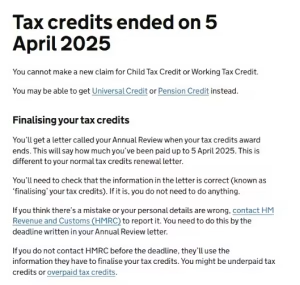
GOV.UK confirms that Child Tax Credit ended on 5 April 2025 and that new claims can no longer be made.
The end of Child Tax Credit does not mean every family-related payment has disappeared.
For example, Child Benefit remains a separate benefit and should not be confused with the former means-tested Child Tax Credit system.
What Replaced Child Tax Credit?
For most eligible working-age households, Universal Credit has replaced Child Tax Credit as the main means-tested benefit providing financial support for children.
The current 2026/27 Universal Credit rules provide £303.94 a month for each qualifying child living with the claimant.
Where the first child was born before 6 April 2017, an additional £47.94 a month is added for that child, making the total £351.88.
| Universal Credit Child Support | 2026/27 Monthly Amount |
| Child Amount | £303.94 Per Child |
| Extra For First Child Born Before 6 April 2017 | £47.94 |
| Lower Disabled Child Addition | £164.79 |
| Higher Disabled Child Addition | £514.71 |
A disabled child can qualify for either the lower or higher disability addition depending on the qualifying disability benefit and circumstances.
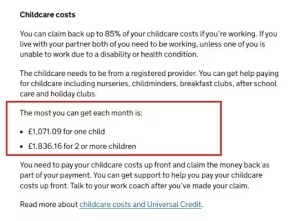
GOV.UK shows the current Universal Credit child amount and the additional amounts available where a child has a qualifying disability.
Universal Credit may also provide help with registered childcare. Eligible working households can currently claim back up to 85% of childcare costs, subject to the scheme’s conditions and monthly maximums.
How Is Child-Related Universal Credit Calculated Now?
Universal Credit uses a different calculation from the old Child Tax Credit system.
A household starts with the Universal Credit standard allowance and then any relevant additional elements are added.
These can include amounts for:
- Children: An amount for each qualifying child
- Disabled Children: A lower or higher disability addition
- Childcare Costs: Support towards eligible registered childcare
- Housing Costs: Help with qualifying rent and some service charges
- Caring Responsibilities: An additional carer’s element in qualifying cases
- Health Conditions: Additional support where the relevant capability rules are met
Deductions can then reduce the final monthly payment.
For example, Universal Credit can be affected by earnings, other income, previous overpayments, the benefit cap and the amount of money or savings held by the household.
Savings below £6,000 normally do not reduce Universal Credit. Savings between £6,000 and £16,000 can reduce the award, while households with more than £16,000 will normally not qualify, subject to specific exceptions or transitional rules.
How money is deliberately spent or transferred can also matter because the DWP may apply deprivation of capital rules where it considers that someone intentionally reduced their capital to obtain or increase means-tested benefits.
This means there is no single Universal Credit child payment that every family receives overall. The child element is only one component within a wider household calculation.
Does The Two-Child Limit Still Apply?
No. The Universal Credit two-child limit ended on 6 April 2026.
Before that date, the extra Universal Credit child amount generally applied only to the first and second child, unless an exception applied.
Universal Credit now includes the extra child amount for every qualifying child for assessment periods beginning on or after 6 April 2026.
However, removing the two-child limit does not mean there are no limits on a household’s overall benefits.
The benefit cap remains in place, and additional child amounts count towards the household’s total benefits when the cap is considered.
Child Tax Credit Vs Universal Credit
Although Universal Credit replaced Child Tax Credit, the two systems work differently.
| Feature | Child Tax Credit | Universal Credit |
| Current Status | Ended 5 April 2025 | Currently Available |
| New Claims | Not Allowed | Allowed For Eligible Claimants |
| Administrator | HMRC | DWP |
| Assessment | Mainly Annual Tax-Credit Calculation | Monthly Assessment Periods |
| Child Support | Child And Disability Elements | Child And Disability Elements |
| Housing Support | Not Included As A CTC Element | Can Be Included |
| Childcare Support | Linked Mainly Through Working Tax Credit | Can Cover Eligible Childcare Costs |
| Savings | Different Tax-Credit Income Rules Applied | Capital Rules Can Reduce Or Prevent Entitlement |
| Payment System | Tax-Credit Award | Monthly Universal Credit Award |
One important difference is that Universal Credit combines several types of means-tested support into one system.
This is also why families should not use an old Child Tax Credit calculator or historical income threshold to estimate what they might receive now.
Current Universal Credit entitlement depends on the household’s present circumstances.
Child Tax Credit Vs Child Benefit
Child Tax Credit and Child Benefit are not the same thing.
Child Tax Credit was a means-tested payment that depended heavily on household income and circumstances. It ended in April 2025.
Child Benefit continues to operate.
For the 2026/27 tax year, the weekly Child Benefit rates are £27.05 for the eldest or only child and £17.90 for each additional child.
| Feature | Child Tax Credit | Child Benefit |
| Available In 2026/27 | No | Yes |
| Child Tax Credit End Date | 5 April 2025 | Not Applicable |
| Means-Tested Award | Yes | Different Income Tax Rules Apply |
| 2026/27 Rate | No Current Rate | £27.05 First Child, £17.90 Others |
| Main Administrator | HMRC | HMRC |
A family receiving Universal Credit may also receive Child Benefit. They are separate schemes and one should not automatically be treated as a replacement for the other.
What Happens To Old Child Tax Credit Overpayments?
Although Child Tax Credit has ended, an old tax-credit debt does not automatically disappear.
HMRC can still recover historical overpayments.
If someone now receives Universal Credit, an outstanding tax-credit overpayment can be recovered through reductions in future Universal Credit payments.
If the person does not receive Universal Credit, they may need to repay HMRC directly.
An overpayment may have arisen because:
- Circumstances Changed: Household details changed during an award
- Incorrect Information Was Used: HMRC or the claimant may have made an error
- Income Changed: Actual income differed from the information used for the award
- Renewal Was Not Completed Correctly: Historical renewal issues could create an overpayment
Anyone who believes an old tax-credit overpayment is incorrect should check HMRC’s calculation rather than ignoring the debt.
What Support Can Pension-Age Parents And Carers Get?
Universal Credit will not always be the correct replacement for somebody who has reached State Pension age.
In some circumstances, Pension Credit can include additional amounts for people responsible for children or young people.
For 2026/27, Pension Credit can include £69.98 a week for each qualifying child or young person, increasing to £81.07 a week for the first child if they were born before 6 April 2017.
Additional disability amounts can also apply.
| Pension Credit Child Addition | 2026/27 Weekly Amount |
| Child Or Young Person | £69.98 |
| First Child Born Before 6 April 2017 | £81.07 |
| Lower Disabled Child Addition | £37.93 |
| Higher Disabled Child Addition | £118.46 |
People approaching or over State Pension age should therefore check whether Pension Credit applies to their circumstances instead of assuming Universal Credit is automatically the correct benefit.
Conclusion
Child Tax Credit no longer has a current weekly, monthly or annual rate because the benefit ended on 5 April 2025.
Its final standard rates applied during 2024/25, when the maximum child element was £3,455 a year and additional amounts could apply depending on the household and whether a child was disabled.
Child Tax Credit did not simply provide every family with the same payment.
HMRC calculated awards using applicable elements, household circumstances, income thresholds and a withdrawal rate.
The rates could also change between tax years, but an increase was never guaranteed for every element.
For families looking for support now, Universal Credit is generally the relevant means-tested benefit for eligible working-age households.
From 6 April 2026, its child amount can be included for every qualifying child following the removal of the two-child limit.
Child Benefit continues separately, while some people of State Pension age may instead qualify for additional child support through Pension Credit.
FAQs About Child Tax Credit
Can I Still Claim Child Tax Credit?
No. Child Tax Credit ended on 5 April 2025 and new claims can no longer be made. Eligible households may instead be able to claim Universal Credit or Pension Credit.
How Much Was Child Tax Credit Per Child?
The final 2024/25 maximum standard child element was £3,455 a year. Additional family or disability elements could apply depending on the household’s circumstances.
How Much Was Child Tax Credit A Week?
The £3,455 annual child element is approximately £66.44 a week when divided across 52 weeks. This is an equivalent figure rather than a separate official weekly Child Tax Credit rate.
Did Child Tax Credit Increase Every Year?
No. Tax-credit amounts were reviewed, but individual elements were not guaranteed to increase every year. For example, the family element stayed at £545 between 2023/24 and 2024/25.
What Was Child Tax Credit Based On?
The award depended on factors including household income, qualifying children, disability and the maximum elements that applied to the household.
What Has Replaced Child Tax Credit?
Universal Credit has replaced Child Tax Credit for most eligible working-age households. Pension Credit may provide support for children in some State Pension age households.
Does The Two-Child Limit Still Apply To Universal Credit?
No. The Universal Credit two-child limit ended on 6 April 2026, so the child amount can now be included for every qualifying child, although other rules such as the benefit cap can still affect the final payment.
What is your reaction?