
How Does HMRC Collect Tax on Savings Interest?

HMRC usually collects tax on savings interest without taking tax directly from your savings account. Banks and building societies normally pay interest gross, then report the interest they have paid to HMRC.
HMRC uses that information alongside your other income to decide whether any of the interest exceeds your tax-free allowances.
If tax is due, it can be collected by changing your PAYE tax code, issuing a Simple Assessment, or through a Self Assessment tax return.
The route depends mainly on whether you receive employment or pension income through PAYE, whether you already complete Self Assessment, and how much savings interest you receive.
For the 2026/27 tax year, the Personal Savings Allowance remains £1,000 for basic-rate taxpayers, £500 for higher-rate taxpayers and £0 for additional-rate taxpayers.
HMRC’s current tax on savings interest guidance also confirms that banks report savings interest after the end of the tax year.
How Does HMRC Check the Interest You Earn on Savings?
For most ordinary UK bank and building society accounts, you do not need to send HMRC a separate report every time interest is paid.
After the end of the tax year on 5 April, banks and building societies provide HMRC with information about the interest they have paid.
HMRC can then combine interest from different accounts and compare the total with your available tax-free allowances.
This is why someone with several relatively small savings accounts can still face a tax charge.
HMRC is interested in the total interest received across taxable accounts, rather than whether one individual account exceeds the Personal Savings Allowance.
Savers who are unsure about their reporting responsibilities may also find it useful to understand whether savings interest needs to be notified to HMRC.
Banks generally report the interest figure, but you should still keep your own records. Bank statements and annual interest certificates become particularly useful if HMRC’s figure differs from what you actually received.
Alice Haine, a personal finance analyst, explains the PAYE mechanism clearly:
“For employees or pension recipients paying tax via PAYE, HMRC typically adjusts your tax code to collect tax on savings interest directly from your payslip.”
How Much Savings Interest Can You Earn Before Paying Tax?
There is no single savings-interest threshold that applies to everyone. Three separate tax provisions can potentially shelter interest from Income Tax.
| Tax-free provision | 2026/27 position | Who can benefit? |
| Personal Allowance | Up to £12,570 | People who have not already used their full allowance against other taxable income |
| Starting rate for savings | Up to £5,000 at 0% | Mainly people with relatively low non-savings income |
| Personal Savings Allowance | £1,000 / £500 / £0 | Depends on whether you fall into the basic, higher or additional-rate band |
| ISA interest | Tax-free | Eligible ISA savers |
The starting rate for savings can provide up to £5,000 of savings interest at 0%, but it is gradually reduced where your other taxable income exceeds the Personal Allowance.
For every £1 of relevant non-savings income above £12,570, the £5,000 starting-rate band is reduced by £1. Once other taxable income reaches £17,570, there is normally no starting-rate band remaining.
The Personal Savings Allowance is separate:
| Taxpayer position | Personal Savings Allowance in 2026/27 |
| Basic-rate taxpayer | £1,000 |
| Higher-rate taxpayer | £500 |
| Additional-rate taxpayer | £0 |
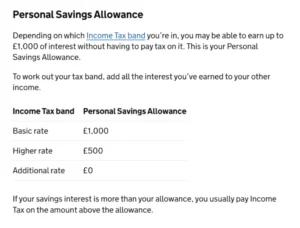
HMRC confirms that the Personal Savings Allowance depends on your Income Tax band
A common mistake is to look only at the balance in a savings account. There is no universal £10,000, £20,000 or £50,000 savings-balance limit that automatically creates a tax charge.
What matters is the amount of taxable interest generated.
That distinction is particularly important when considering an HMRC savings tax warning and the effect of higher interest rates.
Laura Suter, director of personal finance, has warned:
“Lots of savers will assume their savings are tax-free, not realising that tax could be eating away at their hard-earned interest.”
How Does HMRC Actually Collect the Tax You Owe?
The collection method depends on your circumstances rather than the bank simply deducting tax before paying your interest.
| Your situation | How tax is normally collected |
| Employee taxed through PAYE | HMRC can adjust the tax code used by the employer |
| Pensioner with PAYE pension income | HMRC can adjust the pension tax code |
| No suitable PAYE income | HMRC may issue a Simple Assessment |
| Already using Self Assessment | Interest is reported on the tax return |
| More than £10,000 savings and investment income | Self Assessment is required |
PAYE Tax Code Adjustment
For employees and people receiving taxable pensions, this is one of the most common collection methods.
HMRC first receives the previous year’s interest information from banks and building societies.
Where tax is due, HMRC can reduce the tax-free amount built into your PAYE tax code so that slightly more Income Tax is deducted from your salary or pension.
Importantly, HMRC may use the previous year’s savings interest to estimate what you will receive in the current year.
For example, suppose HMRC learns that you received £1,600 of taxable-account interest during 2025/26. It may use that information when estimating your savings income for 2026/27.
If your savings balance has since fallen or interest rates have changed significantly, that estimate may no longer be accurate.
Understanding how these deductions appear becomes easier if you regularly check whether your tax code is correct.
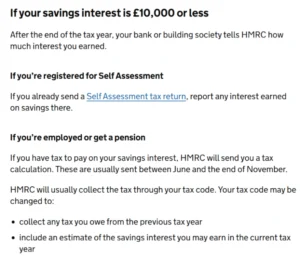
HMRC explains how banks report savings interest and how tax can subsequently be collected through PAYE, Simple Assessment or Self Assessment.
Simple Assessment
A Simple Assessment is different from a Self Assessment return.
HMRC may issue one where tax is due but cannot appropriately be collected through PAYE. The assessment explains how much tax HMRC believes you owe, how the figure was calculated and how it should be paid.
For the 2025/26 tax year, HMRC states that a Simple Assessment received before 31 October 2026 is generally payable by 31 January 2027.
If it arrives on or after 31 October, the payment deadline is generally three months from the date of the letter.
When Do You Need Self Assessment for Savings Interest?
Receiving more interest than your Personal Savings Allowance does not automatically mean every PAYE taxpayer must register for Self Assessment. HMRC can often collect relatively modest liabilities through PAYE.
However, the rules change where savings and investment income becomes substantial.
HMRC states that if your savings interest exceeds £10,000 during the tax year, you need to report it through Self Assessment.
If a bank reports more than £10,000 of savings interest, HMRC may also issue a notice requiring a return.
If you already complete a Self Assessment tax return because you are self-employed, a landlord or have another filing requirement, you should include the relevant savings interest on that return even if HMRC has received information from your bank.
Banks reporting the figures does not remove a taxpayer’s obligation to complete an accurate tax return where Self Assessment applies.
How Is Tax on Savings Interest Calculated?
The calculation starts with your total taxable income, not simply the interest itself.
HMRC broadly needs to determine:
- your taxable non-savings income;
- whether any Personal Allowance remains available;
- whether you qualify for the starting rate for savings;
- which Income Tax band applies after savings income is included;
- the Personal Savings Allowance available to you; and
- how much interest remains taxable after the relevant 0% bands and allowances have been applied.
For 2026/27, taxable savings interest is currently charged at savings rates of 20%, 40% or 45%, depending on where the income falls within the relevant tax bands.
Example: Basic-Rate Taxpayer
Suppose someone receives £35,000 in employment income and earns £1,600 of taxable savings interest.
Their Personal Allowance is already being used against employment income, and their income is too high to qualify for the starting rate for savings.
They receive a £1,000 Personal Savings Allowance.
| Calculation | Amount |
| Savings interest | £1,600 |
| Personal Savings Allowance | £1,000 |
| Taxable interest | £600 |
| Savings tax rate | 20% |
| Tax due | £120 |
HMRC may therefore seek to collect approximately £120 through PAYE or another appropriate collection method.
Example: Higher-Rate Taxpayer
If a higher-rate taxpayer receives £2,000 in savings interest and qualifies for the £500 Personal Savings Allowance:
- £500 is covered by the Personal Savings Allowance.
- £1,500 remains taxable.
- At the current 40% savings higher rate, the tax would be £600, assuming all the taxable interest falls within that rate band.
The examples also show why savers should not treat the PSA as a fixed £1,000 entitlement regardless of income.
HMRC says that your savings interest is added to your other income when determining your tax band, so interest itself can affect whether your PSA is £1,000, £500 or nil.
What Happens If HMRC Uses the Wrong Savings Interest Figure?
An incorrect tax-code adjustment does not necessarily mean your bank or HMRC has permanently overcharged you.
HMRC can use historic savings information to estimate current-year interest. That creates a timing issue: your tax code might be based on interest earned when your balance or savings rate was substantially higher.
HMRC recommends checking the estimated savings figure through your Personal Tax Account and comparing it with the interest you realistically expect to receive.
A practical estimate is to:
- check interest received so far;
- review the current balances and interest rates on your accounts;
- estimate the remaining interest for the tax year; and
- compare the annual figure with the amount HMRC is using.
If the estimate is materially wrong, you can provide updated information to HMRC. HMRC can then issue a revised tax code.
For taxpayers who owe savings tax but do not receive the expected calculation, current HMRC guidance says to contact HMRC if no letter has arrived by the end of November, rather than assuming no tax is payable.
How Does HMRC Treat Joint and Multiple Savings Accounts?
Having money spread between several ordinary taxable savings accounts does not create several Personal Savings Allowances.
HMRC adds together the interest from your taxable savings accounts before considering the allowances available to you.
For a normal joint account, HMRC will generally split the interest equally between the account holders.
For example, if a joint savings account generates £2,000 of interest, HMRC will normally allocate:
| Account holder | Interest attributed |
| First holder | £1,000 |
| Second holder | £1,000 |
Each person’s own tax position is then considered separately.
There can be exceptions where beneficial ownership is genuinely different.
HMRC’s detailed guidance states that spouses and civil partners are normally taxed on half each, although rules exist for situations where their actual beneficial entitlement is not 50:50.
When Is Fixed-Term Savings Interest Taxed?
Fixed-term accounts create one of the more easily overlooked savings-tax issues.
The relevant tax year can depend on when the interest becomes available to you, rather than simply when a bank displays an interest figure.
HMRC’s Savings and Investment Manual explains that interest generally arises when it is received or made available to the saver.
If interest is credited to an account and you can access it, even where early withdrawal carries a penalty, it can be taxable at that point.
If the product’s terms genuinely prevent access to the interest until maturity, HMRC may instead treat the interest as arising when it finally becomes accessible.
This matters with multi-year fixed accounts because several years of accumulated interest could potentially fall into one tax year, depending on the account terms.
Checking the provider’s annual interest certificate and withdrawal conditions is therefore more reliable than assuming every fixed account is taxed annually.
Which Savings Returns Are Normally Tax-Free?
Some savings returns sit outside ordinary taxable savings interest.
Interest earned inside an ISA is normally tax-free and does not use your Personal Savings Allowance. Certain NS&I products also provide tax-free returns; for example, Premium Bond prizes are tax-free.
By contrast, taxable savings income can potentially arise from products such as ordinary bank and building society accounts, credit union savings, fixed-term savings products and some investment or lending arrangements.
The tax treatment should therefore be checked according to the product rather than simply whether the money is described as “savings”.
What Is Changing for Savings Tax From April 2027?
This is one of the most important developments for people researching how HMRC collects tax on savings interest now.
Savings tax rates remain 20%, 40% and 45% in 2026/27. However, Budget 2026 set out further increases from 6 April 2027, to be legislated through Finance Bill 2026-27.
| Savings income rate | 2026/27 | From 6 April 2027 |
| Basic | 20% | 24% |
| Higher | 40% | 44% |
| Additional | 45% | 49% |
These savings rates apply across the UK.
The starting-rate limit remains £5,000 and the Personal Savings Allowance remains £1,000 for basic-rate taxpayers and £500 for higher-rate taxpayers under the published 2027/28 rates and allowances.
The official Budget 2026 savings-income tax measures provide the latest policy detail.
This means a saver who already exceeds their PSA could face a larger bill on exactly the same amount of taxable interest after April 2027.
The wider direction of HMRC’s savings reporting system is also becoming increasingly data-driven, making the developments around the tax reporting changes affecting savings accounts particularly relevant.
Can You Reclaim Tax If HMRC Collects Too Much?
Yes. Savings-tax calculations can be corrected where HMRC has collected more than was actually due.
During the current tax year, first check the estimated savings interest shown in your Personal Tax Account. If the estimate is too high, HMRC can amend it and issue an updated PAYE tax code.
Where too much tax was paid in a previous year, claims can generally be made within four years after the end of the relevant tax year.
Depending on your circumstances, the correction may be made through Self Assessment, directly through HMRC or using form R40.
It can therefore be worth checking whether HMRC owes you a tax rebate if an old tax code was based on savings interest that was significantly higher than the amount actually received.
How Can You Avoid Unexpected HMRC Savings Tax Bills?
The most effective approach is to monitor the interest earned, rather than concentrating only on the capital held in savings.
Useful steps include:
- keep annual interest certificates and savings statements;
- calculate interest across all taxable accounts rather than account by account;
- check whether savings interest pushes you into a different tax band;
- review HMRC’s estimated savings figure after receiving a tax-code change;
- distinguish taxable accounts from ISAs and other tax-free products;
- check when interest from fixed-term accounts becomes accessible;
- include the correct interest on Self Assessment where you already file a return; and
- review your position before 6 April 2027 because the rates applied to taxable savings income are scheduled to rise.
Monitoring is particularly important where large fixed-term accounts mature, interest rates change sharply or substantial balances are transferred between accounts.
Conclusion
HMRC usually collects tax on savings interest without taking money directly from your savings account.
Banks report interest after the tax year, HMRC applies your available allowances, and any tax due is normally collected through PAYE, Simple Assessment or Self Assessment.
The key is to check the interest figure HMRC is using, particularly where rates or account balances have changed.
Keep annual interest statements, review your Personal Tax Account and correct estimates promptly.
With savings tax rates set to rise from April 2027, monitoring taxable interest will become even more important for basic-, higher- and additional-rate savers across the UK.
Frequently Asked Questions
Does HMRC automatically know about my savings interest?
For ordinary UK bank and building society accounts, HMRC normally receives interest information from the financial institution after the tax year ends.
You should still check the figure because errors or outdated estimates can affect your tax code.
Does HMRC take savings tax directly from my bank account?
Normally, no. Interest is generally paid gross and HMRC usually collects tax through PAYE, Simple Assessment or Self Assessment rather than withdrawing the tax from your savings balance.
How much savings interest can I earn tax-free in 2026/27?
A basic-rate taxpayer can receive up to £1,000 under the Personal Savings Allowance, while a higher-rate taxpayer receives £500 and an additional-rate taxpayer receives none.
Other allowances may provide additional tax-free interest in qualifying circumstances.
Will HMRC change my tax code because of savings interest?
It can. If you are employed or receive a pension through PAYE, HMRC can adjust your tax code to collect tax due and can use previous-year savings interest to estimate current-year interest.
Do I need Self Assessment if my interest exceeds £1,000?
Not necessarily. HMRC can often collect the tax through PAYE. However, if your total savings interest exceeds £10,000, HMRC requires the amount to be reported through Self Assessment.
Is interest on a joint account split between both people?
Usually, yes. HMRC generally allocates joint-account interest equally, although different treatment can apply where the beneficial ownership is genuinely different. Each account holder then uses their own applicable tax allowances.
What savings tax rates will apply from April 2027?
Under the Budget 2026 measures, the savings basic, higher and additional rates are scheduled to become 24%, 44% and 49% respectively from 6 April 2027. The changes apply to savings income across the UK.
What is your reaction?