
HMRC Careless Error Tax Penalties: Rates, Examples and How to Avoid Fines

HMRC careless error tax penalties can apply when an individual or business submits an incorrect tax return because they failed to take reasonable care.
However, not every tax mistake results in a financial penalty, and the amount charged depends on the circumstances, the tax involved and how the error is disclosed.
Under the standard UK tax inaccuracy penalty rules, careless errors can attract penalties ranging from 0% to 30% of the potential lost revenue when disclosed voluntarily, or 15% to 30% when HMRC prompts the disclosure.
These percentages are applied to the tax at risk, not automatically to the taxpayer’s entire income or business turnover.
For sole traders, company directors, landlords and employers, understanding the difference between an honest mistake, careless behaviour and deliberate misreporting can significantly affect the final liability.
HMRC’s updated July 2026 compliance guidance confirms that taxpayers who exercised reasonable care but still made an error should not face an inaccuracy penalty.
Nevertheless, the outstanding tax and applicable interest may remain payable.
What Counts as a Careless Error Under HMRC Tax Rules?
A careless tax error occurs when a taxpayer submits inaccurate information because they did not exercise the level of care reasonably expected in their circumstances.
The relevant rules are principally established under Schedule 24 of the Finance Act 2007.
Carelessness does not necessarily involve dishonesty.
A person may genuinely intend to submit an accurate tax return but fail to check financial records, misunderstand information they should reasonably have verified or overlook an obvious discrepancy.
Common examples include:
- Omitting business income despite having the relevant invoices or bank records.
- Claiming personal purchases as allowable business expenses without checking their eligibility.
- Entering incorrect figures from accounting records without reviewing the totals.
- Failing to investigate significant differences between financial statements and a tax return.
- Incorrectly declaring rental income because record-keeping procedures are inadequate.
- Submitting VAT figures without checking whether transactions have been classified correctly.
However, an incorrect figure alone does not establish carelessness.
HMRC must consider what caused the error and whether a reasonable taxpayer in similar circumstances would have taken additional precautions.
The Reasonable Care Test
Reasonable care depends partly on the taxpayer’s experience, abilities and personal circumstances.
For example, a first-time sole trader with straightforward finances may reasonably be expected to follow basic instructions, maintain invoices and seek clarification about unfamiliar tax rules.
A large company operating through an experienced finance department may be expected to implement more sophisticated controls.
In the tax tribunal case involving David Collis, Judge Berner described the relevant standard as that of:
“a prudent and reasonable taxpayer in the position of the taxpayer in question.”
This principle means that HMRC should consider the taxpayer’s actual circumstances rather than automatically imposing a penalty whenever an error is discovered.
For anyone completing a Self Assessment tax return, reviewing income, expenses and supporting documentation before submission is an important part of demonstrating reasonable care.
How Much Are HMRC Careless Error Tax Penalties?
HMRC determines inaccuracy penalties according to the taxpayer’s behaviour and whether the disclosure was prompted or unprompted.
A voluntary disclosure can produce a substantially lower penalty than one made after HMRC has identified a problem.
| Type of tax error | Unprompted disclosure | Prompted disclosure |
| Error despite reasonable care | 0% | 0% |
| Careless error | 0%–30% | 15%–30% |
| Deliberate error without concealment | 20%–70% | 35%–70% |
| Deliberate and concealed error | 30%–100% | 50%–100% |
These are the standard penalty ranges for relevant inaccuracies. Higher penalties can apply to certain offshore matters, and specialist rules apply in some circumstances.
An unprompted disclosure means the taxpayer informs HMRC about an error before having reason to believe HMRC has discovered it or is about to discover it.
A prompted disclosure generally occurs when the taxpayer reports or acknowledges the error after becoming aware that HMRC has identified, or is likely to identify, the problem.
The difference can be financially significant.
For example, when HMRC has already started a relevant compliance investigation, a subsequent disclosure will normally be considered prompted.
An unprompted careless-error penalty can potentially be reduced to zero. However, that outcome is not automatic and depends on the quality and timing of the disclosure.
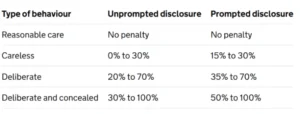
HMRC’s official penalty ranges show how disclosure timing and taxpayer behaviour affect penalties for inaccurate tax returns.
How Does HMRC Calculate a Careless Error Penalty?
HMRC generally calculates an inaccuracy penalty using the potential lost revenue, commonly abbreviated as PLR.
This represents the tax that would be lost or incorrectly repaid because of the inaccurate information.
The basic formula is:
Tax penalty = Potential Lost Revenue × Applicable Penalty Percentage
Consider a business owner who submits a tax return containing an error that understates the tax liability by £5,000.
If HMRC concludes that the error was careless, the penalty depends on whether the disclosure was voluntary and how fully the taxpayer cooperated.
| Example | Tax understated | Penalty rate | Penalty amount |
| Unprompted, maximum reduction | £5,000 | 0% | £0 |
| Unprompted, illustrative 10% rate | £5,000 | 10% | £500 |
| Prompted, minimum rate | £5,000 | 15% | £750 |
| Prompted, illustrative 20% rate | £5,000 | 20% | £1,000 |
| Maximum standard careless penalty | £5,000 | 30% | £1,500 |
These examples illustrate the possible amounts rather than predicting HMRC’s decision in any particular case.
Even where the penalty is reduced to £0, the taxpayer must normally pay the additional £5,000 tax liability and any applicable interest.
How Disclosure Quality Affects the Calculation?
HMRC considers three main elements when assessing cooperation:
| Disclosure activity | Maximum weighting |
| Telling HMRC what went wrong | 30% |
| Helping HMRC establish the correct tax position | 40% |
| Giving HMRC access to relevant records | 30% |
| Total | 100% |
These percentages measure disclosure quality. They are not additional penalties or direct percentage discounts from the tax owed.
For example, suppose a prompted careless inaccuracy has a potential lost revenue of £3,000.
If HMRC determines that the taxpayer qualifies for a 70% reduction of the available penalty range:
- Maximum careless penalty rate: 30%.
- Minimum prompted penalty rate: 15%.
- Available reduction range: 15 percentage points.
- Reduction achieved: 70% of 15 percentage points, or 10.5 points.
- Final penalty rate: 19.5%.
- Financial penalty: £585.
This calculation demonstrates why cooperation can materially influence the financial outcome even after HMRC begins an investigation.
What Is the Difference Between a Careless Tax Error and a Deliberate Error?
The distinction concerns the taxpayer’s actions and knowledge when incorrect information was submitted.
A careless mistake involves a failure to take reasonable care.
A deliberate inaccuracy involves knowingly submitting incorrect information, while deliberate concealment adds active steps intended to hide the problem.
| Behaviour | Example | Standard maximum penalty |
| Reasonable care | A genuine mistake despite appropriate checks | 0% |
| Careless | Failing to review accounting figures before filing | 30% |
| Deliberate | Knowingly excluding taxable income | 70% |
| Deliberate and concealed | Intentionally omitting income and creating false supporting records | 100% |
This classification matters because deliberate tax misconduct can produce consequences extending beyond the financial penalty.
Under qualifying circumstances, HMRC may publish the names of deliberate tax defaulters.
However, ordinary careless mistakes are not automatically treated as deliberate defaults.
Understanding HMRC’s name-and-shame disclosure rules helps businesses distinguish administrative errors from more serious compliance findings.
An important practical consideration is that repeated mistakes can attract closer examination.
If a business repeatedly makes the same error after becoming aware of the underlying problem, HMRC may question whether subsequent inaccuracies were genuinely careless.
Can HMRC Charge a Penalty for an Honest Mistake?
An honest mistake does not necessarily result in a penalty.
The determining question is whether the taxpayer took reasonable care when preparing and submitting the information.
Someone can make a genuine mistake despite checking records, asking appropriate questions and following professional advice.
In those circumstances, HMRC should not charge an inaccuracy penalty.
Jim Harra, HMRC’s former Chief Executive and First Permanent Secretary, addressed this distinction during evidence to Parliament’s Public Accounts Committee in January 2023.
He stated:
“There are no penalties for innocent errors in tax affairs.”
He explained that taxpayers who took reasonable care could still owe additional tax and interest without becoming liable for an inaccuracy penalty.
This is an important distinction for small business owners who believe that every tax adjustment automatically attracts a fine.
For instance, a taxpayer may make a reasonable interpretation of complex guidance that HMRC later challenges.
Where the taxpayer can demonstrate appropriate research, accurate records and responsible decision-making, the circumstances may support a reasonable-care argument.
However, simply describing an error as accidental is insufficient if the taxpayer neglected obvious checks.
What Happens if You Discover a Tax Error Before HMRC Contacts You?
Discovering an error before HMRC identifies it provides an opportunity to correct the position voluntarily.
HMRC recognises that taxpayers sometimes identify inaccuracies after submitting their returns.
The appropriate response is to act promptly and provide accurate information.
A useful correction process involves:
- Identify the tax return and accounting period affected.
- Determine the incorrect figure and establish the correct amount.
- Calculate the potential additional tax liability.
- Collect invoices, bank statements and other relevant evidence.
- Amend the return where the normal amendment procedure remains available.
- Contact HMRC where a separate disclosure or correction process is required.
- Retain evidence of the correction and any correspondence.
For Self Assessment, taxpayers can normally amend a return within 12 months after the statutory filing deadline, subject to the applicable rules.
For example, a standard 2025/26 Self Assessment return can generally be amended until 31 January 2028.
However, correcting a return does not automatically guarantee that HMRC will cancel a penalty.
The original behaviour, timing of disclosure and quality of cooperation remain relevant.
There is another important provision: an error that was not originally careless or deliberate can subsequently be treated as careless if the taxpayer discovers it but fails to take reasonable steps to tell HMRC.
Therefore, ignoring a known problem can create an additional compliance risk.
Can HMRC Suspend a Careless Error Tax Penalty?
Yes. HMRC can suspend certain penalties for careless inaccuracies where appropriate conditions can be established to prevent similar errors in the future.
A suspension means the taxpayer does not immediately have to pay the penalty.
If the taxpayer satisfies the agreed conditions throughout the suspension period, HMRC can cancel the penalty.
The maximum suspension period is two years, although a shorter period may be appropriate.
Conditions for Suspending a Penalty
HMRC requires suspension conditions to be SMART: specific, measurable, achievable, realistic and time-bound.
For example, a sole trader who repeatedly omits cash sales might agree to introduce an improved sales-recording system and perform regular reconciliations.
A company that submits inaccurate VAT figures could be required to implement additional checks designed to address the underlying problem.
| Requirement | Example of corrective action |
| Specific | Introduce a documented process for recording sales |
| Measurable | Complete and retain monthly reconciliations |
| Achievable | Use accounting procedures suitable for the business |
| Realistic | Establish controls that staff can consistently follow |
| Time-bound | Complete agreed improvements within the suspension period |
HMRC must be able to identify conditions that would help prevent future careless inaccuracies.
Suspension is not guaranteed simply because a taxpayer requests it.
Deliberate inaccuracies cannot qualify for this suspension procedure.
Furthermore, if a taxpayer incurs another inaccuracy penalty during the suspension period or fails to meet the agreed conditions, the original suspended penalty can become payable.
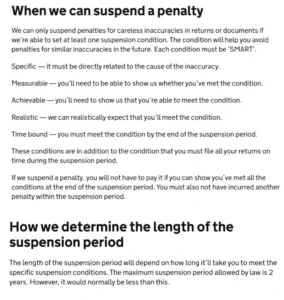
HMRC explains when careless-error penalties can be suspended and which conditions taxpayers must satisfy to have the penalties cancelled.
Can You Appeal Against an HMRC Careless Error Penalty?
Taxpayers can challenge an HMRC penalty where they believe the decision is incorrect or disproportionate.
A successful challenge may depend on demonstrating that reasonable care was taken, the behaviour was incorrectly classified, the potential lost revenue was miscalculated or the available reductions were not properly considered.
Appeals against applicable tax-penalty decisions must normally be made within 30 days of the decision notice.
The precise procedure depends on the tax and the notice received.
For a taxpayer challenging a careless-error assessment, the following evidence may be useful:
- Accounting records showing how the original figures were calculated.
- Correspondence with accountants or tax advisers.
- HMRC guidance considered before the return was submitted.
- Evidence of internal checking and approval procedures.
- Documentation explaining the circumstances surrounding the mistake.
- Records demonstrating prompt correction once the error was discovered.
A taxpayer can normally ask HMRC to reconsider an appealable decision or seek an independent tribunal determination, subject to the relevant procedures.
A reduction in the tax assessment can also change the potential lost revenue used to calculate the penalty.
For businesses, this makes it important to examine the underlying tax calculation rather than concentrating exclusively on the penalty percentage.
Do HMRC Careless Error Penalties Apply to Self Assessment, VAT and Corporation Tax?
The inaccuracy penalty regime covers several major UK taxes, including Income Tax, Corporation Tax and VAT, although the detailed rules and relevant periods must be considered.
Common situations differ according to the taxpayer’s activities.
| Tax category | Possible careless error | Potential consequence |
| Self Assessment | Omitting taxable freelance income | Additional Income Tax and possible penalty |
| Corporation Tax | Incorrectly claiming non-deductible expenditure | Additional Corporation Tax and possible penalty |
| VAT | Claiming input VAT incorrectly | VAT adjustment and possible penalty |
| PAYE | Reporting inaccurate payroll information | PAYE correction and possible penalty |
| Capital Gains Tax | Using an unsupported acquisition cost | Additional Capital Gains Tax and possible penalty |
The applicable penalties are not necessarily identical to late-filing penalties.
For example, submitting a Self Assessment return after the deadline can generate a separate late-filing penalty even if the information eventually submitted is accurate.
Conversely, a tax return submitted before the deadline may still attract an inaccuracy penalty where HMRC establishes careless behaviour.
The standard £100 late Self Assessment filing penalty should therefore not be confused with a percentage-based careless-error penalty.
Understanding HMRC’s late Self Assessment penalties is useful because both penalty regimes can affect the same taxpayer, but they arise from different compliance failures.
Can an Accountant Be Responsible for a Careless Tax Error?
Employing an accountant does not automatically transfer responsibility for an inaccurate tax return away from the taxpayer.
HMRC generally expects individuals and businesses to take reasonable steps to ensure the information submitted on their behalf is accurate.
However, using a competent professional can be relevant evidence when establishing whether reasonable care was taken.
Consider a company director who supplies accurate financial records to an accountant and asks for specialist advice on a complex tax issue.
If the accountant subsequently makes a technical error that the director could not reasonably have identified, those circumstances may support an argument that the director exercised reasonable care.
The position may be different where the director knowingly provides incomplete records or signs a return without checking obvious omissions.
Businesses should therefore establish clear responsibilities for preparing, reviewing and approving tax submissions.
Maintaining a record of professional advice and the information supplied to advisers can be particularly valuable during an HMRC compliance investigation.
How Can Businesses Prevent Careless Tax Errors?
Preventing inaccuracies is generally less expensive and less disruptive than correcting them following an HMRC investigation.
For small businesses, common weaknesses include inconsistent bookkeeping, poor expense classification and insufficient reconciliation of bank accounts.
A practical compliance system does not necessarily require expensive software.
It requires procedures appropriate to the size and complexity of the business.
Recommended measures include:
- Monthly reconciliations: Compare accounting balances with bank and payment records.
- Expense verification: Confirm that deductions satisfy relevant tax requirements.
- Income completeness: Check that all business revenue has been recorded.
- Tax-return reviews: Compare submitted figures with final accounting statements.
- Document retention: Maintain invoices, receipts and supporting calculations.
- Professional consultation: Obtain appropriate advice when transactions are unfamiliar or technically complex.
For qualifying sole traders and landlords, Making Tax Digital changes introduce additional requirements for digital record-keeping and periodic reporting.
Digital systems can help identify discrepancies earlier, but software does not remove the taxpayer’s obligation to review the information.
For example, an automated bookkeeping platform may classify a personal transaction as a business expense. Without appropriate review, that classification could produce an inaccurate tax calculation.
The strongest control is therefore a combination of accurate records, suitable software and meaningful human oversight.
What Happens if You Cannot Afford to Pay the Additional Tax and Penalty?
An HMRC compliance investigation can produce several financial obligations.
These may include the unpaid tax, interest and a separate inaccuracy penalty.
The amounts should be considered individually because they arise under different rules.
A business with limited cash reserves may find it difficult to settle the entire liability immediately.
HMRC may consider a payment arrangement based on the taxpayer’s financial circumstances and ability to pay.
For example, a sole trader who owes £8,000 in additional tax and penalties may need to demonstrate monthly income, essential expenditure and available cash before agreeing repayment terms.
An HMRC Time to Pay arrangement can help eligible taxpayers spread outstanding liabilities across agreed instalments.
However, an instalment arrangement does not automatically cancel penalties or stop interest from accruing.
Businesses should contact HMRC promptly if payment difficulties arise rather than ignoring assessment notices.
Where the penalty itself is disputed, the taxpayer should also observe any applicable appeal deadline.
How Far Back Can HMRC Investigate Careless Tax Errors?
HMRC’s ability to assess historical tax liabilities depends on the circumstances and the relevant statutory time limits.
For many common Income Tax and Capital Gains Tax situations, the general assessment periods are:
| Circumstances | General assessment period |
| Ordinary underassessment without carelessness or deliberate behaviour | 4 years |
| Loss of tax caused by careless behaviour | 6 years |
| Loss of tax caused by deliberate behaviour | 20 years |
These are general assessment periods, not universal deadlines for every type of tax investigation.
Different provisions may apply to offshore matters, particular tax regimes, statutory exceptions or other circumstances.
For example, an inaccurate 2021/22 Income Tax return may still be relevant to an investigation under the six-year careless-behaviour assessment rules, depending on the applicable facts and deadlines.
A taxpayer should not assume that an older tax year is automatically outside HMRC’s assessment powers.
It is also important to distinguish the time limit for assessing additional tax from the rules governing the assessment and enforcement of penalties.
The relevant tax year, behaviour and statutory provisions need to be examined before determining whether HMRC can pursue a historical liability.
FAQs About HMRC Careless Error Tax Penalties
What is the maximum HMRC penalty for a careless tax error?
The standard maximum penalty is 30% of the potential lost revenue. The final percentage depends on disclosure timing, cooperation and any applicable reductions or special rules.
Will HMRC fine me for making an honest mistake?
Not necessarily. If you took reasonable care but still made an error, HMRC should not charge an inaccuracy penalty. Additional tax and interest may nevertheless be payable.
Can HMRC reduce a careless error penalty to zero?
Yes. An unprompted disclosure of a careless inaccuracy can potentially result in a 0% penalty where the maximum available reduction is appropriate. This outcome is not guaranteed.
Can I appeal against an HMRC careless tax penalty?
Yes. You can challenge an appealable penalty decision if you believe HMRC incorrectly assessed your behaviour, tax liability or penalty amount. The normal appeal deadline is 30 days.
Does using an accountant protect me from HMRC penalties?
Not automatically. Taxpayers remain responsible for taking reasonable care, although appropriate reliance on a competent professional may help demonstrate that reasonable care was exercised.
Can HMRC suspend a careless error penalty?
Yes. HMRC may suspend qualifying careless-error penalties for up to two years where agreed conditions can prevent similar inaccuracies. Meeting the conditions can result in the penalty being cancelled.
Is a careless tax error the same as tax fraud?
No. Carelessness involves failing to take reasonable care, while deliberate inaccuracies involve knowingly submitting incorrect information. Fraud and deliberate tax misconduct can involve more serious consequences.
How far back can HMRC investigate careless errors?
For many common tax situations, HMRC can generally assess tax lost through carelessness for up to six years. Different periods can apply to ordinary errors, deliberate conduct and certain offshore matters.
What is your reaction?