
Do Charities Pay VAT in the UK? Rates, Exemptions and Reliefs Explained

Yes. Most UK charities must pay Value Added Tax (VAT) on everyday purchases, including office equipment, professional services, building maintenance and other standard-rated expenses.
However, certain charitable activities and purchases qualify for VAT relief at 0% or 5%, depending on their purpose and eligibility.
Being a registered charity does not automatically make an organisation VAT-exempt.
HM Revenue & Customs (HMRC) distinguishes between taxable business activities, exempt services and non-business charitable activities when determining how VAT applies.
As of November 2026, charities must register for VAT when their taxable turnover exceeds £90,000, although smaller organisations can register voluntarily if they make taxable supplies.
Understanding these distinctions can help charities reduce unnecessary expenditure, manage their finances and remain compliant with UK tax legislation.
Do Charities Have to Pay VAT on Their Purchases?
Charities generally pay VAT at the same rates as other organisations. Their charitable status only provides access to specific reliefs established under UK VAT legislation.
Most purchases attract the standard 20% rate unless the goods or services qualify for reduced or zero rating.
For example, a charity purchasing £5,000 of standard-rated office furniture would normally pay £1,000 in VAT, bringing its total expenditure to £6,000.
However, purchasing qualifying medical equipment or eligible advertising services may result in a 0% VAT charge.
The applicable rate depends on the nature of the purchase, its intended use and whether the charity meets the relevant conditions.
| VAT category | Rate | Typical charitable application |
| Standard rate | 20% | Office furniture, general repairs and professional services |
| Reduced rate | 5% | Qualifying gas, electricity and other fuel supplies, subject to temporary changes |
| Zero rate | 0% | Eligible advertising, specialist equipment and certain construction projects |
| VAT-exempt | No VAT charged | Certain welfare services and qualifying fundraising events |
| Outside the scope | VAT does not apply | Unconditional donations and grants without a supply in return |
An important financial distinction is that zero-rated and exempt activities are not treated identically.
Zero-rated sales remain taxable supplies, potentially allowing a VAT-registered charity to recover related input VAT. Exempt activities generally restrict VAT recovery.
The distinction also applies to other industries. For example, VAT on train tickets illustrates how zero-rated transactions differ from exempt supplies.
Which Goods and Services Are Zero-Rated for Charities?
UK charities can purchase certain goods and services at 0% VAT without necessarily being VAT-registered themselves.
However, the relief applies only where the statutory conditions are satisfied.
Advertising and Fundraising Materials
Eligible advertising services are among the most useful VAT reliefs available to charities.
Qualifying purchases can include:
- Advertisements placed in newspapers and magazines.
- Advertising on qualifying third-party websites and digital platforms.
- Public fundraising advertisements.
- Certain recruitment advertisements.
- Pre-printed donation envelopes and collection boxes.
- Eligible appeal letters and low-cost donation acknowledgement items.
Digital advertising requires particular attention. Not every social media campaign automatically qualifies for zero rating, especially where advertising is directed at particular individuals.
Charities should confirm the nature of the service with their advertising provider before assuming the expenditure is VAT-free.
Medical Equipment and Accessibility
Certain specialist purchases may qualify for zero rating where they are bought by eligible charities for qualifying purposes.
These include medical, veterinary and scientific equipment, together with qualifying aids for disabled people.
Other potentially eligible purchases include ambulances, lifeboats, rescue equipment and vehicles specially designed or adapted for disability-related use.
| Purchase category | Potential VAT rate | Important condition |
| Eligible public advertising | 0% | Must satisfy advertising relief conditions |
| Donation collection boxes | 0% | Must qualify as eligible collection materials |
| Medical and scientific equipment | 0% | Equipment, funding and intended use conditions apply |
| Disability-related equipment | 0% | Must meet the relevant disability relief requirements |
| Ambulances and rescue equipment | 0% | Specific vehicle or rescue-use criteria apply |
| New charitable buildings | 0% | Construction must meet strict relevant charitable purpose conditions |
| Ordinary office computers | Usually 20% | Charitable use alone does not create zero rating |
| General office repairs | Usually 20% | No blanket relief for charitable premises |
Construction projects require particularly careful assessment.
A charity building a new facility for qualifying non-business charitable use may obtain zero rating, but ordinary refurbishment, extensions or commercial premises do not automatically qualify.
This can make a substantial difference to project budgets.
For instance, on £200,000 of construction work that would otherwise be standard-rated, qualifying zero rating would avoid £40,000 in VAT.
This is an illustrative calculation, not an estimate of the relief available to every charitable building project.
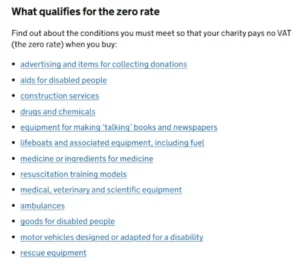
GOV.UK lists the goods and services that may qualify for VAT relief when purchased by eligible charities.
When Do Charities Pay 5% VAT on Gas and Electricity?
Charities can normally benefit from reduced VAT on qualifying fuel and power used for charitable non-business activities or eligible residential accommodation.
Examples include energy consumed by children’s homes, certain residential care facilities and buildings providing free charitable services.
The usual reduced rate is 5%, compared with the standard 20% rate.
However, an important temporary change applies in 2026 and 2027.
From 1 October 2026 to 30 June 2027, qualifying electricity supplies in England, Scotland and Wales attract 0% VAT. Qualifying electricity in Northern Ireland continues to attract the 5% reduced rate.
The temporary zero rate does not automatically extend to gas or other fuels.
| Energy supply | Great Britain, November 2026 | Northern Ireland |
| Electricity for qualifying charitable non-business use | 0% | 5% |
| Electricity for qualifying residential accommodation | 0% | 5% |
| Qualifying natural gas | 5% | 5% |
| Qualifying heating oil | 5% | 5% |
| Electricity for non-qualifying commercial activities | Generally 20% | Generally 20% |
Where at least 60% of a fuel or power supply is for qualifying use, the whole supply may receive the relevant relief. Where qualifying use is below 60%, the supplier generally apportions the bill.
For example, if 40% of a charity’s gas consumption relates to qualifying non-business activity and 60% supports commercial trading, the supplier may need to apply 5% to the qualifying portion and 20% to the remainder.
Small quantities of certain fuels may also qualify under separate rules.
Charities should check their energy bills to establish whether their supplier has applied the correct VAT treatment.
The detailed conditions are set out in HMRC’s fuel and power guidance.
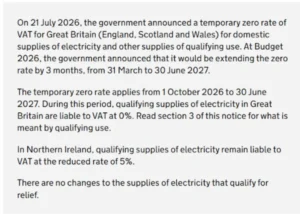
HMRC confirms the temporary 0% VAT rate for qualifying electricity in Great Britain until 30 June 2027, while qualifying supplies in Northern Ireland remain at 5%.
When Must a Charity Register for VAT?
A UK charity must register for VAT when its taxable turnover exceeds £90,000 over a rolling 12-month period.
Registration may also be necessary if the charity expects its taxable turnover to exceed the threshold in the next 30 days alone.
Importantly, the calculation is based on taxable business sales rather than total charitable income.
Calculating Taxable Turnover
Consider a charity receiving income from several different activities.
| Income source | Annual amount | Normally included in taxable turnover? |
| Unconditional public donations | £80,000 | No |
| Grants without a supply in return | £40,000 | No |
| Standard-rated merchandise sales | £45,000 | Yes |
| Zero-rated donated goods sales | £40,000 | Yes |
| Exempt welfare services | £30,000 | No |
| Total income | £235,000 | |
| VAT-taxable turnover | £85,000 |
Although the charity receives £235,000 annually, its VAT-taxable turnover is only £85,000 in this example.
Therefore, it would not automatically need compulsory registration based on those figures alone.
However, a further £6,000 of taxable sales during the relevant rolling period could push its taxable turnover above £90,000 and trigger registration.
The same principle applies to a charity operating a shop, providing paid training or conducting other trading activities.
Voluntary registration is possible below the threshold where the organisation makes taxable supplies, but it creates obligations as well as potential benefits.
These include submitting VAT returns, maintaining digital records and correctly accounting for VAT on taxable sales.
The wider financial implications of being VAT registered are particularly important for charities selling goods directly to consumers.
Charities whose activities are entirely non-business or exempt generally cannot register voluntarily simply to recover their costs.
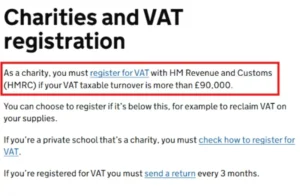
Official HMRC guidance confirms that charities must register for VAT when their taxable turnover exceeds £90,000.
Do Charities Charge VAT on Donations and Fundraising Income?
Not every payment received by a charity represents a taxable transaction.
The crucial question is whether the charity provides goods or services in exchange for the payment.
An unconditional donation where the contributor receives nothing in return is normally outside the scope of VAT.
However, payments for commercial services, sponsorship arrangements, tickets or merchandise may attract VAT depending on their classification.
| Charity income | Typical VAT treatment |
| Unconditional cash donation | Outside the scope |
| Gift Aid donation | Outside the scope |
| Grant with no direct supply in return | Outside the scope |
| Sale of eligible donated goods | Zero-rated |
| Sale of ordinary purchased merchandise | Normally standard-rated unless another relief applies |
| Qualifying charitable fundraising event | Exempt, subject to conditions |
| Corporate sponsorship with promotional benefits | Normally taxable |
| Qualifying welfare services | Exempt |
| Paid services provided commercially | Depends on the type of supply |
Fundraising event exemptions are subject to specific conditions.
Qualifying events must be organised primarily to raise funds and meet relevant restrictions, including the usual limit of 15 events of the same kind at one location during a financial year.
Corporate sponsorship is another area where charities can make costly mistakes.
A company giving £10,000 without receiving anything in exchange may be making a donation outside the scope of VAT. But if the charity agrees to provide advertising, promotional exposure or other benefits, the payment may represent consideration for a taxable supply.
Charitable donations can also involve other tax advantages, including Gift Aid and relief for donors. These are separate from the charity’s VAT position and should not be confused with VAT exemptions.
For broader context, philanthropy and tax reduction strategies highlight how charitable giving interacts with other UK tax rules.
Can Charities Reclaim VAT on Their Expenses?
A VAT-registered charity may recover VAT incurred on purchases used to make taxable business supplies.
However, registration does not entitle the organisation to recover every VAT charge included in its expenditure.
The recoverable amount depends on how the purchase is used.
For example, a charity might operate both a taxable retail activity and a free community support programme.
Purchases directly related to taxable retail operations may generate recoverable input VAT, while costs incurred solely for non-business activities generally do not.
Where a purchase supports multiple activities, an appropriate allocation may be required.
Illustrative VAT Recovery Calculation
Assume a charity incurs £6,000 of VAT on shared overheads.
Following a supportable business/non-business allocation, £3,600 relates to business activities and £2,400 relates to non-business activities.
If the charity’s business activities are entirely taxable and no other recovery restrictions apply:
| VAT calculation | Amount |
| Total VAT paid on overheads | £6,000 |
| Attributable to taxable business activities | £3,600 |
| Attributable to non-business activities | £2,400 |
| Potentially recoverable VAT | £3,600 |
| VAT recovery as a percentage of total | 60% |
This example illustrates the allocation process rather than a universal 60% recovery entitlement.
Charities conducting both taxable and exempt business activities may also need to apply partial exemption rules.
HMRC can request evidence supporting VAT recovery claims. Organisations should therefore retain purchase invoices, VAT records and documentation explaining how shared costs were allocated.
When HMRC requests further information, charities may need to provide supporting details for a VAT repayment claim.
How Can Charities Claim VAT Relief From Suppliers?
Most charity-specific VAT purchase reliefs are applied by the supplier when the transaction takes place.
A charity generally cannot simply declare all expenditure tax-free or assume that HMRC will reimburse VAT charged incorrectly.
For relevant reliefs, the charity should:
- Establish that the goods or services qualify under the VAT legislation.
- Obtain evidence of its charitable status.
- Prepare the appropriate eligibility declaration or certificate.
- Give the required documentation to the supplier.
- Check the VAT treatment on the invoice.
- Retain the records for future compliance checks.
Acceptable evidence of charitable status can include a Charity Commission registration number or an HMRC recognition letter, depending on the organisation.
Scottish and Northern Irish charities generally need HMRC recognition documentation for these purposes.
For certain zero-rated purchases, a written eligibility declaration is required. Construction relief certificates must follow the prescribed format.
These declarations should be separate from the purchase order or invoice.
Detailed eligibility requirements are available through the official VAT relief process for charities.
What VAT Changes Affect Charities in 2026?
The VAT treatment of business donations to charities changed on 1 April 2026.
Previously, VAT-registered businesses generally benefited from special treatment when donating goods to charities for onward sale. Other forms of business goods donations could create VAT liabilities for the donor.
The new relief extends favourable treatment to eligible business goods donated for distribution to people in need or for use in qualifying non-business charitable services.
This includes donations of practical equipment and everyday goods.
The rules contain per-item value restrictions.
| Type of donated goods | Value limit for the new relief |
| Most eligible goods | £100 per item |
| Specified essential goods, such as eligible furniture, computers and household appliances | £200 per item |
| Certain excise-duty goods | Excluded |
The main beneficiaries of this change are businesses donating the goods, because eligible donations no longer create the VAT charge that would otherwise arise under the relevant deemed-supply rules.
For charities, the advantage is indirect but significant: businesses may have a stronger financial incentive to donate usable surplus goods instead of disposing of them.
This could improve access to household equipment, technology and other resources for charitable programmes.
The rules require donor businesses to maintain appropriate records and confirm that recipients satisfy the charitable eligibility conditions.
The development forms part of the government’s wider changes to the VAT treatment of donations of goods to charities.
The practical importance of reducing unnecessary taxation has also been raised by charity sector representatives.
Richard Bray, Chair of the Charity Tax Group, stated in a published 2026 response:
“Our starting point is simple: funds given to charities should stay with charities”
His comments reflect wider concerns about how tax costs reduce the resources available for charitable activities, particularly when organisations face uncertainty about whether specialist VAT reliefs apply.
Which Specialist Charities Can Receive Additional VAT Refunds?
Some charitable organisations qualify for dedicated refund schemes that extend beyond ordinary input VAT recovery.
These provisions are particularly important where a charity provides essential services without charging beneficiaries.
Qualifying categories include:
- Palliative care charities.
- Air ambulance charities.
- Search and rescue charities.
- Medical courier charities.
Under the relevant statutory provisions, eligible organisations may recover certain VAT costs associated with their non-business charitable activities.
This may include qualifying expenditure on vehicles, operational equipment, building costs and other necessary services.
However, the existence of these schemes does not mean every medical or rescue charity can automatically reclaim all its VAT.
Eligibility, expenditure categories and claim procedures must satisfy the applicable regulations.
How Should Charities Account for VAT on Overseas Purchases?
Charities increasingly purchase software, online services, equipment and professional support from overseas suppliers.
International transactions can create VAT obligations even where a charity does not charge beneficiaries for its services.
For instance, purchasing consultancy services from an overseas business may involve the UK reverse charge mechanism, depending on the place of supply and whether the charity is acting as a business customer for VAT purposes.
Imported goods can also attract import VAT unless a specific relief applies.
Special exemptions may be available for eligible goods imported by charities for the benefit of people in need, subject to detailed conditions.
The distinction between domestic and international transactions matters because overseas purchases are governed by additional place-of-supply rules.
Charities dealing with international suppliers should therefore consider the relevant VAT rules for cross-border services before finalising their tax treatment.
What Are the Most Common VAT Mistakes Charities Should Avoid?
VAT compliance problems often arise when charities apply one general tax treatment to several fundamentally different activities.
The most important issues to check include:
- Assuming charitable status removes all VAT: Most ordinary purchases remain taxable.
- Ignoring zero-rated sales: These can count towards the £90,000 registration threshold.
- Treating sponsorship as a donation: Commercial benefits provided to a sponsor can make the transaction taxable.
- Reclaiming VAT on unrelated expenditure: Non-business activities normally restrict recovery.
- Overlooking energy relief: Qualifying electricity and fuel may attract lower rates.
- Applying charitable relief without documentation: Suppliers must receive appropriate eligibility evidence.
- Confusing exemptions with zero rating: The distinction can significantly affect input VAT recovery.
- Overlooking trading subsidiaries: A separate commercial company does not automatically receive the same reliefs as its parent charity.
For trustees and finance managers, the priority should be keeping clear records that distinguish trading income, exempt activities and non-business charitable services.
Periodic reviews of major purchases and income streams can also help identify incorrectly charged VAT before it becomes a substantial financial problem.
Conclusion
UK charities are not automatically exempt from VAT, but they can benefit from valuable tax reliefs when purchasing qualifying goods and services.
Most everyday expenses remain subject to the standard 20% rate, while eligible fuel, advertising, specialist equipment and construction projects may receive reduced or zero rates.
The £90,000 taxable turnover threshold determines compulsory VAT registration, although voluntary registration may suit some charities.
Recent changes to electricity VAT and business goods donations provide additional opportunities to reduce costs.
Ultimately, charities should understand their business activities, maintain accurate financial records and verify eligibility before applying VAT relief or submitting recovery claims.
Frequently Asked Questions
Do registered charities have to pay 20% VAT?
Yes. Registered charities normally pay 20% VAT on standard-rated goods and services unless a specific reduced-rate or zero-rate relief applies. Charitable status alone does not provide a general exemption.
Can charities claim back VAT without being VAT registered?
Most charities cannot reclaim ordinary input VAT without registration. However, certain specialist charities may qualify for dedicated statutory refund schemes, and purchase reliefs can apply without VAT registration.
Do charities pay VAT on electricity and gas?
Qualifying charitable gas supplies generally attract 5% VAT. From 1 October 2026 to 30 June 2027, qualifying electricity in Great Britain attracts 0%, while Northern Ireland continues applying 5%.
Is charity income subject to VAT?
Unconditional donations and grants without a supply in return are normally outside the scope of VAT. Income from selling goods, providing services or commercial sponsorship may be taxable depending on the circumstances.
What is the VAT registration threshold for charities in 2026?
The compulsory registration threshold is £90,000 of taxable turnover over a rolling 12-month period.
Zero-rated business sales count towards the threshold, but exempt income and genuine non-business donations generally do not.
Do charities pay VAT on building work?
Most repairs and maintenance attract 20% VAT. Certain new buildings used for qualifying charitable purposes and specific disability adaptations may qualify for zero rating when the relevant conditions are satisfied.
Do charity shops charge VAT on donated goods?
Eligible sales of donated goods by charities are generally zero-rated. However, goods bought specifically for resale may be subject to standard VAT rules unless another exemption or zero rate applies.
What is your reaction?