
State Pension Overtaxation HMRC Refunds: Who Can Get Money Back?

State Pension overtaxation has become an important issue for retirees because there are now two different refund situations that can easily be confused.
The first involves a historic HMRC calculation error affecting the taxable State Pension figures used for some taxpayers.
HMRC has confirmed that approximately 3.2 million customers are expected to receive repayments totalling around £19.3 million, with corrections covering tax years from 2020–21 onwards.
The second involves people who have paid too much Income Tax after withdrawing money from a private or workplace pension.
This commonly happens when an emergency Week 1/Month 1 tax code is applied to a flexible pension withdrawal.
The important distinction is simple: taxpayers affected by HMRC’s identified historic State Pension calculation problem generally do not need to submit a claim for years from 2020–21 onwards, while someone who has been overtaxed on a private pension withdrawal may need to actively reclaim the money.
Knowing which type of overtaxation applies is therefore the first step towards getting the correct refund.
Why Is HMRC Refunding People Over State Pension Overtaxation?
The State Pension is taxable income, but tax is not normally deducted directly from the State Pension payment itself.
Instead, HMRC takes the State Pension into account when working out someone’s overall Income Tax position.
Where a pensioner also receives employment income, a workplace pension or a private pension, HMRC may adjust the tax code attached to that other income.
People without another PAYE income source may instead receive a Simple Assessment, while taxpayers using Self Assessment normally account for taxable State Pension income through their tax return.
This arrangement means the annual State Pension figure held by HMRC needs to be accurate. If HMRC records too much State Pension income, the person’s calculated tax liability can also become too high.
HMRC confirmed in its September 2026 update that a historical error had affected taxable State Pension amounts used in certain tax calculations.
A system change was implemented on 25 August 2026, and HMRC said it would proactively correct recent years without requiring affected customers to claim individually.
| HMRC State Pension correction | Confirmed position |
| Estimated customers receiving repayments | Around 3.2 million |
| Estimated total repayments | Around £19.3 million |
| Automatic correction period | 2020–21 onwards |
| System correction implemented | 25 August 2026 |
| Main completion period | 2026–27 financial year |
| Possible repayment routes | PAYE adjustment, Self Assessment credit or other repayment method |
John-Paul Marks, HMRC’s Chief Executive and First Permanent Secretary, acknowledged the problem directly:
“I am sorry that this error occurred and recognise the impact on affected customers.”
HMRC expects the majority of corrections and repayments to be completed during the 2026–27 financial year, taking the programme broadly through to the end of March and 5 April 2027.
How Did the State Pension Calculation Error Cause Too Much Tax?
The problem centred on the annual taxable amount of State Pension being used in tax calculations.
The One-Week And 51-Week Calculation
Under the current official guidance on how State Pension is taxed, where the relevant rules apply to someone who started receiving their State Pension on or after 6 April 2010, a full year’s taxable pension is normally calculated using:
- One week at the pension rate applying before the April increase; and
- 51 weeks at the increased pension rate.
Some historic calculations instead used the higher rate for all 52 weeks.
That difference may look small on one person’s annual pension figure, but it can create an Income Tax overpayment when multiplied across millions of pensioners and several tax years.
A parliamentary answer previously explained that the difference in tax for an affected individual could be around £5 in many cases, although an individual’s actual repayment depends on their circumstances.
This is also why the £19.3 million correction programme should not be interpreted as a fixed refund that every State Pension recipient will receive.
Dividing £19.3 million across 3.2 million customers gives an implied average of only around £6, but some people may receive less, some more and many State Pension recipients will receive nothing because they were not affected.
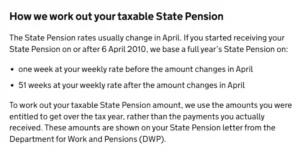
GOV.UK explains how HMRC calculates a full year of taxable State Pension using one week at the previous pension rate and 51 weeks at the new rate.
Who Could Be Entitled to an HMRC State Pension Tax Refund?
Eligibility depends on whether inaccurate pension information actually caused someone to pay more tax than they should have.
Potentially affected groups include pensioners whose tax was dealt with through:
- PAYE on a workplace or private pension;
- PAYE on employment income;
- P800 end-of-year reconciliation;
- Simple Assessment;
- Self Assessment; or
- historic tax calculations containing an incorrect State Pension amount.
Someone whose only income is the State Pension may have no Income Tax liability at all where their total taxable income remains within their available allowances.
The State Pension is nevertheless taxable income, which is an important distinction. Tax becomes due only when total taxable income exceeds the allowances available to the individual.
Pensioners considering how retirement income interacts with tax may also want to understand what happens if they defer their State Pension, because deferral can change the amount eventually received and therefore potentially affect the future tax position.
What Are the Main Causes of Pension Overtaxation?
State Pension calculation errors are only one reason a retired person may pay too much Income Tax.
The main situations can be separated as follows:
| Cause | How an overpayment can arise | Likely correction route |
| Incorrect State Pension figure | Tax calculated using excessive annual pension income | Automatic correction or HMRC review |
| Emergency pension tax code | One-off withdrawal treated as though it will repeat | P55, P50Z or P53Z |
| Wrong PAYE code | Too much tax deducted from another pension or earnings | PAYE adjustment or P800 |
| Self Assessment error | Incorrect pension or benefit figure included | Amend return or contact HMRC |
| Simple Assessment error | Tax demand based on incorrect income | Ask HMRC to correct assessment |
| Tax-free benefit included as taxable | Taxable income overstated | Correct underlying tax record |
| Small pension lump sum overtaxed | Excess PAYE taken from qualifying payment | P53 |
An emergency code can be particularly costly because the PAYE calculation may effectively treat a one-off pension payment as the first of a series of similar payments.
For example, a large taxable withdrawal made in one month may initially be assessed using only a proportion of the annual Personal Allowance and tax bands.
Anyone trying to understand this mechanism in more detail can see how emergency tax can affect a £1,000 payment.
The eventual tax liability should still be based on total taxable income for the complete tax year, which is why the initial deduction and final tax bill can be very different.
Can Tax-Free Benefits Accidentally Affect a Pensioner’s Tax Calculation?
Yes. Pensioners should also check whether benefits have been categorised correctly.
Not every government benefit is taxable.
For example, the current tax rules identify benefits including Attendance Allowance, Pension Credit, Personal Independence Payment and Universal Credit as generally exempt from Income Tax.
If a tax-free payment has incorrectly been included as taxable income alongside the State Pension or other retirement income, the total taxable-income figure could be overstated.
This is different from State Pension overtaxation itself, but the practical result may be similar: HMRC could calculate more Income Tax than is legally due.
People should therefore check the individual income components, rather than looking only at the final refund or tax-bill figure.
How Can You Check Whether HMRC Has Overtaxed Your Pension?
The most reliable approach is to compare what HMRC has recorded against the documents showing what you were actually entitled to receive.
Records Worth Checking
Useful records include:
- DWP State Pension entitlement and uprating letters;
- PAYE tax-code notices;
- P60 certificates from employers or pension providers;
- P45 documents;
- private pension withdrawal statements;
- Self Assessment calculations;
- P800 calculations;
- Simple Assessment notices; and
- HMRC Personal Tax Account information.
For State Pension income, do not simply total the bank deposits received during the year.
HMRC’s current rules explain that the taxable State Pension amount is generally based on the pension entitlement arising during the tax year, rather than solely on when individual payments reached the person’s account.
People who have lost employment paperwork may find it useful to understand the options for getting a copy of P45 information from HMRC before beginning a pension-tax review.
Which HMRC Pension Tax Refund Form Should You Use?
The pension withdrawal refund forms should not be confused with HMRC’s automatic State Pension correction exercise.
They primarily apply where too much Income Tax has been deducted from private pension or workplace pension payments.
Current HMRC guidance lists the following forms.
| Form | When it is generally used |
| P55 | You flexibly accessed part of a pension pot and money remains in the fund |
| P50Z | You flexibly accessed the whole pension pot after stopping work and have no other relevant taxable income apart from circumstances allowed by the form |
| P53Z | You flexibly accessed the whole pension pot and have other taxable income |
| P53 | You received a qualifying small pension lump sum |
| P50Z(DB) | Certain taxable pension death-benefit cases where the whole fund is taken and the relevant no-other-income conditions apply |
| P53Z(DB) | Certain whole-fund pension death-benefit payments where other taxable income exists |
| P55(DB) | Certain partial flexible pension death-benefit withdrawals |
HMRC now provides an official pension tax refund route finder and printable forms to help taxpayers identify the correct process.
Using the wrong form can slow down repayment, so the form should be selected according to how much of the pension was withdrawn and what other taxable income the individual expects to receive.
What Information Should You Prepare Before Claiming a Pension Tax Refund?
A refund application is easier to process when the figures are available before the claim is started.
Depending on the claim route, useful information can include:
- National Insurance number;
- P45 information, including Parts 2 and 3 where applicable;
- Gross pension withdrawal;
- Amount of Income Tax deducted;
- Pension provider details;
- Expected taxable income for the rest of the tax year;
- Other employment or pension income;
- Taxable state benefits;
- Bank account details for repayment; and
- Nominee details where an authorised repayment to a nominee is permitted.
The estimated annual income figure matters because HMRC needs to work out what the taxpayer’s final tax liability is likely to be, rather than simply refunding the difference between the gross pension payment and the amount received.
An incomplete income estimate could therefore result in the wrong repayment and another adjustment after the tax year ends.
How Long Do HMRC Pension Tax Refunds Take?
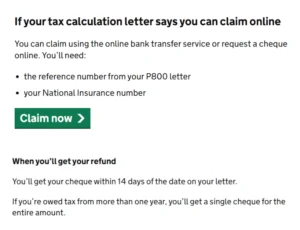
GOV.UK explains how taxpayers can claim an HMRC refund after receiving a P800 tax calculation and shows the expected repayment timescale.
There is no single timetable because the route depends on the type of overpayment.
| Refund route | Typical timetable or processing period |
| P55/P50Z/P53Z pension claim | HMRC guidance has stated refunds can be made within about 30 days of a correct claim |
| Online P800 refund claim | Normally within 5 working days once an eligible repayment is claimed |
| Annual PAYE reconciliation | Calculations generally processed between June and the end of November |
| Simple Assessment | Usually issued as part of the annual tax-calculation process |
| Historic State Pension correction | Majority expected during the 2026–27 financial year |
| Earlier State Pension cases before 2020–21 | Case-by-case HMRC review |
HMRC’s published guidance says P800 and Simple Assessment calculations are normally sent between June and the end of November following the tax year concerned.
Anyone waiting for annual reconciliation can also read more about when HMRC sends P800 tax calculations.
An eligible P800 refund requested digitally can normally reach a bank account considerably faster than a pension flexibility claim once the overpayment has already been calculated.
Will HMRC Automatically Refund State Pension Overtaxation?
It depends entirely on why the tax was overpaid.
For the specific historical State Pension calculation error HMRC has identified, taxpayers affected from 2020–21 onwards are being identified and corrected without having to submit an individual claim.
HMRC has said the correction may appear through:
- A PAYE coding adjustment;
- A Self Assessment account credit;
- A revised tax position; or
- Another payment method where required.
This means affected taxpayers should not necessarily expect a separate bank transfer labelled as a State Pension refund.
People who believe the same issue affected them before 2020–21 can ask HMRC to review their position if they have supporting evidence. HMRC has said those older cases will be considered individually.
Private pension emergency-tax refunds are different. Someone who wants that excess tax returned during the tax year may have to make an active claim rather than waiting for automatic end-of-year reconciliation.
What Should PAYE, P800, Simple Assessment and Self Assessment Pensioners Do?
Different tax systems require slightly different checks.
| Tax position | Main document to review | Practical action |
| PAYE pensioner | Tax code notice and pension P60 | Check State Pension deduction and estimated income |
| P800 recipient | P800 calculation | Compare pension figures and claim any confirmed refund |
| Simple Assessment | PA302 calculation | Check State Pension and other taxable income before paying |
| Self Assessment | Tax return and calculation | Check State Pension entitlement figure before filing |
| Flexible pension withdrawal | Pension statement/P45 | Check gross payment and tax deducted |
| Historic State Pension case | Previous tax calculations | Monitor correction or contact HMRC for older years |
P800 recipients should also verify that a repayment request is genuine before supplying financial information.
The process for checking whether a P800 refund is legitimate is particularly useful because tax-refund periods can attract phishing messages.
Receiving an official-looking message does not by itself establish that a refund request is genuine.
What Do the Latest HMRC Pension Refund Figures Show?
The scale of pension withdrawal overtaxation is substantially larger than the relatively small individual refunds arising from the State Pension calculation correction.
HMRC’s latest published pension flexibility figures show that between 1 July and 30 September 2026, it processed:
| Claim type | Claims processed |
| P55 | 13,383 |
| P53Z | 3,975 |
| P50Z | 915 |
| Total | 18,273 |
The total value repaid during that three-month period was £64,962,461.
These figures relate to pension flexibility tax repayments and should not be confused with the separate £19.3 million State Pension correction programme.
They demonstrate why emergency pension taxation remains financially significant.
A State Pension calculation error might produce a relatively small repayment for an individual, whereas emergency tax deducted from a large private pension withdrawal can potentially involve hundreds or thousands of pounds.
Former pensions minister and pensions specialist Steve Webb has repeatedly criticised the pension-withdrawal tax system. Discussing the requirement for pension savers to reclaim excess tax, he said:
“This is a system designed for the convenience of the tax office, not the taxpayer.”
His criticism highlights one of the central weaknesses of the current approach: the correct final tax may eventually be established, but taxpayers can temporarily lose access to money that was deducted unnecessarily.
Why Can an Emergency Tax Code Produce Such a Large Pension Overpayment?
PAYE normally works efficiently where someone receives regular monthly or weekly income.
A flexible pension withdrawal is different.
If the pension provider does not have an appropriate tax code, an emergency Week 1/Month 1 basis may be used for the first taxable payment.
This can effectively allocate only part of the annual Personal Allowance and tax bands to that payment.
As a result, a relatively large one-off pension withdrawal can initially appear to the PAYE system like the beginning of a much higher annual income.
The taxpayer might therefore see part of the withdrawal taxed at a higher rate even though their actual income across the complete tax year will be considerably lower.
HMRC’s internal PAYE guidance confirms that emergency Month 1/Week 1 treatment can be used in pension-flexibility cases and provides P50Z, P53Z and P55 as the principal in-year repayment routes for the corresponding circumstances.
What Should You Do If Your State Pension Error Predates 2020–21?
This is one of the most important limitations of HMRC’s automatic correction programme.
HMRC has said it can reliably identify and automatically correct cases from 2020–21 onwards using the data available to it.
That does not automatically mean an earlier overpayment is invalid.
A taxpayer who believes the same calculation problem affected an earlier year can ask HMRC to review the position, but they should be prepared to provide supporting evidence.
Useful evidence could include:
- State Pension entitlement letters;
- Historical tax calculations;
- Old P800 notices;
- Self Assessment returns;
- Pension P60s;
- Tax-code notices; and
- Correspondence showing the pension rates used.
HMRC has specifically stated that earlier cases will be considered case by case, so an older refund should not be treated as guaranteed.
How Can Pensioners Reduce the Risk of Being Overtaxed Again?
The most effective strategy is to monitor the underlying information before an incorrect figure turns into a completed tax calculation.
Pensioners can:
- Check tax-code notices when State Pension or private pension income changes;
- Compare HMRC’s estimated pension income with the amount actually expected;
- Check State Pension entitlement letters after an annual uprating;
- Inspect the first taxable withdrawal from a private pension carefully;
- Retain P45 and P60 documents;
- Check whether benefits included in a tax calculation are actually taxable;
- Review P800 and Simple Assessment figures before accepting them;
- Check pre-populated Self Assessment information rather than assuming it is correct; and
- Keep HMRC informed when pension income changes materially.
HMRC provides an online service allowing taxpayers to review estimated pension income where a change may be affecting their tax code.
The key principle is that automated information should still be checked against the taxpayer’s own records.
Conclusion
State Pension overtaxation is not one single refund problem.
Some pensioners are being corrected automatically because HMRC used inaccurate State Pension figures in historic tax calculations, while others must actively reclaim emergency tax deducted from flexible private pension withdrawals.
The safest approach is to identify which route applies, compare HMRC’s figures with pension and tax records, and act promptly where a claim is required.
Keep P45 documents, pension statements, tax-code notices and income estimates together.
For State Pension cases from 2020–21 onward, HMRC expects most corrections to be completed during the 2026–27 financial year, without affected customers submitting claims themselves.
FAQs
How do I know if HMRC owes me a State Pension tax refund?
Compare the State Pension income shown in your tax calculation with your actual annual entitlement and check previous PAYE, P800, Simple Assessment or Self Assessment records.
HMRC is automatically reviewing identified historic cases from 2020–21 onwards.
Do I need to claim part of the £19.3 million State Pension repayments?
Generally not if you are part of HMRC’s identified correction exercise covering 2020–21 onwards. HMRC says it will identify affected customers and correct their tax positions automatically.
Which form should I use if I only withdrew part of my private pension?
P55 is generally the relevant route where you flexibly accessed part of the pension pot, funds remain and the applicable conditions are satisfied. Do not use P55 simply because you receive the State Pension.
How long can an HMRC pension tax refund take?
A correct pension flexibility claim has historically been targeted for repayment within around 30 days.
If HMRC identifies an overpayment through a P800 and allows an online claim, digital repayments are normally considerably faster.
Can HMRC tax my State Pension directly before paying it?
The State Pension is taxable, but Income Tax is not normally deducted before the payment reaches you. HMRC usually accounts for the tax through another PAYE source, Self Assessment or Simple Assessment.
What happens if my State Pension tax error was before 2020–21?
You can ask HMRC to review an earlier year if you have evidence showing that the taxable State Pension figure was incorrect. HMRC has said these older cases will be considered individually rather than corrected automatically.
Can a tax-free benefit create an incorrect HMRC pension calculation?
Potentially, yes. If a benefit that should be exempt from Income Tax has incorrectly been included in taxable income, it can distort the overall calculation and should be queried with HMRC.
What is your reaction?