
HMRC AI Chatbot Tax Rules: Can HMRC Access Your ChatGPT Conversations Under New Tax Laws?

HM Revenue and Customs (HMRC) is preparing to expand its powers to examine digital tax records, potentially allowing investigators to request relevant conversations and calculations created using artificial intelligence (AI) chatbots such as ChatGPT, Claude and Microsoft Copilot.
The proposed HMRC AI chatbot tax rules have raised concerns among taxpayers, accountants and business owners who increasingly rely on AI tools to calculate expenses, interpret tax legislation and prepare financial returns.
Under the government’s plans, HMRC could obtain a clearer picture of how taxpayers arrive at financial figures, including information generated through automated accounting systems and AI-powered software.
However, HMRC has not been given unrestricted access to people’s private AI conversations. The proposals concern information relevant to existing lawful tax investigations, rather than general surveillance of chatbot users.
We analysed the government’s draft legislation, HMRC’s official AI software guidance and published commentary from tax and legal professionals to examine what these changes mean for UK businesses and individual taxpayers.
What Are the New HMRC AI Chatbot Tax Rules?
The government proposes to modernise the legislation governing HMRC’s access to digital financial records, including information stored or processed by AI-powered systems.
The proposals focus on two existing provisions of the Finance Act 2008:
- Schedule 36: Gives HMRC powers to obtain information and documents reasonably required to check a taxpayer’s tax position, subject to statutory safeguards.
- Section 114: Deals with documents and computer records, including how information held in electronic form can be accessed and examined.
The reforms would broaden the language used in Section 114 to reflect modern digital technology.
This is particularly relevant because financial information is no longer stored exclusively in traditional accounting systems. Businesses now use cloud platforms, automated bookkeeping software and generative AI tools to process financial information.
Under the proposed changes, HMRC may be able to examine information explaining how relevant tax calculations were produced, even where those calculations involved automated software.
| HMRC AI tax rules | Current position and proposals |
| Access to AI chatbot conversations | Potentially possible where records are relevant to a lawful tax enquiry |
| Routine monitoring of private AI chats | Not authorised by the proposals |
| Access to automated tax calculations | Existing powers would be clarified and modernised |
| Requests to third-party software providers | Relevant records may be requested using lawful information powers |
| Taxpayer responsibility | Individuals and businesses remain responsible for accurate returns |
| Initial failure-to-comply penalty | £300 under the existing Schedule 36 regime |
| Legislative status | Proposed changes, not yet operative |
| Expected commencement | Upon Royal Assent to Finance Bill 2026–27, subject to enactment |
The government published draft legislation on 13 July 2026 and updated the accompanying policy material on 3 November 2026.
According to the official HMRC information powers reform policy, the purpose is to ensure that tax investigators can obtain relevant information in increasingly digital business environments.
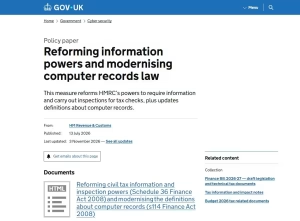
HMRC’s official GOV.UK policy page outlining proposed reforms to digital information and computer records, last updated on 3 November 2026. Capture the policy title, publication date and documents section.
Can HMRC Access Your ChatGPT or Other AI Chatbot History?

HMRC could potentially request relevant AI chatbot records during a lawful tax investigation, but this does not mean investigators can automatically read an individual’s entire conversation history.
The distinction is important.
AI conversations may contain financial calculations, expense classifications, tax planning discussions and explanations of business transactions.
For example, a self-employed taxpayer might upload transaction data into an AI chatbot and ask it to calculate annual deductible expenses.
If HMRC subsequently investigates the taxpayer’s return, the calculations and supporting information generated by the software may become relevant to establishing whether the reported figures were accurate.
Nevertheless, the proposed legislation does not specifically identify ChatGPT or create an unrestricted power to search personal AI accounts.
Matthew Holman, a partner at law firm Cripps, explained in comments published by City AM on 11 November 2026 that the proposed legislation expands the definitions used by existing information powers.
His analysis suggests that AI-generated records could fall within the broader wording, even though chatbot histories are not expressly mentioned in the draft legislation.
This introduces an important question for taxpayers: whether an AI conversation was simply used to understand general tax rules or formed part of the records supporting a submitted tax calculation.
Which AI conversations could become relevant?
| AI chatbot activity | Potential relevance to HMRC |
| Asking ChatGPT about the personal allowance | Usually general educational activity |
| Calculating business expenses using AI | Potentially relevant if used to prepare a tax return |
| Uploading invoices for automated tax calculations | Potentially relevant financial working records |
| Asking Claude about VAT registration | General guidance unless linked to a particular tax position |
| Using Copilot to prepare corporation tax computations | Potentially relevant where calculations support a return |
| Discussing unrelated personal matters | Not automatically relevant to a tax enquiry |
| Generating hypothetical tax avoidance scenarios | Context-dependent; a hypothetical discussion is not itself proof of wrongdoing |
These examples illustrate possible relevance rather than automatic disclosure obligations.
HMRC must still establish the legal basis for requesting information.
How Could HMRC Obtain AI Chatbot Records During an Investigation?
HMRC already has statutory powers to request financial information where it is reasonably required to check a person’s tax position.
A common mechanism is an information notice issued under Schedule 36 of the Finance Act 2008.
Depending on the circumstances and statutory conditions, an information notice can require a taxpayer or third party to provide specified documents or information.
The proposed Section 114 amendments would clarify how these existing mechanisms apply to modern digital systems.
Consider a business that uses cloud accounting software with an integrated AI assistant.
The software could automatically categorise transactions, suggest deductible expenses and generate financial reports.
If HMRC investigates an unexplained discrepancy, it may need more than the final figure appearing in the submitted return.
It could seek relevant supporting data explaining how the calculation was produced.
The government also recognises that relevant financial information may be stored by software providers and other intermediaries rather than directly by taxpayers.
This creates the possibility of requests involving third-party technology businesses.
However, there is an important limitation: the proposed changes do not create a new standalone information-gathering power.
HMRC must continue to rely on an existing lawful basis and comply with relevant statutory safeguards.
A request to a software provider is also not the same as gaining direct technical access to every conversation stored on its platform. The provider’s records, legal obligations and ability to supply the requested information would matter.
When Will the New HMRC AI Chatbot Rules Come Into Force?
As of 12 November 2026, the proposed changes to digital information powers have not yet taken effect.
The government intends to introduce them through Finance Bill 2026–27.
Its updated policy states that the measure will become operative on Royal Assent to that legislation.
Some November 2026 news reports have discussed possible commencement dates in spring 2027, including March or May.
However, the official policy does not establish a fixed calendar date. The operative date is linked to Royal Assent, and the proposals remain subject to the parliamentary process.
The distinction matters because current HMRC information powers already exist, whereas the proposed modernised definitions are not yet in force.
The following timetable summarises the position.
| Date | Development |
| 28 January 2026 | HMRC publishes guidance on generative AI in commercial tax software |
| 13 July 2026 | Government publishes draft legislation to modernise digital information powers |
| 7 September 2026 | Technical consultation deadline |
| 28 October 2026 | Budget 2026 confirms plans to legislate through Finance Bill 2026–27 |
| 3 November 2026 | HMRC updates information-powers reform policy |
| 11 November 2026 | National news reports highlight potential access to AI tax conversations |
| 2027, subject to legislation | Changes expected to take effect upon Royal Assent |
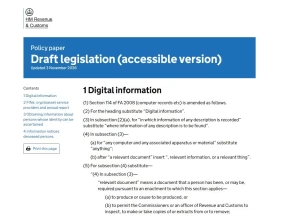
The ‘Digital information’ section of HMRC’s draft legislation showing proposed amendments to Section 114 of the Finance Act 2008. Open ‘Draft legislation (accessible version)’ from the official policy page and capture Section 1.
Why Is HMRC Expanding Its Powers Over Digital Tax Records?
The proposed changes reflect the growing importance of automated technology in accounting and tax reporting.
Businesses increasingly depend on software to prepare invoices, maintain records, reconcile payments and calculate tax liabilities.
AI introduces additional capabilities, but it also creates new questions about transparency and accountability.
For example, traditional accounting software generally uses defined rules to calculate figures.
Generative AI systems may interpret information and produce suggested calculations using probabilistic models.
This creates a risk that a plausible-looking calculation could be wrong.
From HMRC’s perspective, examining the process behind a tax figure can be important when determining whether a submitted return accurately reflects the underlying financial transactions.
Seb Maley, chief executive of tax insurance provider Qdos, highlighted this issue in comments reported by The Independent on 11 November 2026.
He explained that growing reliance on AI makes it important for taxpayers to understand how automated calculations are produced and why they should use trustworthy technology and qualified advisers.
Crucially, Maley emphasised that AI does not remove responsibility from the taxpayer or business for its tax obligations.
For businesses, the implication is that automated accounting should remain auditable.
A calculation supported by invoices, transaction records and a clear methodology is easier to verify than a figure copied from an AI response without supporting evidence.
How Could the HMRC AI Rules Affect Small Businesses and Self-Employed Workers?

Small businesses and self-employed professionals could face particular challenges because they often combine low-cost digital tools with limited access to specialist tax advice.
Many sole traders use AI to understand allowable expenses, estimate taxable profits, prepare invoices or organise bookkeeping.
Although these activities can improve efficiency, they also introduce risks where AI-generated information is accepted without checking the relevant tax rules.
For example, a freelancer might ask ChatGPT to categorise £20,000 of annual business expenses.
If the chatbot incorrectly classifies £2,000 of personal expenditure as allowable business costs, the resulting expense calculation would be overstated by 10%.
That percentage is an illustrative calculation, not an estimate of typical AI error rates.
The tax consequences would depend on the freelancer’s actual circumstances, including the nature of the expenditure and the applicable tax rules.
Businesses adopting digital record-keeping should also understand the requirements of HMRC Making Tax Digital, which increasingly connects tax reporting with compatible accounting software.
Making Tax Digital and the proposed AI information-powers reforms are separate measures.
However, together they demonstrate the importance of maintaining reliable digital financial records.
How could company directors be affected?
Company directors may use AI to evaluate salary and dividend combinations, analyse business expenses or model corporation tax liabilities.
Those calculations can have financial consequences if the software relies on outdated allowances, applies incorrect accounting assumptions or fails to recognise important legal distinctions.
An AI-generated explanation should therefore be treated as preliminary assistance rather than a definitive tax opinion.
Directors should ensure that the underlying evidence for tax decisions is available independently of the chatbot that helped produce them.
Companies that use automated expense or invoice processing should also establish appropriate internal controls and approval procedures.
Could HMRC Fine Taxpayers for Using AI Chatbots?
No. There is no general HMRC penalty simply for asking an AI chatbot about tax.
The penalties discussed in recent news coverage concern failures to comply with statutory requirements, not ordinary use of artificial intelligence.
Under existing Schedule 36 provisions, failure to comply with a valid information notice without a reasonable excuse may result in an initial penalty of £300.
If non-compliance continues, further daily penalties of up to £60 may apply under the standard regime.
Other penalties and enforcement mechanisms can apply in particular circumstances.
Some media reports have also referred to penalties of up to £3,000 in connection with tax inaccuracies.
That figure should not be confused with the standard £300 information-notice penalty or described as an automatic consequence of failing to provide chatbot history.
Tax inaccuracies are dealt with under their applicable statutory penalty regimes, which depend on the type of error, taxpayer behaviour and other circumstances.
The government has separately announced reforms requiring taxpayers to correct identified inaccuracies.
Those correction-of-errors reforms are scheduled to take effect from 1 April 2028, subject to legislation.
For taxpayers completing a Self Assessment tax return, the priority remains accuracy, appropriate evidence and compliance with filing obligations.
What Does HMRC Say About Using AI for Tax Calculations?
HMRC has already issued guidance explaining how generative AI should be used in commercial software products that help customers prepare or submit tax information.
Published on 28 January 2026, the guidance recognises that AI can improve tax administration while identifying important risks involving inaccurate outputs, privacy and overreliance on automation.
It sets out five central expectations.
| HMRC expectation | What it means for AI tax software |
| Transparency | Users should know when AI is involved and understand its limitations |
| Reliable information | Calculations should be based on dependable tax legislation, guidance and case law |
| Human oversight | Users should be able to review and correct AI-generated information |
| Data protection | Sensitive personal and financial information should be handled securely |
| Ethical development | Software should operate responsibly and include appropriate accountability |
These are HMRC’s expectations for software developers, not a blanket prohibition on individuals using general-purpose chatbots.
The official HMRC generative AI software guidance specifically recognises the potential for AI systems to produce convincing but inaccurate information.
Such errors are often described as AI hallucinations.
For example, a chatbot might provide an outdated tax threshold, invent a relief that does not exist or incorrectly apply a legitimate allowance to a taxpayer’s circumstances.
The quality of the response depends on the source information, the model’s limitations and the complexity of the question.
HMRC consequently expects software products to incorporate human review rather than substitute automated outputs for professional judgment.
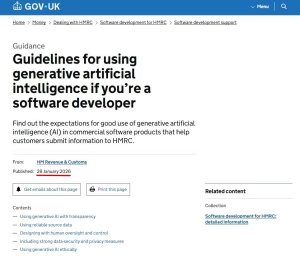
HMRC’s official guidance for software developers using generative artificial intelligence, published on 28 January 2026. Capture the section listing transparency, reliable source data, human oversight, data security and ethical requirements.
What Privacy Rights Will Taxpayers Have Under the Proposed Rules?
Privacy is one of the most significant issues arising from the potential disclosure of AI chatbot conversations.
A taxpayer may use the same AI account for financial matters, professional correspondence and unrelated personal questions.
A request for relevant tax information therefore raises questions about how private material should be distinguished from records genuinely needed for a tax investigation.
Nicola Cain, chief executive and principal consultant at legal consultancy Handley Gill, discussed the data protection implications in comments published by City AM.
Cain explained that even where legislation provides a lawful basis for requesting information, HMRC must continue to meet applicable legal requirements, including necessity and proportionality.
This is an important safeguard because the proposed changes do not mean every digital record becomes automatically disclosable.
Certain information may also benefit from legal professional privilege.
This protection can apply to qualifying confidential communications between a client and a legal professional.
An ordinary conversation with a general-purpose AI chatbot does not automatically acquire legal professional privilege simply because it concerns a legal or tax issue.
Whether particular material is protected depends on the relevant legal circumstances.
Taxpayers who believe an information notice seeks legally privileged, irrelevant or otherwise protected material should obtain appropriate legal advice.
They should not assume that a broad request removes existing statutory protections.
Can Taxpayers Challenge an HMRC Request for AI Chat Records?
Depending on the nature of an information notice and the statutory rules applying to it, a taxpayer may have grounds to appeal or challenge particular requirements.
For example, a request could raise questions where the information is not reasonably required to establish a tax position.
However, appeal rights are not identical for every information notice.
Certain requirements relating to statutory records and notices approved by a tribunal are subject to restrictions on appeal.
Taxpayers should examine the notice carefully and obtain professional advice where necessary.
Ignoring an HMRC information notice is generally not an appropriate way to challenge it and can expose the recipient to penalties.
A taxpayer responding to a notice should identify what information is requested, check the legal and factual basis, establish whether the records are available and seek clarification promptly if the request appears excessive.
Where an appeal is available, the relevant deadline must also be observed.
How Should Businesses Prepare for HMRC’s AI Tax Rules?
Businesses do not need to abandon AI tools because of the proposed reforms.
Instead, they should review how AI contributes to financial reporting and establish controls over information quality, access and retention.
We recommend six practical measures.
- Keep original financial records. Retain invoices, receipts, bank statements and supporting documents rather than relying exclusively on AI-generated summaries.
- Check every material AI-generated tax calculation. Verify tax treatments against current legislation and reliable professional advice, particularly where expenses, reliefs or complex transactions are involved.
- Separate business and personal information. Use appropriately managed business systems for financial workflows and avoid mixing unrelated sensitive information into the same records.
- Review software privacy and retention policies. Understand what information an AI provider stores, who can access it, where it is processed and whether it can be exported.
- Maintain a clear audit trail. Record the source data, significant assumptions, calculations and human approvals supporting tax submissions.
- Establish an HMRC enquiry procedure. Decide who will review information notices, preserve relevant records, engage with advisers and coordinate lawful disclosure.
Businesses should also avoid deleting records that they are legally required to retain or that are subject to an existing information-preservation obligation.
These controls can help limit errors and unnecessary disclosure while improving the quality of financial reporting.
Could AI Conversations Be Used as Evidence of Tax Evasion?
AI-generated conversations could potentially become evidential material in a tax investigation if they contain relevant information about a taxpayer’s conduct or financial arrangements.
However, an AI conversation discussing a hypothetical tax scenario is not, by itself, evidence that someone has committed tax evasion.
Context matters.
Matthew Holman of Cripps has warned about the possibility of AI conversations containing statements that could later be interpreted as evidence of a taxpayer’s intentions.
He also highlighted the unpredictable nature of chatbot responses, including the possibility that an AI system might suggest an unlawful arrangement.
This creates a distinction between asking a question, considering a hypothetical transaction and deliberately implementing an unlawful tax arrangement.
Investigators would still need to assess the relevant facts, legal requirements and evidence.
A taxpayer who discovers an error caused by incorrect AI advice should address it promptly and seek professional guidance on the appropriate correction.
In serious cases involving deliberate non-compliance, HMRC’s enforcement framework can create substantial financial and reputational consequences.
These may include penalties and, where the statutory conditions are satisfied, publication under the HMRC deliberate tax defaulters regime.
Nevertheless, using AI for a legitimate tax question should not be confused with tax evasion.
Is HMRC Also Using Artificial Intelligence to Detect Tax Fraud?
Yes. HMRC has been expanding its own use of AI and data analytics to support tax administration and compliance activities.
This is separate from the proposed rules concerning access to information created by taxpayers using AI.
HMRC’s technology strategy includes using advanced analytical tools to identify patterns, improve risk assessment and support investigations.
The authority has also worked with private technology providers to modernise its approach to financial data analysis.
For example, the HMRC Quantexa technology partnership reflects the wider development of AI-assisted tax compliance systems.
This illustrates two distinct developments.
HMRC is using technology to improve how it processes and assesses information, while also proposing to modernise the statutory framework for obtaining relevant records from increasingly digital businesses.
The two developments should not be treated as evidence that HMRC currently monitors every private AI conversation.
Will the HMRC AI Chatbot Tax Rules Change How Businesses Use AI in 2027?
The immediate practical effect is likely to be greater attention to how AI-generated tax information is documented and verified.
For tax software developers, the proposed amendments create additional reasons to design systems with clear audit trails and transparent calculation processes.
For accountants and tax advisers, they reinforce the importance of checking automated outputs before relying on them in client filings.
For small businesses, the main lesson is that AI can support administration but cannot replace responsibility for the accuracy of tax submissions.
The reforms may also lead software providers to strengthen information-export functions, record management and audit capabilities, although specific product changes have not been mandated by the draft legislation.
The final scope will depend on the legislation enacted and subsequent operational guidance.
FAQs About HMRC AI Chatbot Tax Rules
Can HMRC Access My ChatGPT Conversations?
HMRC cannot automatically access private ChatGPT conversations. However, relevant AI-generated tax records may be requested during a lawful tax investigation.
What Are the New HMRC AI Chatbot Tax Rules?
The proposed rules would modernise HMRC’s powers to obtain digital tax records, potentially including relevant information generated through AI chatbots and accounting software.
When Will HMRC AI Chatbot Tax Rules Start?
The changes are expected in 2027, subject to legislation. They are intended to take effect when Finance Bill 2026–27 receives Royal Assent.
Can HMRC Fine Taxpayers for Using ChatGPT?
No. Using ChatGPT for tax advice is not an offence. However, submitting inaccurate tax returns or failing to comply with lawful HMRC information notices can result in penalties.
Can HMRC Access Deleted AI Chatbot Conversations?
Potentially, if relevant records still exist with a service provider and can lawfully be obtained. Deleting a chat does not necessarily erase all retained copies.
Is It Legal to Use AI for Tax Returns in the UK?
Yes. Taxpayers and accountants can use AI to assist with tax preparation, but they remain responsible for checking calculations and submitting accurate information.
Can Hmrc Request AI Records From Businesses?
Yes, relevant digital records may be requested under existing lawful information powers. Proposed reforms would clarify how those powers apply to modern technologies.
What is your reaction?