
How Much National Insurance Do I Pay? UK Rates, Thresholds and Salary Examples

For the 2026/27 tax year, most employees pay 8% National Insurance on earnings between £242 and £967 a week, or £1,048 to £4,189 a month.
Earnings above £967 a week are normally charged at 2%. You do not normally pay employee National Insurance on earnings below the £242 weekly Primary Threshold.
The amount you actually pay depends on how much you earn, whether you are employed or self-employed, your National Insurance category and, for employees, how much you earn within each pay period.
National Insurance is separate from Income Tax. Your PAYE tax code affects Income Tax rather than the rate of employee National Insurance.
If deductions on a payslip appear unusual, it can therefore help to first establish whether your tax code is correct and then check the NI calculation separately.
Last Updated: 3 November 2026
National Insurance Rates And Thresholds For 2026/27
Employees generally pay Class 1 National Insurance.
For a standard Category A employee, the main thresholds for the tax year running from 6 April 2026 to 5 April 2027 are:
| Earnings Band | Weekly | Monthly | Annual | Employee NI Rate |
| Below Lower Earnings Limit | Below £129 | Below £559 | Below £6,708 | No Contribution |
| Lower Earnings Limit To Primary Threshold | £129–£242 | £559–£1,048 | £6,708–£12,570 | 0% |
| Primary Threshold To Upper Earnings Limit | £242.01–£967 | £1,048.01–£4,189 | £12,570–£50,270 | 8% |
| Above Upper Earnings Limit | Above £967 | Above £4,189 | Above £50,270 | 2% |
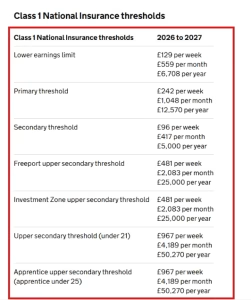
The Lower Earnings Limit is important because an employee earning between £129 and £242 a week normally pays no employee NI but may still receive the benefit of contributions for their National Insurance record.
Official HMRC rates showing the 2026/27 Lower Earnings Limit, Primary Threshold, Upper Earnings Limit and Class 1 National Insurance rates.
On What Basis Is National Insurance Calculated?
National Insurance is not calculated in exactly the same way for everyone. The main factors are:
- Employment Status: Employees generally pay Class 1 NI, while self-employed people may have Class 4 liability and can pay voluntary Class 2 in some circumstances.
- Earnings Or Profits: Employees are assessed using employment earnings, while Class 4 for the self-employed is calculated from taxable profits.
- Pay Period: Employee NI is normally calculated according to earnings in each relevant pay period, such as weekly or monthly.
- NI Category: An employee’s National Insurance category letter can affect the rate applied.
- Applicable Thresholds: Only earnings or profits falling into the relevant contribution bands are charged at the corresponding rate.
HMRC’s employee NI calculator asks for the pay period, payment date, gross pay and National Insurance category letter because those factors affect the calculation.
This also means National Insurance and Income Tax should not be treated as the same calculation.
A person can have a change to their Income Tax deduction without the same change applying to their NI.
How To Calculate National Insurance?
For a standard employee earning no more than £50,270 a year on a regular salary, a simple annualised estimate can be made by taking the amount above £12,570 and applying the 8% rate.
For example, someone earning £30,000:
£30,000 − £12,570 = £17,430
£17,430 × 8% = £1,394.40
Their estimated employee National Insurance would therefore be about £1,394.40 a year, or approximately £116.20 a month when shown as a simple annual average.
Once earnings exceed £50,270, the portion above that level is normally charged at 2% rather than 8%.
Actual payroll deductions can differ slightly from a simple annual calculation because employee NI is generally calculated within individual pay periods.
Bonuses, overtime and irregular earnings can therefore affect the deduction shown on a particular payslip.
For comparison, the take-home calculation for someone earning £14 per hour in the UK shows how Income Tax and National Insurance combine to reduce gross salary to net pay.
How Much National Insurance Do You Pay At Different Salaries?
The following estimates assume a standard Category A employee with regular earnings throughout 2026/27.
| Annual Salary | Estimated Employee NI Per Year | Average Per Month |
| £20,000 | £594.40 | £49.53 |
| £30,000 | £1,394.40 | £116.20 |
| £40,000 | £2,194.40 | £182.87 |
| £50,000 | £2,994.40 | £249.53 |
| £60,000 | £3,210.60 | £267.55 |
| £100,000 | £4,010.60 | £334.22 |
These figures are annualised estimates rather than guaranteed payslip deductions.
They do not account for unusual NI categories, salary sacrifice arrangements or irregular pay.
A higher salary does not mean your entire earnings are charged at the highest NI rate.
Only the part falling within each band receives the applicable percentage.
For example, someone earning £60,000 does not pay 2% on the full £60,000. They normally pay 8% on earnings between £12,570 and £50,270 and 2% on the portion above £50,270.
How Much National Insurance Do Self-Employed People Pay?
The system works differently for the self-employed because contributions are generally based on profits rather than a salary.
For 2026/27:
| Annual Self-Employed Profit | National Insurance Position |
| Below £7,105 | No compulsory Class 2 payment, although voluntary Class 2 may be available |
| £7,105 Or More | Class 2 is treated as paid to protect the NI record |
| Above £12,570 To £50,270 | Class 4 charged at 6% |
| Above £50,270 | Class 4 charged at 2% on profits above this level |
The voluntary Class 2 rate is £3.65 a week for 2026/27.
Someone with profits of at least £7,105 normally has Class 2 treated as paid without needing to make the contribution themselves.
For example, someone with £30,000 of self-employed profits would have £17,430 above the £12,570 Lower Profits Limit.
Applying the 6% Class 4 rate gives an estimated Class 4 contribution of:
£17,430 × 6% = £1,045.80
Most Class 4 contributions are dealt with through Self Assessment.
Employee Vs Employer National Insurance
Employee National Insurance and employer National Insurance are separate liabilities.
For 2026/27, the standard employer Class 1 Secondary Threshold is £96 a week, £417 a month or £5,000 a year. The standard employer rate above the threshold is 15%.
| NI Type | Usually Paid By | Main 2026/27 Rate |
| Employee Class 1 | Employee | 8% then 2% |
| Employer Class 1 | Employer | 15% above the standard threshold |
| Self-Employed Class 4 | Self-Employed Person | 6% then 2% |
| Voluntary Class 2 | Eligible Self-Employed Person | £3.65 Per Week |
| Voluntary Class 3 | Individual Filling Eligible NI Gaps | £18.40 Per Week |
Employer NI is an additional employment cost. It is not normally taken out of the employee’s net salary.
Voluntary contributions also have a different purpose.
Class 3 contributions, for example, can be used in eligible circumstances to fill gaps in a National Insurance record and cost £18.40 a week in 2026/27.
How Different Circumstances Affect National Insurance?
Your NI deduction can change even when your basic salary remains the same.
Two Jobs
If you work for more than one employer, National Insurance is generally considered separately for each employment.
Some higher earners with more than one job may qualify to defer part of their contributions.
Bonuses and Overtime
Bonuses and overtime can increase the earnings included in a particular pay period.
Because employee NI is normally calculated by pay period, a large one-off payment can produce a noticeably higher NI deduction for that week or month.
Irregular Earnings
Someone who works seasonal shifts or has changing hours may pay NI in some periods but nothing in others.
Employed and Self-Employed
If you have a job and run a business at the same time, your employer may deduct Class 1 NI from your wages while Class 4 can also become due on qualifying self-employed profits.
HMRC considers the relevant position after the Self Assessment return is filed.
Company Directors
Limited company directors can be employees of their own companies and can pay Class 1 National Insurance through PAYE.
Directors have specific NI calculation rules, so their contribution pattern can differ from that of an ordinary employee.
When Do You Stop Paying National Insurance?
Employees normally stop paying Class 1 employee National Insurance once they reach State Pension age.
Their employer may still have to pay employer National Insurance on their wages because employer and employee contributions are separate.
GOV.UK states that ordinary Class 1 employee deductions apply where the worker is under State Pension age and earns above the relevant threshold.
Reaching State Pension age does not necessarily mean someone has to stop working.
Decisions about when to claim retirement income are separate, and someone considering delaying their claim can also look at how State Pension deferral works.
Workers earning between £129 and £242 a week in 2026/27 normally do not pay employee NI but may still receive qualifying benefits from their National Insurance record.
Those earning below £129 may be able to use voluntary contributions where eligible.
Can You Claim Back Overpaid National Insurance?
Yes. National Insurance can sometimes be overpaid.
Possible reasons include:
- Multiple Employments: Contributions may need reviewing where someone has several jobs.
- Incorrect NI Category: Payroll may have used the wrong National Insurance category.
- Employment Changes: Starting, leaving or changing jobs can occasionally create deduction issues.
- Mixed Employment: Someone who is both employed and self-employed may need their overall contribution position reviewed.
- Payroll Error: An employer may have deducted an incorrect amount.
HMRC allows people to check their National Insurance record and claim a refund where they believe contributions have been overpaid.
National Insurance refunds should not be confused with Income Tax refunds.
If PAYE tax also appears too high, it is worth separately checking whether HMRC owes you a tax rebate because Income Tax and NI follow different calculation rules.
Keep payslips and employment records when investigating a deduction because they show the pay period, earnings and NI taken.
National Insurance Changes For 2027/28
Budget 2026 has now confirmed key National Insurance figures for the tax year beginning 6 April 2027.
For standard employees, the main 8% and 2% Class 1 rates remain unchanged.
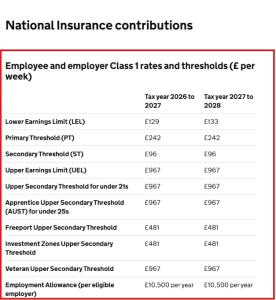
The Primary Threshold remains £242 a week and the Upper Earnings Limit stays at £967 a week.
However, the Lower Earnings Limit will rise from £129 to £133 a week.
| National Insurance Measure | 2026/27 | 2027/28 |
| Lower Earnings Limit | £129 Per Week | £133 Per Week |
| Primary Threshold | £242 Per Week | £242 Per Week |
| Upper Earnings Limit | £967 Per Week | £967 Per Week |
| Main Employee Rate | 8% | 8% |
| Rate Above Upper Earnings Limit | 2% | 2% |
| Standard Employer Rate | 15% | 15% |
| Self-Employed Small Profits Threshold | £7,105 | £7,355 |
| Voluntary Class 2 | £3.65 Per Week | £3.80 Per Week |
| Voluntary Class 3 | £18.40 Per Week | £19.05 Per Week |
| Main Class 4 Rate | 6% | 6% |
The Lower and Upper Profits Limits for Class 4 remain £12,570 and £50,270 respectively for 2027/28, with rates remaining at 6% and 2%.
Official Budget 2026 rates table confirming employee, employer and self-employed National Insurance figures for 2026/27 and 2027/28.
Conclusion
How much National Insurance you pay depends primarily on your earnings or profits, employment status, NI category and, for employees, how much you earn during each pay period.
For most employees in 2026/27, the key figures are straightforward: no employee NI is normally charged below the £242 weekly Primary Threshold, the main rate is 8% between £242 and £967 a week, and earnings above £967 a week are normally charged at 2%.
Self-employed workers follow different rules, with Class 4 starting on profits above £12,570 and Class 2 treated as paid once profits reach the relevant Small Profits Threshold.
Checking the thresholds against your payslip or Self Assessment calculation is the most reliable way to understand why a particular National Insurance amount has been charged.
FAQs
How Much National Insurance Do I Pay On £30,000?
A standard employee earning £30,000 throughout 2026/27 would pay approximately £1,394.40 a year in employee NI using an annualised calculation.
How Much National Insurance Do I Pay On £40,000?
A £40,000 salary produces an estimated £2,194.40 a year in employee National Insurance under standard 2026/27 rates.
How Much National Insurance Do I Pay On £50,000?
An employee earning £50,000 would pay approximately £2,994.40 a year in employee NI based on the standard rates and an annualised calculation.
What Salary Do You Start Paying National Insurance?
Most employees start paying Class 1 National Insurance once earnings exceed the Primary Threshold of £242 a week, £1,048 a month or £12,570 a year in 2026/27.
Do I Pay National Insurance If I Have Two Jobs?
Potentially. NI is generally calculated separately for each employment, so whether you pay depends on your earnings from each job and the applicable rules.
Do Pensioners Pay National Insurance?
Employees normally stop paying employee Class 1 National Insurance once they reach State Pension age, although their employer may still have employer NI obligations.
Do Self-Employed People Pay National Insurance?
Yes, where their profits meet the relevant thresholds. In 2026/27, Class 4 is normally charged at 6% on profits between £12,570 and £50,270 and 2% above £50,270.
What is your reaction?