Scotland Mansion Tax Proposals: Key Dates, Rates and Impacts

Last checked: 7 July 2026
The Scotland mansion tax proposals are a targeted Council Tax reform aimed at high-value residential properties, rather than a separate standalone wealth tax.
Under the current proposal, two new bands would sit above the existing Band H: Band I for homes valued between £1 million and £2 million, and Band J for homes valued at more than £2 million, as set out in the Scottish Government’s official consultation document.
For homeowners, buyers, councils and property professionals, the key point is that the policy is still moving through consultation. The final rates are not yet fixed, and any implementation would depend on legislation and Scottish Parliament approval.
Key highlights:
| Key point | Current position |
| Policy type | Proposed high-value Council Tax bands |
| Common name | Mansion tax |
| Proposed bands | Band I and Band J |
| Property threshold | Above £1 million |
| Valuation date | 1 April 2026 |
| Consultation deadline | 24 August 2026 |
| Possible start date | 1 April 2028 |
| Expected reach | Fewer than 1% of Scottish homes |
This is informational, not financial/legal advice.
What Are the Scotland Mansion Tax Proposals?
The Scotland mansion tax proposals would introduce two new Council Tax valuation bands for high-value residential properties. The official term is “High-Value Property Council Tax Bands”, although the policy is widely being described as a mansion tax.
The reform would sit within Scotland’s existing Council Tax system. It would not replace Council Tax, and it would not trigger a full revaluation of every Scottish home. Instead, it would focus on properties estimated to be worth more than £1 million.
Main points to understand:
- Band I would cover homes valued from £1 million to £2 million.
- Band J would cover homes valued above £2 million.
- Existing Council Tax Bands A to H would remain in place.
- Homes below £1 million would not move into the new bands because of this reform.
- The proposal is designed to raise extra revenue for local government.
The Scottish Government’s Council Tax consultation paper states that the consultation seeks views on proposed rates for two new high-value property bands, with Band I and Band J applying above the £1 million and £2 million thresholds respectively.
Is Scotland’s Mansion Tax Already Confirmed?
No. Scotland’s mansion tax is not fully confirmed in its final form. The policy has been proposed, and the Scottish Government is consulting on illustrative rates, but final multipliers would need to be set through primary legislation.
That distinction matters because readers may see headlines suggesting the charges are already fixed. The BBC’s report on plans highlights the public-facing impact of the proposal, including the possibility of higher Council Tax bills for homes worth more than £1 million. However, the legal position remains that this is a consultation-stage proposal, not a finalised tax change.
The Scottish Government’s mansion tax rates consultation says views are being sought on two new Council Tax bands for properties worth more than £1 million and £2 million respectively.
It also confirms that final proposed rates would be laid in Parliament after consultation responses and local government engagement.
Deputy First Minister and Cabinet Secretary for Finance Jenny Gilruth said: “Our approach to tax is based on fairness”.
That official statement should be read in the context of the government’s wider argument that higher-value property owners should contribute more towards local services.
Which Homes Could Be Affected by the Scotland Mansion Tax Proposals?
The proposals would affect homes estimated to be worth more than £1 million at 1 April 2026 values. The Scottish Government estimates that fewer than 1% of Scottish homes, around 15,000 properties, could fall into the new bands.
Band I: Homes Valued Between £1 Million and £2 Million
Band I would apply to residential properties with an estimated open market capital value of more than £1 million and up to £2 million. This may include detached homes, townhouses, flats, rural properties or other residential homes where the value crosses the threshold.
The word “mansion” may give the impression that only very large estates are affected, but the test is value, not appearance, size or property type.
Band J: Homes Valued Above £2 Million
Band J would apply to residential properties worth more than £2 million. Because this band would target the highest-value homes, the illustrative Council Tax multiplier is significantly higher than the Band I example.
How Would Band I and Band J Change Council Tax Bills?
The proposed figures are illustrative. They are not final rates. Council Tax charges are based on multipliers relative to Band D, and each local authority sets its own Band D rate. That means the final amount paid by a Band I or Band J household would vary depending on the council area.
Illustrative rate comparison:
| Proposed band | Property value | Illustrative annual charge | Estimated increase above average Band H |
| Band I | £1m–£2m | Around £4,770 | Around £720 more |
| Band J | Over £2m | Around £7,650 | Around £3,600 more |
The Scottish Government’s illustrative rates and revenue section says the explored multipliers are around 2.886 for Band I and 4.628 for Band J, based on 2026–27 Band D charges. It also estimates that the bands could raise £12 million to £16 million per year across Scotland.
These figures provide a working basis for consultation responses, not a guaranteed future bill.
Why Is Scotland Proposing a Mansion Tax Through Council Tax?

The Scottish Government’s argument is based on tax fairness and local government funding. The policy is designed to make owners of higher-value residential properties contribute more through the Council Tax system, while keeping the revenue within local government.
Local Government Funding
Additional money raised through the new bands would be retained by local authorities. This is important because Council Tax is a local revenue tool used to help fund services such as education, social care, waste collection, local roads and community services.
Fairness and Property Wealth
The fairness argument is that some very high-value homes currently sit within Band H, the existing top Council Tax band, alongside properties that may be significantly less valuable. The proposed Band I and Band J would create more distinction at the top of the property-value scale.
What Revenue Could Be Raised?
Based on illustrative rates, the government estimates additional annual revenue of around £12 million to £16 million. The estimate depends on the final multipliers, the number of properties captured, and how values are assessed.
The revenue claim should therefore be read as an estimate, not a fixed financial outcome.
How Would the Targeted Revaluation Work?
The targeted revaluation would be carried out by Scottish Assessors and would apply only to properties estimated to be worth more than £1 million at 1 April 2026 values. It would not be a general revaluation of every Scottish property.
This is one of the most important points for readers. Existing Bands A to H are still based on 1991 values. The new high-value bands would use a 2026 valuation date because they are designed to identify current high-value homes above £1 million.
The Scottish Government says all other homes would remain on the existing 1991 valuation basis, meaning no property currently worth less than £1 million would move bands because of the introduction of the new high-value bands.
A property could, however, move from any existing Council Tax band into Band I or Band J if it is estimated to be worth more than £1 million at the relevant valuation date.
What Could the Proposals Mean for Scotland’s Property Market?
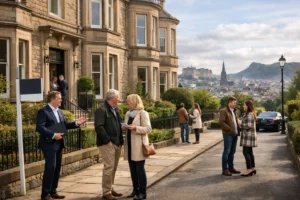
The Scotland mansion tax proposals could affect the high-value property market, but the impact remains uncertain. While higher ownership costs may influence buyers, house prices also depend on mortgage rates, income, supply, location and wider economic conditions.
The market concern is that some buyers may factor future Council Tax costs into offers for expensive homes. The Times’ market warning frames this risk around possible pressure on house prices, particularly for pricier properties that could face larger annual bills. This should be treated as a warning or market concern, not a confirmed outcome.
The effect may also vary by location. High-value homes are not evenly distributed across Scotland, meaning the potential impact could be more visible in certain city, coastal, commuter and rural luxury markets than in areas with fewer £1 million-plus properties.
Possible property market effects:
- Buyers may ask more questions about likely Band I or Band J exposure.
- Sellers may need clearer valuation evidence before listing high-value homes.
- Estate agents and advisers may need to explain the proposal carefully to avoid overstating confirmed costs.
- Local market impact may differ between Edinburgh, Glasgow, rural hotspots and other high-value areas.
For now, the property market impact remains conditional on final rates, valuation rules, affordability protections and how buyers respond before the proposed 2028 start date.
What Concerns Could Homeowners and Councils Raise During the Consultation?
The consultation is likely to attract responses on fairness, affordability, implementation and local impact.
The policy targets high-value property, but not every homeowner in a high-value home has a high disposable income.
Common consultation concerns:
- Asset-rich but income-limited households may struggle with higher annual bills.
- Long-term owners may have seen large paper gains without higher income.
- Property valuations may be disputed near the £1 million threshold.
- High-value homes may be concentrated in certain council areas.
- Buyers and sellers may delay decisions until final rates are known.
Affordability for Asset-Rich but Income-Limited Households
The Scottish Government acknowledges that higher bands could represent a significant increase for some households, especially those who have owned a home for a long time and whose income has not risen in line with property value.
Could Transitional Options Be Used?
The wider Council Tax reform discussion has explored phased arrangements, deferral schemes and possible adaptations to the Council Tax Reduction scheme. No final protection package has been confirmed for the new high-value bands, so this remains an area to watch.
What Should Homeowners, Buyers and Property Professionals Do Next?

The best next step is to treat the proposals seriously but avoid panic. The consultation stage is designed to gather evidence and views before final legislation is introduced.
Practical next steps:
- Check whether a property could plausibly exceed £1 million at 1 April 2026 values.
- Follow the consultation before the 24 August 2026 deadline.
- Avoid treating the illustrative rates as final bills.
- Consider how local authority rates could affect the final amount.
- Keep records of property features, improvements and comparable sales.
- Seek professional advice before making sale, purchase or tax-planning decisions.
Businesses connected to the property market should also monitor buyer behaviour, valuation disputes and local authority communications. The final policy design may matter as much as the headline rates.
Key Takeaways
The Scotland mansion tax proposals would create two new Council Tax bands above Band H. Band I would apply to homes valued between £1 million and £2 million, while Band J would apply to homes valued above £2 million.
The policy is not yet final. The consultation closes on 24 August 2026, and the intended start date is 1 April 2028, subject to parliamentary approval. The published annual charges are illustrative only.
For homeowners and property professionals, the main issues are valuation, affordability, local authority variation and the possible effect on high-value property demand.
Conclusion
The Scotland mansion tax proposals represent a significant targeted reform of Council Tax for high-value homes. They are designed to raise additional money for local government while creating more tax distinction at the top end of the residential property market.
However, the final impact will depend on consultation responses, legislation, Scottish Parliament scrutiny, local authority rates and any affordability protections. Until those details are settled, homeowners, buyers and advisers should rely on official updates rather than headlines alone.
FAQs Scotland Mansion Tax Proposals
Is the mansion tax a separate annual property tax?
No. In Scotland, the proposal is being taken forward through new Council Tax bands rather than a completely separate annual property tax.
Could a flat or townhouse fall into one of the new bands?
Yes, if its estimated open market value is above £1 million at the relevant valuation date. Property type is not the deciding factor.
Would second homes be included?
The proposal is based on residential property value. Owners should check final legislation for detailed rules on second homes and liability.
Why are 1991 values still relevant?
Existing Council Tax Bands A to H remain based on 1991 values. The proposed new high-value bands would use 1 April 2026 values.
Can a homeowner challenge a valuation?
Appeal and review details would need to be confirmed through implementation guidance. Homeowners should wait for official assessor information.
Why could Band I raise more money than Band J?
Band I is expected to include more properties than Band J, even though Band J would have a higher illustrative charge.
Where would the extra revenue go?
The Scottish Government says additional revenue from the new bands would be retained by local government to support local services.
Editorial Note:
This article is written for informational and news-analysis purposes for a UK audience. It should not be treated as financial, legal, tax or valuation advice. Homeowners, buyers, landlords and property professionals should check official Scottish Government updates, local authority guidance and professional advice before making decisions.
How We Checked?
This article was checked on 7 July 2026 against the Scottish Government’s official consultation documents, the official government news release, and supplied media references. Because this is a live consultation, details may change after responses are analysed and legislation is prepared.
What is your reaction?