
Disciplinary Action at Work in the UK: Rules, Procedures, Employee Rights and Examples

Last Update – 02-11-2026
Disciplinary action is a formal process employers use to address employee misconduct, poor performance or breaches of workplace rules. It can involve a written warning, a final warning or, in serious circumstances, dismissal.
However, UK employers must handle disciplinary matters fairly, giving employees a reasonable opportunity to understand the allegations and respond before a decision is made.
A disciplinary meeting does not automatically mean an employee will lose their job. In many cases, the objective is to correct behaviour, improve performance and prevent similar problems from happening again.
Under UK employment practices, employers should investigate concerns properly, provide relevant evidence, arrange an appropriate hearing and offer the opportunity to appeal.
The Acas disciplinary procedure establishes an important framework for handling workplace concerns fairly and consistently.
Disciplinary procedures are also becoming increasingly important for businesses as employment law changes affect the time employees have to bring tribunal claims and their eligibility for unfair dismissal protection.
Understanding the complete process helps employers reduce legal risks while ensuring employees are treated fairly.
What Is Disciplinary Action in the Workplace?
Disciplinary action refers to measures taken by an employer when an employee is believed to have broken workplace rules, failed to meet expected standards or behaved inappropriately.
It is usually governed by the employer’s disciplinary policy, employment contracts and the principles outlined in the Acas Code of Practice on disciplinary and grievance procedures.
Common situations that may result in disciplinary action include:
- Repeated lateness or unauthorised absence.
- Failure to follow reasonable workplace instructions.
- Bullying, harassment or inappropriate conduct.
- Misuse of company equipment or confidential information.
- Persistent failure to meet reasonable performance standards.
- Serious breaches of health and safety procedures.
- Theft, fraud, violence or other potentially gross misconduct.
Not every workplace problem requires a formal disciplinary procedure.
For minor concerns, managers may first discuss the issue privately with the employee, establish why it happened and agree on improvements.
This distinction is important because disciplinary action should not simply be used to punish employees. It should also encourage positive workplace behaviour and support improved performance.
For situations involving disagreements between colleagues, workplace mediation may sometimes provide a constructive alternative to formal proceedings.
What Are the Main Types of Disciplinary Action?
The appropriate disciplinary outcome depends on the seriousness of the issue, available evidence, previous warnings and the employer’s disciplinary policy.
| Type of disciplinary action | When it may be used | Possible consequence |
| Informal or verbal warning | Minor misconduct or an initial concern | Employee is advised to improve |
| First written warning | Confirmed misconduct or unsatisfactory performance | Formal warning recorded |
| Final written warning | Repeated misconduct or a sufficiently serious first offence | Dismissal may follow further breaches |
| Demotion or other contractual sanction | Where justified and permitted under applicable contractual arrangements | Changes to role or responsibilities |
| Dismissal with notice | Serious or repeated issues where dismissal is reasonable | Employment ends with applicable notice |
| Summary dismissal | Gross misconduct established following a fair process | Employment ends without notice |
A common misunderstanding is that every employee must receive three warnings before dismissal. There is no universal legal requirement for that sequence.
An employer may issue a final written warning for a sufficiently serious first incident or consider dismissal where gross misconduct is established.
However, the severity of the sanction must be reasonable, and a fair process must still be followed.
Informal Warnings
An informal warning usually involves a private conversation between an employee and their manager.
For example, an employee who arrives late twice during a week may be asked to explain the situation and agree on expectations for future attendance.
The manager should explain the concern, listen to the employee and record any agreed improvements.
An informal conversation will not necessarily count as a formal disciplinary sanction, although the organisation may keep a confidential record.
First Written Warnings
A first written warning is normally issued following a formal disciplinary process where misconduct or poor performance has been established.
It should explain the problem, identify the improvements required, specify a reasonable timeframe and clarify the consequences of further misconduct.
The warning should also explain how long it will remain active and how the employee can appeal.
Final Written Warnings
A final written warning may be appropriate where an employee fails to improve after an earlier warning or where a first offence is sufficiently serious.
For example, an employee who repeatedly ignores important workplace safety requirements may receive a final warning if the facts justify that sanction.
The employer should clearly explain that further misconduct or failure to improve may result in dismissal.
What Is the Difference Between Misconduct and Gross Misconduct?
Misconduct and gross misconduct are two important classifications in workplace disciplinary procedures.
Ordinary misconduct generally involves behaviour that breaches workplace standards but may be addressed through warnings and corrective measures.
Gross misconduct describes conduct so serious that it may justify dismissal without notice.
| Misconduct | Potential gross misconduct |
| Occasional lateness | Serious dishonesty or fraud |
| Minor unauthorised absence | Theft from the employer |
| Failure to follow routine instructions | Serious insubordination |
| Inappropriate workplace communication | Physical violence |
| Minor breaches of company policies | Serious safety violations or gross negligence |
| Careless handling of routine duties | Deliberate misuse of highly confidential information |
These examples are illustrative, not automatic classifications. The employer must consider the circumstances, company rules, seriousness of the conduct and surrounding evidence.
An allegation of gross misconduct does not mean an employee is automatically guilty.
Even where an employer believes that serious wrongdoing has occurred, the employee should normally receive a proper investigation and a fair disciplinary hearing before dismissal is decided.
How Does the Disciplinary Action Process Work in the UK?
A fair disciplinary procedure normally involves several stages designed to establish what happened, allow the employee to respond and reach a reasonable decision.
The GOV.UK guidance on disciplinary procedures explains the expected framework for disciplinary hearings, decisions and appeals.
Step 1: Identify the Workplace Concern
The employer should first establish the nature of the concern.
This may involve reviewing an employee’s attendance record, examining a complaint, identifying a performance issue or considering a suspected breach of workplace rules.
Managers should avoid reaching conclusions before obtaining relevant information.
For example, an unexplained absence might initially appear to be misconduct. However, further enquiries could establish that the employee experienced an emergency or was unable to communicate because of a medical problem.
Where appropriate, an informal discussion may resolve the issue without formal proceedings.
Step 2: Conduct a Fair Investigation
If the concern cannot reasonably be resolved informally, the employer should investigate.
An investigation may involve:
- Reviewing emails, documents, attendance records or other relevant evidence.
- Interviewing witnesses and obtaining factual statements.
- Speaking with the employee about the allegations.
- Considering evidence that supports or contradicts the complaint.
- Recording findings accurately and confidentially.
The purpose of the investigation is to establish whether there is a disciplinary case to answer.
It should not be treated as an exercise in proving that the employee has done something wrong.
Where practicable, different managers should conduct the investigation and the disciplinary hearing. This helps reduce the risk of perceived bias.
An investigatory meeting should not itself result in a disciplinary sanction.
The statutory right to be accompanied generally applies to formal disciplinary hearings rather than ordinary investigation meetings, although contracts, policies or reasonable adjustments may provide additional rights.
Step 3: Notify the Employee in Writing
Where the investigation identifies a case to answer, the employee should receive a formal disciplinary invitation.
The notification should contain the allegations, relevant evidence, proposed hearing arrangements and possible outcomes.
Employees should be given reasonable time to prepare their response.
An employer should not assume that simply inviting someone to a meeting without explaining the allegations satisfies the requirements of a fair process.
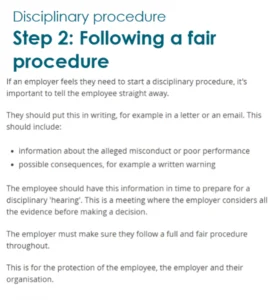
Official Acas guidance outlining the importance of a fair disciplinary procedure.
Step 4: Hold a Disciplinary Hearing
A disciplinary hearing gives the employee an opportunity to respond to the allegations before any disciplinary decision is made.
During the meeting, the employer should explain the concerns, review the evidence, invite the employee’s response and consider any mitigating circumstances.
The employee should also be permitted to present relevant documents and identify witnesses or additional evidence.
For example, an employee accused of ignoring a safety instruction might produce evidence that the instruction was unclear or that the required equipment was unavailable.
If significant new information emerges, the employer may need to adjourn the hearing and investigate further.
A fair hearing should be conducted professionally, without intimidation or an assumption that the outcome has already been decided.
Step 5: Decide the Appropriate Outcome
After the hearing, the employer should evaluate the available evidence and decide whether disciplinary action is justified.
Possible outcomes include no further action, an informal resolution, a written warning, a final written warning or dismissal.
The employer should consider the seriousness of the issue, any mitigating circumstances, previous disciplinary history and how similar cases have been handled.
The employee should receive the decision in writing without unreasonable delay.
Step 6: Allow an Appeal
Employees should have an opportunity to appeal a formal disciplinary decision.
The appeal should be considered impartially and, wherever practicable, by someone who was not involved in the original decision.
The employee should be told how to appeal and the relevant timeframe under the organisation’s policy.
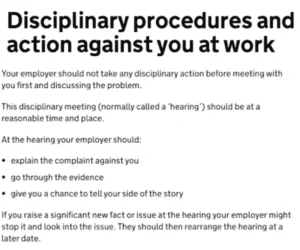
GOV.UK guidance explaining disciplinary hearings, employees’ right to respond and possible disciplinary outcomes.
What Rights Does an Employee Have During Disciplinary Action?
Employees have important procedural protections when facing disciplinary proceedings.
These protections help ensure that disciplinary decisions are based on evidence rather than assumptions, personal disagreements or discrimination.
The Right to Know the Allegations
Employees should receive sufficient information about the allegations and potential consequences to prepare a meaningful response.
They should normally have access to relevant written evidence before the disciplinary hearing.
An allegation should be specific enough to explain what conduct or performance is being questioned.
The Right to Be Accompanied
At a qualifying disciplinary hearing, an employee or worker has the statutory right to be accompanied by an appropriate companion.
This will generally be a work colleague, certified trade union representative or trade union official.
The companion may address the hearing, summarise the employee’s case and confer with the employee.
However, the companion cannot ordinarily answer questions on the employee’s behalf.
Where a chosen companion is unavailable, the employer must normally postpone the hearing to a reasonable alternative date proposed by the worker if that date is within five working days of the original hearing date.
A longer postponement may still be appropriate where fairness requires it.
In some circumstances, including disability-related reasonable adjustments, an employer may need to consider additional support.
The Right to Respond
Employees should be able to explain what happened, challenge evidence, present relevant documents and identify circumstances that the employer may have overlooked.
A disciplinary process that does not provide a meaningful opportunity to respond may be vulnerable to challenge.
The Right to Appeal
Employees should be informed of their right to appeal after a formal disciplinary decision.
An appeal may involve arguments about insufficient evidence, procedural unfairness, new information or a disproportionate sanction.
Employees should retain copies of meeting invitations, evidence, outcome letters and appeal correspondence.
Can an Employer Suspend an Employee During Disciplinary Action?
Yes. Employers may suspend an employee while investigating a serious workplace concern, but suspension should not be automatic.
Suspension may be considered where there is a genuine risk to workplace safety, evidence, witnesses or the integrity of an investigation.
The employer should assess whether less disruptive alternatives are available, such as temporarily changing duties or reporting arrangements.
Disciplinary suspension will normally be on full pay, subject to the employment contract and applicable legal requirements.
Importantly, suspension does not mean that an employee has been found guilty of misconduct.
The employer should explain the reason for the suspension, maintain appropriate communication and review whether it remains necessary.
An unnecessarily prolonged suspension may cause reputational harm, workplace stress and additional employment disputes.
How Long Does a Disciplinary Warning Stay on an Employee’s Record?
There is no single statutory duration for all disciplinary warnings in the UK.
The period will usually depend on the employer’s disciplinary policy, the severity of the issue and the particular warning issued.
For example, some organisations may use a six-month period for a first written warning and 12 months for a final written warning.
These periods are examples of workplace practice, not universal legal rules.
A warning should explain how long it remains active and what improvements are expected during that period.
Once a warning expires, it should not ordinarily continue to operate as an active disciplinary sanction. However, the employer may retain relevant records for legitimate purposes under applicable data protection requirements.
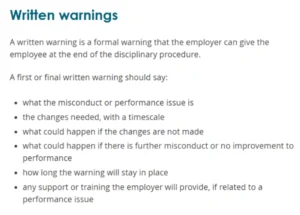
Acas guidance explaining first written warnings, final written warnings and disciplinary outcomes.
Can an Employee Be Dismissed Without a Written Warning?
An employee may sometimes be dismissed without receiving a previous written warning.
This is particularly relevant where gross misconduct has been established following a fair process.
Examples might include serious fraud, workplace violence or other conduct that fundamentally damages the employment relationship.
However, employers should not confuse dismissal without a previous warning with dismissal without an investigation or hearing.
A summary dismissal means employment ends without the usual contractual notice because of gross misconduct. It does not remove the employer’s obligation to follow a fair process.
In less serious cases, dismissal without an earlier warning may be unreasonable, particularly where the employee was never informed of the concern or given an opportunity to improve.
Employers should also consider whether a lesser sanction would adequately address the problem.
What Is the Difference Between Disciplinary Action and a Grievance?
Disciplinary proceedings and grievance procedures are related but serve different purposes.
A disciplinary procedure usually begins when the employer raises concerns about an employee’s behaviour or performance.
A grievance procedure usually begins when an employee formally raises concerns about workplace treatment, management decisions or employment conditions.
| Disciplinary action | Grievance procedure |
| Usually initiated by the employer | Usually initiated by the employee |
| Addresses misconduct or poor performance | Addresses workplace complaints or concerns |
| May result in warnings or dismissal | May result in corrective action or an investigation outcome |
| Employee responds to allegations | Employee explains their complaint |
| Includes an appeal process | Also normally includes an appeal process |
Sometimes both procedures overlap.
For example, an employee facing disciplinary allegations may raise a grievance alleging that the investigation is biased or discriminatory.
Depending on the circumstances, an employer may need to pause the disciplinary proceedings or consider related matters together.
A grievance should not automatically be treated as a reason to abandon a legitimate disciplinary investigation, nor should it be ignored merely because disciplinary proceedings have already started.
What Mistakes Should Employers Avoid During Disciplinary Proceedings?
Poorly managed disciplinary cases can damage employee trust, increase workplace conflict and expose businesses to legal claims.
Common mistakes include:
- Failing to investigate properly: Decisions based only on rumours or incomplete evidence may be difficult to justify.
- Predetermining the outcome: An employer should not decide to dismiss someone before considering their explanation.
- Applying rules inconsistently: Similar circumstances should normally receive consistent treatment, while relevant differences are considered.
- Denying accompaniment rights: Employees must be allowed appropriate representation at qualifying hearings.
- Ignoring mitigation: Personal circumstances, unclear instructions, inadequate training or disability-related issues may be relevant.
- Failing to document decisions: Incomplete records make it harder to explain how a decision was reached.
- Refusing a fair appeal: A meaningful opportunity to challenge a disciplinary decision is an important procedural safeguard.
The commercial cost of mishandling workplace conflict can be substantial.
In research discussed by Acas in July 2026, formal disciplinary and grievance procedures were estimated to cost UK employers £2.36 billion annually, compared with approximately £250 million for informal resolution.
Acas Chair Baroness Maggie Jones highlighted the benefit of earlier intervention, stating:
“Effective early intervention in conflict saves money and time as well as promoting staff wellbeing and productivity.”
This supports an important business principle: while serious misconduct requires appropriate action, employers should not overlook opportunities to resolve less serious concerns early.
In the same Acas-published research, 58% of surveyed business respondents who tried informal dispute resolution identified good working relationships as helpful, while 53% identified a shared willingness to find a solution.
These findings reinforce the value of communication, consistency and well-trained managers.
What Are Some Practical Examples of Disciplinary Action?
Understanding how disciplinary procedures operate in realistic workplace situations can help employers and employees distinguish between appropriate action and unnecessarily severe sanctions.
Example 1: Repeated Lateness
An employee regularly arrives 20 minutes late despite previous informal discussions.
The manager reviews attendance records, asks for an explanation and considers whether external circumstances are affecting the employee.
If the lateness continues without adequate justification, the employer may begin a formal disciplinary procedure and consider issuing a written warning.
The outcome should include clear attendance expectations and a reasonable improvement period.
Example 2: Poor Workplace Performance
A customer service employee consistently struggles to meet reasonable productivity or quality requirements.
Before starting formal disciplinary action, the employer should examine whether the employee has received sufficient training, support and clear performance expectations.
A performance improvement plan may be more appropriate than immediate disciplinary punishment.
Where an employee cannot meet the required standards despite appropriate support, the organisation may need to consider a formal capability procedure.
Example 3: Serious Breach of Confidentiality
An employee is suspected of deliberately sharing confidential customer information with an unauthorised person.
The employer investigates the allegation, examines relevant access records and provides the employee with an opportunity to explain their actions.
If deliberate serious wrongdoing is established, the outcome could include a final written warning or dismissal, depending on the circumstances.
In serious cases, the employer may also need to assess its responsibilities under data protection legislation.
Example 4: Workplace Bullying Allegation
An employee raises a formal complaint alleging repeated bullying by a colleague.
The employer should examine the allegations impartially, consider witness evidence and follow its relevant workplace procedures.
If misconduct is established, proportionate disciplinary action may follow.
The employer should also take steps to prevent victimisation and maintain confidentiality as far as reasonably possible.
How Can Employers Create an Effective Disciplinary Policy?
A written disciplinary policy gives employees and managers a clear understanding of workplace expectations.
It also helps reduce inconsistent decision-making.
An effective policy should explain the scope of disciplinary rules, examples of misconduct and gross misconduct, investigation arrangements, hearing procedures and available sanctions.
It should also outline accompaniment rights, appeals, confidentiality and recordkeeping.
For small businesses, a clear and practical policy may be more effective than an unnecessarily complicated process.
Managers should understand how to conduct investigations, assess evidence and communicate decisions without prejudging outcomes.
Employers should also distinguish misconduct from capability issues. Where performance difficulties are connected to disability, health, insufficient training or other underlying circumstances, additional legal obligations or adjustments may apply.
For serious or complex cases, obtaining guidance from experienced employment lawyers in London or another appropriately qualified employment law adviser can help organisations assess the risks before making a final decision.
What Happens If an Employer Does Not Follow the Acas Code?
Failure to follow the Acas Code of Practice does not automatically make disciplinary action unlawful.
However, employment tribunals can consider whether the employer and employee followed the Code when deciding relevant cases.
Where an unreasonable failure to comply is established, a tribunal can increase or reduce certain awards by up to 25%.
For example, an employer that refuses to investigate allegations properly, denies a fair hearing or unreasonably obstructs an appeal may face increased legal risk.
An employee’s unreasonable failure to follow relevant procedures can also affect a tribunal award.
The 25% adjustment is not an automatic penalty for every procedural mistake, and the Code does not create an independent tribunal claim simply because one of its provisions was not followed.
Employers should also check whether their disciplinary procedures form part of the employment contract, because failing to comply with binding contractual terms may create separate legal issues.
What Employment Law Changes Affect Disciplinary Action in 2026 and 2027?
Employment law developments are particularly relevant to disciplinary dismissals and subsequent tribunal claims.
Employment Tribunal Deadlines From October 2026
From 1 October 2026, the time limit for most employment tribunal claims increased from three months minus one day to six months minus one day.
This generally applies where the relevant workplace problem occurred on or after 1 October 2026. Earlier incidents may remain subject to the previous deadline.
Employees should be aware that an internal disciplinary hearing or appeal does not automatically pause the employment tribunal limitation period.
Notifying Acas for early conciliation within the applicable time limit can affect the calculation of the tribunal deadline.

Official Acas guidance showing the employment tribunal deadline changes introduced on 1 October 2026.
Unfair Dismissal Protection From January 2027
As at 31 October 2026, most employees in Great Britain ordinarily require two years of continuous service to qualify for a standard unfair dismissal claim, although important exceptions apply.
From 1 January 2027, the qualifying period is scheduled to reduce to six months, with the existing compensatory award cap also due to be removed.
This makes fair disciplinary investigations, properly documented hearings and proportionate dismissal decisions increasingly important for employers.
Protection against discrimination and certain automatically unfair reasons for dismissal does not depend on the ordinary two-year qualifying period.
The statutory rules in Northern Ireland differ.
Proposed Changes to the Acas Code
Acas consulted on a revised disciplinary and grievance Code during 2026, with the consultation closing on 23 September.
The proposed updates place greater emphasis on early informal resolution, clearer communication and proportionate use of suspension.
However, the consultation draft is not yet the operative statutory Code. Employers should continue to follow the existing requirements until any replacement formally takes effect.
What Should an Employee Do After Receiving a Disciplinary Letter?
Receiving a disciplinary invitation can be concerning, particularly where dismissal is mentioned as a possible outcome.
However, employees should approach the process carefully and avoid assuming the decision has already been made.
First, read the letter and identify the allegations, potential consequences and hearing arrangements.
Next, request any relevant documents that have not been supplied, review the employer’s disciplinary policy and prepare a factual response.
Employees may find it useful to organise evidence chronologically, identify relevant witnesses and arrange an appropriate companion.
During the hearing, remain professional, explain the circumstances clearly and ask for clarification where necessary.
If the eventual decision appears unfair, consider whether there are grounds for an appeal and seek independent advice where appropriate.
Employees should also be careful about resigning during a disciplinary process without understanding the potential legal and financial consequences.
Frequently Asked Questions
What Does Disciplinary Action Mean at Work?
Disciplinary action is a formal process an employer uses to address employee misconduct, poor performance or breaches of workplace rules. It can result in a warning, other permitted sanctions or dismissal.
Does Disciplinary Action Always Mean Dismissal?
No. Many disciplinary cases result in warnings, improvement plans or no further action. Dismissal is generally considered where the circumstances justify it.
Can an Employee Refuse to Attend a Disciplinary Hearing?
An employee can explain why they cannot attend and request reasonable arrangements. However, repeatedly refusing to attend without good reason may result in the employer making a decision using the available evidence.
Can an Employer Give a Final Written Warning Without a First Warning?
Yes. A final written warning may be justified for sufficiently serious misconduct or poor performance, provided the employer follows a fair process and the sanction is proportionate.
Is a Disciplinary Warning a Criminal Record?
No. An ordinary workplace disciplinary warning is an employment matter, not a criminal conviction. However, some workplace misconduct may separately involve criminal allegations.
Can Employees Appeal a Disciplinary Decision?
Yes. Employees should be given an opportunity to appeal formal disciplinary decisions. Appeals should be considered impartially and without unreasonable delay.
Can Disciplinary Action Be Taken During Probation?
Yes. Probation does not prevent employers from investigating misconduct or taking appropriate action. Employees also retain important statutory protections, including protections against unlawful discrimination.
Can an Employer Discipline Someone for Conduct Outside Work?
Sometimes. Conduct outside working hours may justify disciplinary action where it has a sufficient connection to employment, workplace relationships or legitimate business interests.
The employer should investigate and consider the circumstances before deciding.
What is your reaction?