02038301215: Who Called Me and Is the Number Safe?

The telephone number 02038301215, commonly written as 020 3830 1215, is a London geographic landline number.
Several community phone-reporting websites associate it with a British Gas customer feedback survey, usually made after someone has contacted the company’s call centre.
However, this identification comes from user-submitted reports rather than a definitive public confirmation from British Gas. The displayed number should therefore not be treated as proof that every call is genuine.
A person who recently contacted British Gas and then receives a brief request for service feedback may have received a legitimate survey call.
Someone who was not expecting contact, or who is asked for passwords, payment details, security codes or remote access to a device, should end the call and verify the organisation independently.
02038301215 Number Summary:
| Detail | Available information |
| Telephone number | 020 3830 1215 |
| International format | +44 20 3830 1215 |
| Number type | Geographic landline |
| Area code | 020, associated with London |
| Original range provider reported by lookup sites | Gamma Telecom Holdings Limited |
| Common caller identification | British Gas customer-service feedback survey |
| Official ownership publicly confirmed? | Not conclusively confirmed |
| Safe to answer? | Possibly, but the purpose and caller must still be verified |
| Main warning signs | Requests for money, passwords, PINs, security codes or remote access |
| Reporting option for suspicious mobile calls | Forward the number to 7726 |
| Last reviewed | 21 July 2026 |
Who Is Calling from 02038301215?
Public reports most commonly describe calls from 02038301215 as post-contact British Gas surveys.
People reporting the number say the call followed an earlier conversation with British Gas about an account, bill or customer-service issue.
The caller may ask the customer to rate the assistance they received or answer a small number of questions about their experience.
The supplied Who Called reference page identifies the number as a London landline associated at range level with Gamma Telecom Holdings Limited. This describes the telecommunications range, not necessarily the organisation using the number at the time of a particular call.
A separate community reporting service also describes 020 3830 1215 as a British Gas follow-up survey number, particularly where the recipient had recently contacted the company.
These reports provide a useful indication, but they do not amount to official proof of ownership. Community phone databases rely heavily on individual experiences, which may be incomplete, mistaken or outdated.
Is 02038301215 a British Gas Number?
The available reports suggest that 02038301215 may be used for British Gas customer feedback calls. This is the most frequently reported explanation for the number.
A call is more likely to be consistent with a genuine feedback survey when:
- The recipient contacted British Gas shortly before the call.
- The caller only asks for opinions about that interaction.
- No payment, password or security information is requested.
- The caller accepts that the recipient does not wish to participate.
- There is no pressure, threat or urgent demand.
The association should nevertheless be treated as an indication rather than a guarantee.
A telephone number can be transferred between providers, used by outsourced contact centres or falsely displayed through caller ID spoofing. The fact that a number appears to belong to a known organisation does not prove who is actually speaking.
Is 02038301215 Safe?
There is not enough verified evidence to label every call from 02038301215 as either completely safe or fraudulent.
The available community reports lean towards a legitimate customer survey explanation. However, the safest assessment depends on what happened during the individual call.
The Call May Be Genuine When
The recipient had recently spoken to British Gas and the caller simply requested feedback about that conversation.
A normal customer-experience survey might ask:
- Whether the original query was resolved.
- How clearly the adviser explained the issue.
- How satisfied the customer was with the service.
- Whether the customer would recommend the company.
A feedback survey should not require a full password, online banking login, card PIN, one-time passcode or payment transfer.
The Call Should Be Treated as Suspicious When
The caller:
- Claims there is an urgent unpaid bill without providing verifiable account context.
- Asks for complete bank or card information.
- Requests a password, PIN or one-time security code.
- Tells the recipient to transfer money to a “safe account”.
- Asks for remote access to a phone, tablet or computer.
- Threatens disconnection, legal action or arrest unless immediate action is taken.
- Refuses to let the recipient verify the call independently.
Ofcom says common scam warning signs include unexpected contact, pressure to act immediately, requests for personal or financial information and instructions to keep the conversation secret.
Its advice is to hang up and call the organisation using a number obtained from an official website or account document.
Can the Number Be Spoofed?
Yes. Even where a telephone number is normally used by a legitimate business, criminals may be able to make that number appear on a recipient’s screen.
This practice is known as caller ID spoofing. It is used to make a call appear to come from a familiar company, bank, government department or local London number.
Ofcom strengthened its guidance in January 2025 by requiring UK providers to block calls arriving from abroad that falsely present a UK landline number, subject to limited legitimate exceptions.
Nevertheless, Ofcom continues to warn that some spoofed calls may still get through.
Therefore, the caller’s behaviour is more important than the number displayed.
What Should Someone Do After Receiving the Call?

Someone who receives a call from 02038301215 can use the following process.
1. Consider Whether the Call Was Expected
The recipient should check whether they recently contacted British Gas or dealt with an energy-account query.
A feedback call shortly after a genuine interaction would match the pattern described by several public reports. An unsolicited call with no obvious connection deserves more caution.
2. Do Not Disclose Security Information
The recipient should not provide:
- Online-account passwords.
- Card PINs.
- One-time banking codes.
- Full payment-card details.
- Remote access to a computer or mobile device.
Even where the caller appears to know a person’s name, address or supplier, that information alone does not prove the call is genuine.
3. End the Call When Unsure
There is no obligation to complete a telephone survey. A genuine organisation should allow the recipient to end the conversation without pressure.
The recipient can then contact British Gas through a telephone number shown on its official website, app, bill or account correspondence.
The callback number supplied by the unexpected caller should not be used for verification.
4. Block or Report Repeated Calls
If the call appears suspicious or becomes persistent, the number can be blocked through the phone’s recent-calls settings.
Ofcom advises mobile users to report suspected scam calls by sending the telephone number to 7726, which spells “SPAM” on a telephone keypad. The service is free and allows the mobile network to investigate the number.
5. Act Quickly If Money or Information Was Shared
Anyone who has disclosed banking information or transferred money should contact their bank immediately using the number on the back of their bank card or through the bank’s official app.
Suspected fraud should also be reported through Report Fraud in England, Wales and Northern Ireland. In Scotland, suspected fraud can be reported to Police Scotland by calling 101.
Ofcom also recommends contacting a mobile provider where a suspicious link was opened or software was installed.
Are Calls from 020 Numbers Expensive?
Numbers beginning with 020 are ordinary London geographic numbers rather than premium-rate numbers.
The amount charged for returning a call normally depends on the person’s landline or mobile tariff.
Calls to UK geographic numbers beginning with 01 or 02 are often included within monthly call allowances, although this should be confirmed with the relevant provider.
The format should be written as 020 3830 1215, not “0203 830 1215”. The London area code is 020, while the remaining eight digits form the local number.
Although this particular format is not normally premium rate, Ofcom advises people not to return unexpected missed calls until they have checked the number and considered why it contacted them.
What Is the Difference Between a Scam Call and a Nuisance Call?
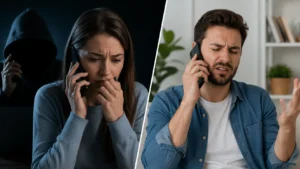
A nuisance call is not automatically a fraud attempt.
A nuisance call may involve unwanted marketing, an automated sales message or repeated commercial contact. A scam call is intended to deceive someone into giving away money, account access or personal information.
The Information Commissioner’s Office handles complaints about nuisance marketing calls.
People can register their landline or mobile number with the free Telephone Preference Service, which records that they do not want unsolicited live marketing calls.
Calls that continue after TPS registration can be reported to the ICO. Fraudulent calls should instead be reported to Report Fraud or Police Scotland, depending on the recipient’s location.
A genuine customer survey connected to a recent interaction may not be an unsolicited marketing call. However, the recipient can still decline to participate and ask the organisation not to contact them for survey purposes.
Final Takeaway
The available public reports suggest that 02038301215 is commonly used for British Gas customer feedback surveys, particularly after a customer has contacted the company.
That explanation is plausible, but it is based mainly on community experiences rather than definitive public confirmation of ownership.
A short survey that follows a genuine British Gas conversation and does not request sensitive information may be legitimate. However, any unexpected caller demanding money, passwords, one-time codes or remote access should be treated as suspicious.
The safest approach is to end uncertain calls and contact the organisation through independently verified details.
Frequently Asked Questions
Who called from 02038301215?
Community reports most frequently associate 02038301215 with a British Gas customer-service feedback survey following a previous call. However, this is not conclusive proof of the caller’s identity.
Is 02038301215 a scam number?
There is no firm evidence showing that every call from the number is a scam. Several reports describe legitimate-looking feedback surveys, but each call should be assessed independently because telephone numbers can be spoofed.
Should someone answer 02038301215?
Answering is a personal choice. Someone expecting a British Gas feedback call may decide to answer, but they should not provide passwords, banking security codes or payment details. An unknown missed call does not need to be returned.
Why did 02038301215 call after a British Gas conversation?
The call may have been an automated or adviser-led customer satisfaction survey intended to collect feedback about the recent contact-centre experience.
Can 02038301215 access a bank account?
The number itself cannot access a bank account. Risk arises if the recipient gives the caller login information, card details, passwords or one-time security codes, or follows instructions to transfer money.
How can someone stop calls from 02038301215?
The number can be blocked using the phone’s recent-calls menu. Suspected scam mobile calls can be reported to 7726, while repeated unwanted marketing calls can be reported to the ICO.
Is it safe to call 02038301215 back?
It is normally a standard-rate London geographic number, but returning the call may not be necessary. Anyone wishing to contact British Gas should use verified contact details from the company’s official website, app, bill or account correspondence.
Note: This article has been reviewed against official Ofcom, Information Commissioner’s Office and UK fraud-reporting guidance.
What is your reaction?