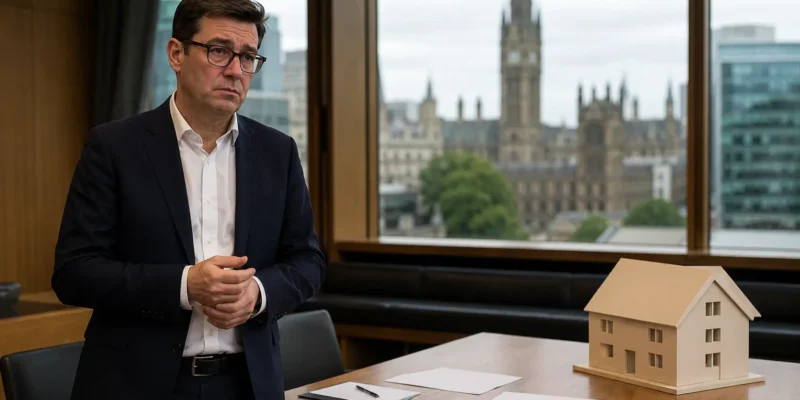
Andy Burnham Home Tax Plan Explained: Key Facts and Proposals

Last checked: 6 July 2026
The Andy Burnham home tax plan is not a confirmed standalone tax that will apply to every UK household.
Instead, it refers to a series of reported proposals and policy discussions around council tax, property taxation, land value tax, stamp duty, and business rates.
The wider debate is about whether the UK’s existing property tax system should be reformed to better reflect modern property values, land use, and local government funding.
While these ideas have attracted significant attention, no nationwide home tax has been formally approved or implemented.
Key takeaways:
- No new home tax has been confirmed.
- Focus remains on property tax reform.
- Changes could affect homeowners and businesses differently.
- No national legislation has been approved.
- Reforms remain under discussion.
What Is the Andy Burnham Home Tax Plan and What Has Actually Been Confirmed?

The phrase “Andy Burnham home tax plan” is mainly a search and media shorthand. It does not currently describe one confirmed official tax with one fixed rate for every home.
Instead, it points to a wider debate about whether council tax, stamp duty and business rates should be redesigned.
Recent reporting, including this BBC report on Burnham’s tax plans, has brought more attention to how his wider policy agenda could affect households, public finances and businesses.
However, the key point for readers is that no nationwide “home tax” has been formally approved or implemented.
Confirmed and discussed points:
- Council tax reform is part of the debate.
- Land value tax and proportional property tax ideas have been linked to Burnham.
- Business rates reform is a major business-facing part of the discussion.
- No final UK-wide household tax bill has been confirmed.
- Any reform would depend on future legislation, valuation rules, exemptions and transition arrangements.
Recent reporting and analysis have also focused on Burnham’s comment that there may be “some room for movement on tax”, while maintaining a commitment to Labour’s fiscal rules.
This makes the issue politically sensitive because tax reform can easily be presented as either fairness-driven modernisation or a new burden on homeowners.
The most accurate summary is that this is a property tax reform debate, not a confirmed immediate tax demand.
Why Is Council Tax Reform at the Centre of Andy Burnham’s Home Tax Debate?
Council tax is central because it is the existing annual property-related tax most households already understand. Critics argue that it no longer reflects modern property values or regional changes in the housing market.
How does council tax currently work in England?
Council tax bands in England are still based on the price a property would have sold for on the open market on 1 April 1991.
The official GOV.UK guidance on council tax bands confirms that England’s bands are based on 1991 values, while Wales uses 1 April 2003 values.
That matters because property prices have changed dramatically since 1991.
Some high-value homes may remain in a banding system that does not fully reflect today’s market, while some households in lower-growth areas can feel they pay a high amount compared with local property values.
Why do critics call the current council tax system unfair?
Critics argue that the current council tax system no longer reflects today’s property values because it is still based on 1991 property valuations in England.
As a result, homes with significantly different market values may not pay council tax that is proportionate to their current worth.
Common criticisms include:
- Outdated valuations: Council tax bands are based on 1991 property values.
- Uneven tax burden: Higher-value homes do not always pay proportionately more than lower-value properties.
- Regional differences: Property price growth has varied widely across the UK, creating disparities between regions.
While many consider the system outdated, any reform could create both winners and losers, with some households paying less and others facing higher annual council tax bills depending on the final policy.
Could a Land Value Tax Replace Council Tax and Stamp Duty?

A land value tax is charged on the value of land rather than the buildings on it.
Supporters argue it better reflects location and land value, while critics say it would be difficult to introduce, fairly assess, and could affect homeowners with valuable properties but limited incomes.
The proposal has been discussed as a possible alternative to council tax and stamp duty, but no such reform has been confirmed.
Replacing the current system would require new valuation methods, rules for different property types, protections for vulnerable households, and a transition period.
As a result, the debate is about long-term property tax reform, not an immediate new home tax.
How Would a Proportional Property Tax Change UK Household Bills?
A proportional property tax would usually charge a percentage of a home’s value each year, rather than relying on old council tax bands.
It is one of the most relevant models in the current debate because it links tax liability more directly to property value.
What is a proportional property tax?
A proportional property tax is an annual charge based on the value of a property. According to Tax Policy Associates analysis, the Fairer Share model discussed in this context would replace council tax and stamp duty with an annual tax of 0.48% of a home’s value, rising to 0.96% for second homes, empty homes and overseas owners.
That does not mean these rates are confirmed government policy. They are part of a reform proposal that has been discussed and analysed.
How could it differ from council tax and stamp duty?
Council tax is paid annually and is based on bands. Stamp duty is paid when a property is purchased. A proportional property tax would potentially shift more of the burden from moving home to owning property.
Comparison table:
| Tax area | Current approach | Reform idea being discussed | Main uncertainty |
| Council tax | Annual tax based on historic bands | Replace or reform with property-value-based tax | Final rates and protections |
| Stamp duty | Paid when buying property | Could be reduced or replaced | Whether removal would be full or partial |
| Second homes | Council tax premiums may apply locally | Higher annual property tax rate possible | National treatment and local rules |
| Business rates | Based on rateable value of commercial property | Shift more burden to large warehouses | Impact on rents, landlords and consumers |
A proportional system may look simpler on paper, but it would create difficult choices around valuation, affordability and regional impact.
Who Could Pay More or Less Under the Andy Burnham Home Tax Proposals?
The impact would depend entirely on the final design. However, broad patterns can be identified from the reform ideas being discussed.
Potentially affected groups:
- Lower-value homeowners: Some could pay less if a new system reduces the burden on homes in lower-value areas.
- Higher-value homeowners: Some could pay more if annual bills are linked more closely to current property values.
- Second-home owners: They could face higher rates under some models.
- Landlords: Higher property taxes could affect yields, rents or investment decisions.
- Asset-rich, cash-poor households: Pensioners or long-term owners in high-value areas may need protections or deferral rules.
- Buyers and sellers: If stamp duty were replaced, moving home could become cheaper, but annual ownership costs might rise.
A reform that benefits one group can increase pressure on another. That is why any responsible article must avoid claiming that everyone will either win or lose.
What Would Andy Burnham’s Tax Proposals Mean for Business Rates and High Streets?
Business rates are the most immediate business-facing part of the debate. For ibusinesstalk.co.uk readers, this may be just as important as the residential property tax angle.
How could small high street businesses be affected?
The Independent reported that Burnham’s plan to overhaul business rates to support small high street firms could cost around £880 million annually, based on fresh analysis.
It also reported that the policy could exempt more than 140,000 additional small premises from business rates.
Current small business rate relief rules are more limited.
The official GOV.UK small business rate relief guidance says a business may pay no business rates where its only property has a rateable value of £12,000 or less, while relief tapers between £12,001 and £15,000.
The reported Burnham proposal would increase the 100% relief threshold from £12,000 to £18,000 and extend tapered relief up to £21,000.
If implemented, that could materially change costs for smaller shops, cafés, pubs and local service businesses.
Why are warehouses and online giants part of the debate?
The proposal is reportedly intended to shift more property tax burden onto large warehouses and out-of-town developments, especially those associated with online retail.
The Independent reported that Burnham argued “online giants” should contribute more through higher taxation of large warehouses to support smaller businesses and high streets.
This links the policy to a wider fairness argument: whether high street businesses with visible premises are paying too much compared with large distribution-led retail models.
Real-life example: small retailer vs large warehouse
A small independent retailer may currently pay business rates that place pressure on its finances. Under the reported proposals, expanded relief could lower those costs and improve cash flow.
By comparison, a large warehouse could face higher property taxes if the reforms are introduced. The overall impact would depend on the final policy, business costs, and market conditions.
Overall, these proposals remain under discussion, and no nationwide business rates changes have been confirmed.
Is the “Home Tax” Label Misleading or Politically Risky?

Yes, the “home tax” label can be misleading because it compresses several separate ideas into one phrase.
Council tax reform, land value tax, proportional property tax, stamp duty reform and business rates are connected, but they are not the same thing.
Misinformation to avoid:
- It is not confirmed as a new universal tax on every home.
- It is not only about private homeowners.
- It should not be confused with business rates reform, although both sit under property taxation.
- It is not the same as inheritance tax.
- It is not linked to Andy Burnham’s wife or personal biography searches.
- Immigration policy is separate from the property tax debate.
This distinction matters for AI Overviews, search snippets and readers who may only see a short summary.
A responsible explanation should say that the Andy Burnham home tax plan refers to reported property tax reform ideas, not a final confirmed bill.
The phrase is politically risky because home ownership is emotionally and financially significant in the UK.
Any suggestion of a new annual tax can create concern before policy details are available.
What Should Homeowners, Landlords and Businesses Watch Next?

Readers should watch for official policy documents, Treasury statements, manifesto commitments and draft legislation rather than relying only on headlines. Until formal proposals are published, the practical impact remains uncertain.
What confirmed facts should readers know now?
Confirmed facts and safe takeaways:
- Council tax bands in England are still based on 1991 property values.
- Current small business rate relief rules use rateable value thresholds.
- Burnham has been linked with property and business rates reform ideas.
- No final “home tax” bill for every household has been confirmed.
- Any major reform would need detailed design and political approval.
These points should be treated as the baseline before drawing conclusions about personal or business finances.
What policy details still need to be clarified?
Important missing details include the final tax rate, whether land or full property value would be assessed, how often valuations would happen, whether stamp duty would be abolished, and what protections would apply for pensioners or low-income owners in high-value homes.
For businesses, the key questions are whether the reform would be revenue-neutral, how large warehouses would be defined, and whether landlords or occupiers would carry the long-term cost.
What Is the Current Position?
The discussion around the Andy Burnham home tax plan remains a debate about property tax reform rather than a confirmed new tax.
While council tax, stamp duty, and business rates continue to attract policy attention, no nationwide changes have been approved.
Any significant reform would require detailed legislation, political approval, and clear implementation plans before taking effect.
Conclusion
The Andy Burnham home tax plan is best understood as a live property tax reform debate, not a confirmed new bill for every household.
The key questions are whether council tax, stamp duty and business rates should change, who would gain, and who could pay more.
Until official proposals are published, homeowners, landlords and businesses should treat headlines carefully and rely on confirmed policy details before making informed financial decisions.
FAQs
Is Andy Burnham planning a new tax on every UK home?
No final universal tax on every UK home has been confirmed. The discussion is about reported property tax reform ideas, including council tax reform, land value tax and proportional property tax.
What is the Andy Burnham land tax proposal?
The phrase usually refers to Burnham’s reported interest in land value tax or property-value-based reform. A land value tax would focus on the value of land rather than relying only on historic council tax bands.
Would Andy Burnham abolish stamp duty?
Some reform models discuss replacing council tax and stamp duty with an annual property tax. However, no final stamp duty replacement policy has been confirmed.
Could pensioners with valuable homes be affected?
They could be affected under some property-value-based models, especially if they own high-value homes. The actual impact would depend on caps, deferrals, exemptions and transition rules.
How do Andy Burnham’s wider tax policies link to property reform?
The wider debate is about shifting more tax focus towards property, wealth or commercial assets rather than increasing headline taxes on earned income.
That is why council tax, business rates and capital gains tax are often discussed together.
Is inheritance tax part of the home tax plan?
Inheritance tax is separate from the home tax debate. It may appear in wider searches about wealth taxation, but it should not be treated as part of the property tax plan unless a direct policy link is confirmed.
Do Andy Burnham’s immigration policies affect the home tax proposal?
No. Immigration policy is separate from council tax, land value tax and business rates. It appears in related searches because users look for wider Andy Burnham policies, not because it is part of the home tax issue.
Editorial Note:
This article is written as a professional business news explainer for UK readers. It separates confirmed rules from reported proposals and political analysis.
It does not present speculation as confirmed tax law, and it should be updated if official policy documents, legislation or Treasury costings are published.
How We Checked?
This article was checked against official GOV.UK guidance for council tax and business rates, Labour’s published fiscal plan, and current reporting and analysis from the supplied reference material.
Claims about current law were supported by official sources where available.
Claims about Burnham-linked proposals were framed as reported, discussed or analysed unless confirmed by official documentation.
What is your reaction?