
Flexible Working in the UK: Types, Employee Rights, Benefits and Rules for 2026/27

Last Updated – 03-11-2026
Flexible working has become an important part of modern employment in the UK.
From hybrid working and compressed hours to job sharing and flexible start times, employers are increasingly adapting traditional working arrangements to accommodate changing employee expectations.
However, flexible working is not simply about working from home or choosing when to start work.
It is also an employment law issue that affects contractual terms, business operations, employee wellbeing and workplace equality.
Under current UK employment legislation, eligible employees can request flexible working from their first day of employment.
Employers must consider statutory requests reasonably, consult employees before refusing them and normally reach a decision within two months.
The importance of flexible working is reflected in recent research.
An Acas-commissioned YouGov survey, published in October 2026, found that 78% of employees considered flexible working important, with 45% describing it as very important.
For businesses, this demonstrates why flexibility increasingly influences recruitment, employee retention and workforce planning.
Understanding the legal framework is essential for employees seeking different working arrangements and employers trying to balance operational needs with staff expectations.
What Is Flexible Working?
Flexible working refers to an employment arrangement that allows employees to adjust when, where or how they perform their duties.
Instead of following the same working hours or location every day, employees may agree arrangements that better suit their circumstances while continuing to meet their contractual responsibilities.
According to GOV.UK’s flexible working guidance, employees can request changes to their working hours, start and finish times, working days or workplace location.
Flexible working may involve:
- Working from home for part of the week.
- Starting or finishing work earlier.
- Working fewer days while maintaining contracted hours.
- Sharing a full-time position with another employee.
- Reducing weekly working hours.
- Working different shifts or seasonal schedules.
- Combining office-based and remote working.
A significant point is that flexible working does not automatically mean reduced working hours.
For example, an employee working 35 hours across four days instead of five continues to work the same total hours. Someone reducing their contracted hours from 35 to 28 would instead be moving to part-time employment.
Both arrangements are examples of flexible working, but their implications for salary and contractual benefits may differ.
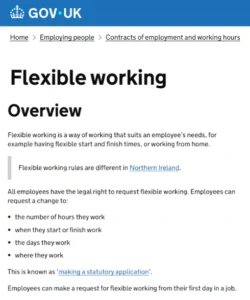
Official UK government guidance explaining flexible working and the legal right to request changes to working arrangements.
What Are the Different Types of Flexible Working?
Flexible working is not limited to remote employment. Organisations can introduce different arrangements depending on their industry, staffing requirements and operational responsibilities.
| Type of flexible working | How it works | Workplace example |
| Flexible hours | Employees vary starting and finishing times | Working 7 am–3 pm instead of 9 am–5 pm |
| Hybrid working | Employees divide their time between home and the workplace | Three office days and two home-working days |
| Remote working | Employees work away from the employer’s premises | A software developer working from home |
| Compressed hours | Full-time hours are completed over fewer days | Working 35 hours over four days |
| Part-time working | Employees work fewer hours than a comparable full-time role | Working 25 hours per week |
| Job sharing | Two employees share the responsibilities of one job | Two people covering one full-time position |
| Staggered hours | Employees have different starting and finishing times | Customer support teams working overlapping shifts |
| Annualised hours | Working hours are calculated over a year | Seasonal businesses adjusting schedules throughout the year |
| Term-time working | Employees work primarily during school terms | Administrative staff with school-holiday arrangements |
How Does Hybrid Working Differ From Remote Working?
Hybrid working combines workplace attendance with remote employment.
Employees might work from the office on selected days while completing other duties from home.
Remote working generally involves working away from the employer’s premises, sometimes on a permanent basis.
Although both models provide location flexibility, hybrid arrangements often require more coordination around office attendance, meetings and equipment.
Employers should also establish suitable cybersecurity arrangements. Having documented remote access policies can help businesses control access to confidential information, manage devices and reduce security risks.
What Is Compressed Working?
Compressed working allows employees to complete their contracted hours across fewer working days.
For example, an employee contracted to work 35 hours weekly might agree to complete those hours across four days, working eight hours and 45 minutes each day.
This could provide an additional non-working day without reducing contracted weekly hours.
However, businesses must still consider statutory rest requirements, fatigue, customer coverage and the practicality of longer shifts.
A compressed working week is also different from a reduced-hours four-day week, where employees work fewer total hours, potentially without a salary reduction if their employer expressly agrees.
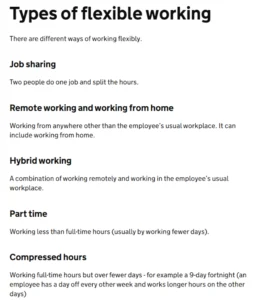
GOV.UK guidance outlining the different types of flexible working available to employees.
Who Is Eligible to Request Flexible Working in the UK?
Employees in England, Scotland and Wales generally have the statutory right to request flexible working from their first day of employment.
The right is not restricted to parents, carers or people with medical conditions.
An employee may request different working arrangements because of education, family commitments, travel requirements, personal wellbeing or other circumstances.
The statutory entitlement depends on employment status, however, and not simply the description of a person’s job.
| Employment category | Statutory flexible working request |
| Full-time employee | Generally eligible from day one |
| Part-time employee | Generally eligible from day one |
| Fixed-term employee | Generally eligible from day one |
| Employee on probation | Generally eligible from day one |
| Agency worker | Depends on actual legal employment status |
| Casual or zero-hours worker | Depends on actual legal employment status |
| Genuinely self-employed contractor | Not generally covered by the employee statutory procedure |
Someone described as a casual or zero-hours worker may still qualify if their legal status is that of an employee. Employment status should therefore be assessed using the actual working relationship.
The legal rules are different in Northern Ireland, where employees should consult the applicable local employment guidance.
An important distinction is that the right to request flexibility does not guarantee that an employer must approve the particular arrangement proposed.
Employers can refuse qualifying requests where one or more permitted business reasons apply, provided they follow the required procedure.
What Are the Flexible Working Rules in 2026?
The main statutory framework for flexible working in Great Britain was updated on 6 April 2024.
Those changes continue to govern requests in October 2026.
The current rules include:
| Legal requirement | Position in October 2026 |
| Minimum employment service | No qualifying service period for employees |
| Number of statutory requests | Two within any 12-month period |
| Simultaneous requests | One live statutory request at a time |
| Application format | Written request |
| Employee explanation of business impact | Not legally required |
| Employer consultation | Required before rejecting a statutory request |
| Decision deadline | Two months, including any appeal, unless extended by agreement |
| Appeal | Good practice, but not an automatic statutory right |
| Refusal | Must rely on one or more permitted business reasons |
These rules make requesting flexible working more accessible than under the former system, which required 26 weeks of employment.
Employees should nevertheless understand that the statutory request procedure is a mechanism for considering changes rather than an unconditional entitlement to choose working arrangements.
How Can Employees Apply for Flexible Working?
Employees should prepare their requests carefully, even though they are no longer legally required to explain how the proposed arrangement might affect their employer.
A clear application helps both parties understand the requested changes and consider whether they are practical.
Step 1: Review Your Employment Contract
Before applying, employees should check their employment contract, staff handbook and company flexible working policy.
Some employers already allow flexible hours or hybrid working without requiring a statutory request.
Where an informal arrangement would meet the employee’s needs, it may be possible to agree it directly with a manager.
However, employees who want to use the statutory procedure should identify their request clearly as a statutory flexible working request.
Step 2: Decide Which Arrangement You Want
The employee should identify the specific change they are requesting.
For example:
- Working from home every Monday and Friday.
- Starting work at 8 am instead of 9 am.
- Reducing working days from five to four.
- Moving from full-time to part-time hours.
- Using compressed hours without reducing weekly contracted hours.
Being specific about hours, days and the intended start date reduces potential misunderstandings.
Step 3: Submit a Written Request
A statutory application must include:
- The date of the request.
- A statement confirming that it is a statutory flexible working request.
- Details of the proposed changes to working hours, times or location.
- The requested commencement date.
- Whether any previous statutory requests have been made to that employer and, if so, when.
Employees do not have to provide a personal justification or explain the expected impact on the business.
Nevertheless, suggesting how the arrangement could work may be commercially helpful.
Example of a Flexible Working Request Email
Subject: Statutory Request for Flexible Working
Dear [Manager’s Name],
I am writing to make a statutory request for flexible working.
I would like to request an adjustment to my current working arrangement, allowing me to work from home on Mondays and Fridays while continuing to attend the office on Tuesdays, Wednesdays and Thursdays.
I would like this arrangement to begin on [Proposed Date].
My contracted hours and existing responsibilities would remain unchanged. I would be available during my normal working hours and would continue attending essential meetings and completing assigned tasks.
I have [not previously made a statutory flexible working request / previously made a request on Date].
I would welcome an opportunity to discuss this proposal and explore any adjustments that may help it operate effectively.
Kind regards,
[Employee’s Name]
This is an illustrative request rather than a real employee testimonial. It can be adapted for different arrangements.
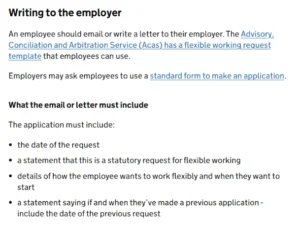
Official guidance showing what information an employee must include in a statutory flexible working application.
How Long Does an Employer Have to Respond to a Flexible Working Request?
Under current legislation, employers must reach and communicate their final decision within two months of receiving a valid statutory request.
This includes the time required for any internal appeal.
For example, if an employee submits a request on 10 November 2026, the normal statutory decision period would expire on 10 January 2027.
The employee and employer can agree to extend the decision period if more time is required.
Employers should confirm any extension in writing to prevent disagreements about the deadline.
A reasonable process usually involves acknowledging the request, assessing operational implications, arranging consultation where necessary and communicating the decision clearly.
If an employer approves the request in full, a consultation meeting is not compulsory.
Can an Employer Refuse a Flexible Working Request?
Yes. An employer can refuse a statutory flexible working request if one or more legally recognised business reasons apply.
However, an employer cannot simply disregard the application or reject it without the required consultation.
The eight permitted reasons are:
| Reason for refusal | Practical business example |
| Additional costs | The arrangement creates costs the business cannot reasonably accommodate |
| Inability to reorganise work | Other employees cannot cover essential responsibilities |
| Inability to recruit additional staff | Suitable replacement or additional cover cannot be obtained |
| Negative impact on quality | The arrangement would materially affect service or product standards |
| Negative impact on customer demand | Customer requirements cannot be met during the proposed hours |
| Negative impact on performance | The working pattern would adversely affect operational performance |
| Insufficient work during requested hours | Limited work is available during the proposed schedule |
| Planned structural changes | A forthcoming restructuring makes the arrangement impractical |
Employers should assess the circumstances of each application rather than automatically treating an entire job category as unsuitable for flexible working.
For example, a manufacturing employee may not be able to perform machine-related duties remotely, but changes to shift start times may still be possible.
Clare McNeil, CEO of Timewise, highlighted this issue in comments published by Acas on 1 October 2026, observing that even shift-based and site-based roles have more room for flexibility than some employers recognise.
Her assessment is especially relevant to retail, hospitality, manufacturing and other industries where working from home is not a realistic option.
Businesses should therefore consider different forms of flexibility before concluding that a position cannot accommodate any changes.
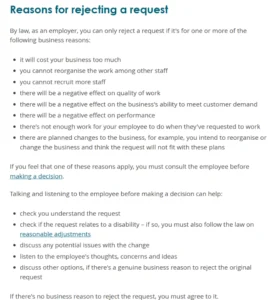
Acas guidance explaining the eight statutory business grounds that may justify refusing a flexible working request.
What Happens After a Flexible Working Request Is Approved?
When an employer approves a statutory request, the agreed change must be reflected in the employee’s contractual terms and conditions.
This is an important distinction between a formal contractual arrangement and an occasional informal agreement to work differently.
The confirmation should make clear:
- The new working days and hours.
- The agreed work location.
- Whether the arrangement is permanent or temporary.
- Any changes to pay or benefits.
- The date the new arrangement begins.
- Any agreed review or trial arrangements.
An employer and employee may also agree to test a working arrangement for a limited period before deciding whether to adopt it permanently.
For example, a company could agree to a three-month hybrid working trial while assessing communication, service coverage and delivery deadlines.
Such a trial should have a clear documented basis, particularly where the alternative arrangement could otherwise be understood as a permanent contractual change.
Formalising the arrangement protects both parties and reduces future disagreements about attendance or working hours.
Does Flexible Working Affect Salary, Holiday Entitlement and Pensions?
Flexible working does not automatically reduce an employee’s salary.
The financial consequences depend on whether the employee changes their total contractual hours or simply works those hours differently.
| Working arrangement | Potential effect on pay and benefits |
| Hybrid working with unchanged hours | Salary generally remains unchanged |
| Flexible start and finish times | No automatic salary reduction |
| Compressed full-time hours | Salary generally remains unchanged |
| Reduced part-time hours | Salary may reduce proportionately |
| Job sharing | Pay generally reflects agreed individual hours |
| Temporary reduced-hours arrangement | Depends on the agreed contractual terms |
For example, an employee earning £35,000 annually for 37.5 hours a week who agrees to reduce their hours to 30 per week might receive a revised annual salary of £28,000 if their pay changes proportionately.
This is an illustrative calculation and assumes no separate pay agreement.
Holiday entitlement must still comply with statutory requirements.
Part-time employees receive statutory holiday entitlement on an appropriate basis, and the employer should ensure that the calculation reflects the actual working pattern.
Pension contributions may also change where pensionable earnings decrease, subject to the pension scheme’s rules.
Employees working from home should separately consider whether they qualify for tax relief on additional household expenses. The eligibility rules are not the same as the rules for flexible working itself.
Our examination of the HMRC working from home allowance explores the distinction between qualifying work-related costs and expenses arising from personal preference.
Current HMRC criteria should always be checked before claiming relief.
What Are the Benefits of Flexible Working for Employees and Employers?
Flexible working can offer advantages to both employees and businesses, although the outcomes depend on how the arrangements are implemented.
Benefits for Employees
Employees may benefit from reduced commuting, greater control over working schedules and improved opportunities to balance professional and personal responsibilities.
Flexible working can also make employment more accessible to people with disabilities, caring responsibilities or other commitments.
For example, staggered starting times may enable an employee to manage school drop-offs while remaining available for the required working hours.
However, flexibility needs clear boundaries. Working from home should not mean employees are expected to remain available outside their contractual hours.
Benefits for Employers
For employers, flexible working can contribute to recruitment, retention and better workforce planning.
The potential advantages include:
- Access to a wider recruitment pool.
- Greater employee satisfaction.
- Improved workforce retention.
- More effective coverage across different business hours.
- Better opportunities to accommodate individual circumstances.
- Potential reductions in unnecessary office-related expenditure.
Flexibility may also influence a business’s ability to compete for experienced employees.
When employers are assessing how to reduce time-to-hire, offering suitable working arrangements can make vacancies more attractive to applicants who require flexibility.
These benefits are not guaranteed. Businesses still need appropriate communication, management systems and measurable performance expectations.
Why Is Flexible Working Becoming More Important in UK Employment?
The growing importance of flexibility is supported by evidence from employees themselves.
An Acas-commissioned YouGov survey of 1,020 employees in Great Britain, conducted between 30 April and 6 May 2026, found the following:
| Employee response | Percentage |
| Flexible working is very important | 45% |
| Flexible working is fairly important | 33% |
| Flexible working is not very important | 13% |
| Flexible working is not at all important | 7% |
| Do not know | 2% |
Together, 78% of respondents described flexible working as important.
Commenting on the findings in October 2026, Acas Chair Baroness Maggie Jones emphasised that successful flexible working arrangements can benefit employers, staff and the wider economy.
Her remarks underline an important commercial issue: flexible working is increasingly connected to workforce participation and retention, not merely employee convenience.
Minister for the Future of Work Kate Dearden also connected workplace flexibility with retaining experienced staff, explaining that suitable arrangements can influence whether an employee remains in a role.
For businesses experiencing recruitment difficulties, this makes flexibility an important consideration within longer-term workforce planning.
How Can Small Businesses Successfully Introduce Flexible Working?
Smaller employers may face different operational challenges from larger organisations.
A business with five employees may find it harder to reorganise responsibilities than one with several departments and established staffing cover.
However, this does not mean smaller businesses should automatically exclude flexibility.
A practical approach begins by identifying which functions require fixed attendance and which activities can be reorganised.
Establish Clear Working Expectations
Employers should document expected working hours, communication standards, availability requirements and performance responsibilities.
A hybrid employee, for example, should understand which meetings require physical attendance and whether their working pattern permits changes to office days.
Assess Roles Rather Than Making Assumptions
Not every position can support the same arrangement.
A warehouse worker and a marketing analyst may have very different requirements, but each role could offer some form of flexibility.
Employers should assess practical alternatives, including staggered shifts, annualised hours and job sharing.
Use Objective Performance Measures
Managers should evaluate working arrangements using outcomes rather than assumptions about productivity.
Relevant measures may include project completion, service standards, customer response times, employee feedback and quality of work.
Businesses can also assess recruitment and retention trends to understand whether flexible working contributes to improved workforce stability.
Maintain Workplace Equality
Managers should follow consistent procedures and avoid assuming that employees with certain personal circumstances automatically deserve priority over others.
A supportive working environment also involves regular communication, access to training and realistic workload expectations.
These principles align with the wider importance of creating a supportive environment for employees, particularly when teams operate across different locations and schedules.
What Should Employers Include in a Flexible Working Policy?
A clear written flexible working policy helps employees understand their rights and helps managers apply procedures consistently.
A practical policy should explain who can request flexible working, the distinction between statutory and informal requests, how applications are submitted and how the employer reaches decisions.
It should also address consultation meetings, written outcomes, appeals, confidentiality, contractual variations and arrangements for reviewing agreed patterns.
Employers should train managers to assess requests based on genuine operational requirements.
Where a proposal is difficult to accommodate, managers should consider whether a modified schedule, alternative working location or trial period could address the concern.
For example, if a customer services employee asks to finish at 3 pm but the business requires cover until 5 pm, the employer could explore staggered team schedules rather than immediately refusing the request.
A documented decision-making process also helps businesses demonstrate that they have applied their policy consistently.
What Flexible Working Law Changes Are Expected in 2027?
The Employment Rights Act 2025 introduces further changes intended to strengthen the framework around flexible working requests.
As of October 2026, important additional requirements are expected to take effect in autumn 2027, subject to the relevant implementation process.
The planned changes include a stronger reasonableness test when employers refuse statutory requests.
Under the revised framework, employers will need to explain why refusing an employee’s request is reasonable in the circumstances, relying on one or more of the existing statutory business reasons.
There will also be more detailed mandatory consultation requirements before an employer can refuse a request.
| Area | Rules applying in October 2026 | Expected changes in autumn 2027 |
| Right to request from day one | Already applies | Continues |
| Maximum requests | Two in 12 months | Continues unless further amended |
| Employer response period | Two months | Continues unless further amended |
| Consultation | Required before refusal | More detailed mandatory requirements |
| Grounds for refusal | Eight statutory business reasons | Existing grounds retained |
| Reasonableness of refusal | Existing procedural and permitted-ground requirements | Additional reasonableness test |
| Explanation of refusal | Business reasons must be communicated | Stronger requirement to explain why refusal is reasonable |
These reforms have not all taken effect as of 31 October 2026.
Employers should therefore avoid treating draft consultation provisions as rules already in force.
For SMEs, preparation should involve reviewing flexible working policies, manager training and decision records ahead of implementation.
What Can Employees Do if Their Flexible Working Request Is Rejected?
An employee whose request has been refused should first review the employer’s explanation and consider whether the proposed arrangement could be modified.
It may be possible to agree different days, a revised schedule or a temporary trial.
Employees should also check whether the employer provides an appeals procedure.
There is currently no automatic statutory right to appeal a flexible working decision. However, Acas recommends offering an appeal as part of a reasonable procedure.
If an appeal is available, the employee should identify any errors, provide additional relevant information and explain the outcome they are seeking.
Where the refusal involves potential discrimination, unreasonable handling, incorrect facts or failure to follow legal requirements, the employee may have grounds to pursue the matter further.
An employment tribunal does not automatically overturn an employer’s decision simply because the employee disagrees with it.
Instead, the tribunal considers the legal grounds available in the circumstances.
For complaints arising on or after 1 October 2026, the usual tribunal time limit for flexible working complaints is six months from the relevant decision or event, subject to applicable rules and adjustments for Acas early conciliation. Earlier events may have shorter deadlines.
Employees should seek advice promptly because an internal appeal does not necessarily protect a tribunal deadline.
Where a disagreement develops into a wider employment dispute, appropriate legal advice can help clarify the available remedies.
Depending on the issue, an experienced specialist in employment law may be able to advise on contractual rights, discrimination and tribunal proceedings.
What Are the Most Common Mistakes Employers and Employees Should Avoid?
Flexible working disputes often arise from unclear expectations or procedural mistakes rather than disagreement about flexibility itself.
Common problems include:
- Assuming every flexible working request must be approved.
- Believing only parents or carers can make statutory requests.
- Using an outdated 26-week eligibility requirement.
- Failing to identify an application as a statutory request.
- Overlooking the two-month decision deadline.
- Refusing a request without consulting the employee.
- Automatically rejecting remote or flexible arrangements for an entire workforce category.
- Introducing a permanent change without confirming contractual terms.
- Confusing existing rules with reforms planned for 2027.
For employers, the most important precaution is to maintain a fair, evidence-based decision-making process.
For employees, the strongest approach is usually a clear written request supported by a practical willingness to discuss alternatives.
Frequently Asked Questions About Flexible Working
Is Flexible Working a Legal Right in the UK?
Employees have a statutory right to request flexible working from their first day of employment. This does not automatically guarantee approval.
Can an Employer Say No to Flexible Working?
Yes. Employers can refuse statutory requests for one or more of the eight permitted business reasons, provided they follow the required procedure.
Can I Request Flexible Working During Probation?
Yes. Employees can make statutory flexible working requests from day one, including during probation.
How Many Flexible Working Requests Can I Make in a Year?
Employees can make up to two statutory flexible working requests in any 12-month period, but only one can remain live at a time.
Do I Need to Explain Why I Want Flexible Working?
No. Employees are not legally required to give personal reasons or explain the expected business impact when making a statutory request.
Does Flexible Working Mean Working From Home?
Not necessarily. Flexible working also includes compressed hours, staggered shifts, job sharing, part-time schedules and other arrangements.
Can Flexible Working Reduce My Salary?
It depends on the agreement. Reduced contracted hours may lead to lower pay, while changes to working location or the distribution of unchanged hours do not automatically reduce salary.
What Happens if My Employer Ignores My Request?
A failure to handle a valid statutory request properly or meet the relevant deadline may provide grounds for further action, including a potential employment tribunal complaint.
What is your reaction?