How to Avoid Paying Council Tax on an Empty Property: Exemptions, Discounts, and Rules

Last Updated: 26 October 2026
Owning an empty property does not automatically mean you can stop paying Council Tax.
In most cases, an empty residential property remains liable for Council Tax, and a long-term empty home can actually become more expensive because the local council may add an empty home premium.
However, there are legitimate situations where the normal bill can be reduced or removed, or where an owner can qualify for an exception from the additional empty home premium.
These include certain probate cases, properties undergoing major structural work, genuinely derelict homes, properties being actively marketed for sale or rent and other statutory exemptions.
The exact position also depends on where the property is located because England, Scotland and Wales operate different rules, while Northern Ireland uses domestic rates rather than Council Tax.
When Is Council Tax Payable On An Empty Home?
An empty property will usually still be liable for Council Tax. Simply removing furniture, switching off utilities or leaving a house unoccupied does not create an automatic exemption.
In England, the local council can decide whether to offer a discount on an empty property.
The amount and duration of any discount can therefore vary between council areas. Owners should check their local policy rather than assuming there is a national grace period.
There are separate rules for properties that qualify for statutory exemptions. Circumstances involving probate, repossession, residential care or a property that legally cannot be occupied can produce very different results.
It is therefore worth checking both the property’s circumstances and the available Council Tax discounts before assuming the full bill must be paid.
Empty Property Council Tax Rules In 2026
The most important rule for owners in England is the long-term empty homes premium.
A property is treated as a long-term empty home for this purpose when it has been unoccupied and substantially unfurnished continuously for at least one year.
Councils have discretion over whether to impose the premium and the level they charge, subject to the statutory maximum.
The maximum rates in England are:
| Length Of Time Empty | Maximum Premium | Maximum Total Council Tax |
| Less Than 1 Year | No Long-Term Empty Premium | 100% |
| 1 To Under 5 Years | 100% Extra | 200% |
| 5 To Under 10 Years | 200% Extra | 300% |
| 10 Years Or More | 300% Extra | 400% |
These are maximum levels rather than automatic national charges. Individual councils can choose a lower premium or decide how the premium applies locally.
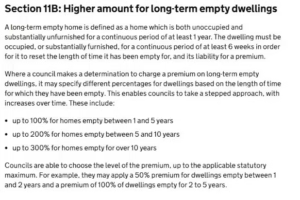
GOV.UK confirms England’s empty-home premium thresholds and the maximum charges that can apply to long-term empty properties.
Does Buying An Empty Property Reset The Empty Period?
No. Purchasing a property does not automatically restart the empty-home premium clock.
In England, the length of time is attached to the property’s continuous period of being empty rather than simply how long the current owner has owned it.
For example, if a property has already been empty and substantially unfurnished for several years when it is purchased, the new owner could inherit a property that already falls within one of the higher premium periods.
Prospective buyers should therefore establish how long a property has been empty before completing a purchase.
There is also an important reset rule.
For England’s long-term empty premium, the property generally needs to become occupied or substantially furnished continuously for at least six weeks before the previous empty period is reset.
When Can You Avoid Paying Council Tax On An Empty Property?
There is no single loophole that removes Council Tax simply because a house is vacant.
Instead, owners need to establish whether the property qualifies for a statutory exemption, local discount, discretionary reduction or exception from the empty home premium.
Council Tax Exemptions
Certain empty properties may qualify for a full Council Tax exemption.
Depending on the circumstances, exemptions can apply to properties such as:
- Probate Properties: Certain homes left empty following the death of the owner or occupier can qualify
- Repossessed Properties: An exemption can apply where a mortgage lender has repossessed an unoccupied home
- Care Home Cases: A former home may qualify where the resident has moved permanently into residential care or hospital
- Properties That Cannot Legally Be Occupied: An exemption can apply where occupation is prohibited by law
- Compulsory Purchase Cases: Certain empty homes awaiting demolition following compulsory purchase can qualify
The wider rules on who is exempt from Council Tax are important because eligibility normally depends on the reason the property is empty rather than emptiness alone.
Local Council Discounts And Reductions
Even when a statutory exemption does not apply, a council may have discretion to reduce the amount charged.
In England, local councils can decide whether to provide discounts for empty properties and how generous those discounts should be.
That means two otherwise similar empty homes in different council areas can face different bills.
There is also a wider discretionary power under Section 13A of the Local Government Finance Act 1992.
A billing authority can reduce Council Tax further where it considers this appropriate, including potentially reducing liability to zero. This is discretionary rather than an automatic entitlement.
Owners seeking discretionary help should normally explain why the property is empty, what action they are taking and why the normal Council Tax charge would be unreasonable in their particular circumstances.
Empty Home Premium Exceptions
An important distinction exists between a Council Tax exemption and an empty home premium exception.
A premium exception may remove the additional premium but leave the property’s ordinary Council Tax bill payable.
In England, mandatory premium exceptions include:
| Exception | Class | Typical Maximum Period |
| Actively Marketed For Sale | Class G | 12 Months |
| Actively Marketed For Let | Class H | 12 Months |
| Recent Probate | Class I | 12 Months From Probate Or Letters Of Administration |
| Major Repairs Or Structural Alterations | Class M | Up To 12 Months |
There are also premium exceptions covering qualifying annexes and homes connected with armed forces accommodation.
For properties being sold or let, simply putting up an advertisement may not be enough.
Councils can consider whether the property is genuinely advertised, whether the asking price or rent reflects the market, whether there are artificial barriers preventing a transaction, whether the property has an EPC and whether reasonable steps are being taken to secure a buyer or tenant.
Keeping copies of estate-agent agreements, listings, EPC records, viewing records and correspondence can therefore help demonstrate that the property is genuinely being marketed.
Council Tax On An Empty Property After Someone Dies
Council Tax rules following a death can be particularly confusing because the exemption and premium rules operate separately.
Where a property has been left empty following the death of its owner or occupier, it can generally remain exempt while it is unoccupied and probate or letters of administration have not yet been granted.
Following probate, a further exemption of up to six months can be available provided the property remains unoccupied and has not been sold or transferred to a beneficiary.
There is also a separate Class I exception from the empty-home premium. This can run for up to 12 months from the date probate is granted or letters of administration are issued.
The six-month Council Tax exemption and 12-month premium exception can therefore overlap.
Once the ordinary exemption ends, standard Council Tax may become payable even though the additional empty-home premium remains excluded for part of the 12-month period.
Executors should notify the council promptly and retain the grant of probate or letters of administration together with evidence showing that the property remains unoccupied.
Does Renovating An Empty Property Stop Council Tax?
Renovating a property does not automatically stop Council Tax.
Replacing a kitchen, fitting a new bathroom, redecorating, replacing windows, rewiring or carrying out minor roof repairs will not normally be enough by themselves to remove a property from the Council Tax list.
For England and Wales, the official valuation guidance distinguishes ordinary repairs from major renovation and genuine dereliction.
A property undergoing substantial redevelopment that leaves it incapable of occupation may potentially be removed from the Council Tax list.
Major Structural Repairs
Major renovation can include substantial structural work affecting most of the property, such as:
- Structural Alterations: Significant changes to the building’s structure
- Extensive Strip-Out Work: Removal of walls, floors, ceilings, fixtures or fittings
- Major Fire Or Flood Repairs: Large-scale reconstruction affecting most of the home
- Serious Reconstruction: Work that makes the property incapable of being occupied while it is carried out
In England, an empty home that requires or is undergoing qualifying major repairs or structural alterations can also receive the Class M exception from the empty-home premium for up to 12 months.
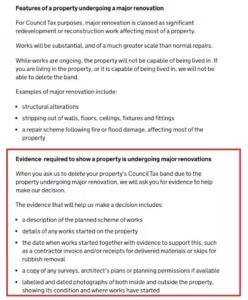
GOV.UK explains when major renovation or dereliction can justify removing a property from the Council Tax list and the evidence needed to support a request.
Derelict And Uninhabitable Properties
A property does not become derelict merely because it needs substantial modernisation.
The official guidance says genuine dereliction can involve serious problems such as collapsed ceilings, major roof damage, extensive structural rot, damaged floor joists, missing external doors or windows and stripped services.
If the property is genuinely incapable of normal repair without major reconstruction, it may qualify to be removed from the Council Tax valuation list.
Council Tax would no longer be payable while the property remains deleted from the list.
Useful evidence can include:
- Dated Photographs: Images showing the condition of all relevant parts of the property
- Structural Reports: Professional evidence describing major defects
- Contractor Documents: Invoices and records showing when substantial work began
- Architectural Plans: Plans showing the proposed reconstruction
- Planning Documents: Relevant permissions or applications
- Work Specifications: Details of what must be completed before the property becomes habitable
Who Pays Council Tax Between Tenancies?
For landlords, an empty period between tenants can create Council Tax liability even when the void period lasts only a short time.
The general position is that the owner becomes responsible when the property is empty and there is no tenant who remains liable under the applicable rules.
Certain HMOs can also make the property owner responsible rather than individual occupiers.
England also introduced significant private-tenancy changes on 1 May 2026 through the Renters’ Rights Act.
Assured private tenancies generally became periodic, and the legislation changed the treatment of a tenant’s material interest for Council Tax purposes.
Where a tenant serves notice, liability can continue for the duration of the tenancy, including until the end of the notice period.
Landlords should therefore keep clear records of:
- Tenancy Start Dates
- Tenancy End Dates
- Tenant Notices
- Dates Keys Were Returned
- Dates New Tenants Became Liable
- Periods When The Property Was Completely Empty
If there is uncertainty about which authority should receive payment, the rules on who you pay Council Tax to can help identify the relevant billing authority.
What Evidence Do You Need To Claim An Exemption Or Reduction?
The evidence required depends on what you are claiming.
A council dealing with an empty property may ask for documents showing why it is empty, how long it has been empty and what steps are being taken to bring it back into use.
Useful evidence can include:
- Probate Documents: Grant of probate, letters of administration and evidence of ownership
- Estate Agent Records: Marketing agreements, online listings and viewing records
- Letting Documents: Letting-agent instructions, rental advertisements and proposed tenancy information
- Energy Performance Certificate: Particularly where the property is being marketed
- Building Evidence: Structural reports, photographs, invoices and building plans
- Occupancy Evidence: Utility records or other documentation establishing when occupation began or ended
- Council Correspondence: Copies of previous decisions, exemptions and premium notices
For sale and letting premium exceptions in England, councils can assess whether marketing is genuine rather than relying on the existence of an advertisement alone.
Keeping evidence from the beginning of the empty period can make it much easier to resolve a later dispute.
What To Do If The Council Refuses Your Exemption Or Discount?
If you believe the council has incorrectly charged Council Tax, refused an exemption or applied an empty-home premium that should not apply, contact the council first.
Explain which part of the decision you dispute and provide supporting evidence.
In England, GOV.UK states that the council has two months to respond to a formal challenge about a Council Tax bill.
If the council rejects the challenge, or does not respond within the required period, an appeal may be possible to the Valuation Tribunal.
Normally, you should continue paying the Council Tax shown on the existing bill while the dispute is being considered. If the decision is later changed, the council can revise the account and adjust any overpayment.
A separate process applies where the dispute concerns whether a derelict or substantially renovated property should remain in the Council Tax valuation list.
Empty Property Council Tax Rules In England, Scotland, Wales And Northern Ireland
Council Tax rules are not identical throughout the UK.
England
In England, councils can impose an empty-home premium once a property has been unoccupied and substantially unfurnished continuously for at least one year.
The maximum premium is:
- One To Five Years: Up to 100% extra
- Five To Ten Years: Up to 200% extra
- Ten Years Or More: Up to 300% extra
Individual councils decide whether to use the premium and at what level within the statutory limits.
Scotland
Scotland has separate rules.
From 1 April 2026, Scotland introduced a national default Council Tax premium of 100% for second homes and long-term empty homes.
Local authorities have powers to set premiums above or below that default, impose no premium or apply a discount according to local circumstances and the Scottish framework.
Owners should therefore check the policy of the Scottish local authority where the property is situated.
Wales
Welsh councils can impose premiums on long-term empty properties that have been empty for more than 12 months.
Since April 2023, local authorities have had powers to set a premium of up to 300% of the standard Council Tax rate. The actual premium differs by authority.
Wales also has specific exceptions for circumstances such as properties genuinely being marketed for sale or letting.
Northern Ireland
Northern Ireland does not operate Council Tax.
Residential properties instead fall under the domestic rates system.
Empty domestic properties generally face the same rates as occupied properties unless an exclusion applies.
The owner is normally responsible for paying rates on an empty property.
If the property is commercial rather than residential, Council Tax may not be the relevant charge at all. Different rules apply to business rates on an empty property.
Ways To Reduce Council Tax Legally On An Empty Property
The most effective approach is to establish exactly why the property is empty and apply the correct rule rather than simply stopping payment.
Property owners should consider the following:
- Check For A Statutory Exemption: Establish whether the circumstances fall within an exempt class
- Ask About Local Discounts: Councils may operate their own empty-property discount policies
- Apply For A Premium Exception: Sale, letting, probate and major repairs may qualify in England
- Request A Discretionary Reduction: Section 13A may provide additional help where the council considers it appropriate
- Keep Evidence Of Marketing: Maintain listings, estate-agent correspondence, EPC records and viewing information
- Document Major Works: Keep photographs, invoices, surveys and structural reports
- Notify The Council Promptly: Report changes in ownership, occupation and property condition
- Challenge Incorrect Decisions: Use the appropriate council or valuation appeal process where supported by evidence
None of these methods involves hiding occupancy, creating artificial tenancies or providing misleading information. The reduction must be supported by the property’s genuine circumstances.
Conclusion
An empty property does not automatically qualify for free Council Tax.
In many cases, the owner will continue paying the normal charge, and keeping the property empty for a long period can result in substantially higher bills.
The legitimate ways to reduce or avoid the charge depend on the circumstances.
Statutory exemptions can remove Council Tax entirely in qualifying cases, while local discounts and discretionary reductions can lower the bill.
England also provides specific exceptions from the empty-home premium for circumstances including probate, genuine marketing for sale or letting and major structural repairs.
Property owners should check their council’s current policy, keep evidence supporting any claim and notify the authority whenever the property’s circumstances change.
This is particularly important because empty-property rules differ significantly between England, Scotland, Wales and Northern Ireland.
Frequently Asked Questions
How Long Can A House Be Empty Without Paying Council Tax?
There is no general UK rule allowing a property to remain empty for a fixed period without Council Tax.
In England, an empty home will normally remain liable unless a discount or exemption applies, and an additional premium can begin after one year.
Do You Pay Council Tax On An Empty Unfurnished Property?
Usually, yes. In England, simply leaving a property empty and substantially unfurnished does not automatically remove Council Tax liability.
Local discounts or statutory exemptions may change the amount payable.
Can An Empty House Be Charged Double Council Tax?
Yes. In England, a council can impose a premium of up to 100% once a qualifying property has been empty for at least one year, resulting in a maximum total bill of 200% of the normal amount. Higher premiums can apply after five and ten years.
Can You Be Charged 400% Council Tax On An Empty House?
In England, yes. A property that has been continuously empty for at least ten years can face a premium of up to 300% on top of the normal bill, making the maximum total charge 400%.
Whether the maximum is actually charged depends on the council’s policy.
Does Buying An Empty Property Reset The Council Tax Premium?
No. In England, the empty period generally relates to the property rather than the current owner’s ownership period.
Buyers should check how long a property has already been empty before purchasing it.
How Long Must Someone Live In A Property To Reset The Empty Period?
For England’s long-term empty-home premium, the property generally needs to be occupied or substantially furnished continuously for at least six weeks before the previous empty period resets.
Do You Pay Council Tax While An Empty House Is Being Sold?
Usually, yes. However, in England a qualifying property that is actively marketed for sale can receive a Class G exception from the additional empty-home premium for up to 12 months.
Standard Council Tax can still remain payable unless another exemption or discount applies.
Do You Pay Council Tax While An Empty House Is Being Renovated?
Routine refurbishment does not automatically remove Council Tax.
Major structural work may qualify for a local discount, a temporary exception from the empty-home premium or, where the property is undergoing sufficiently substantial renovation and cannot be occupied, removal from the Council Tax list.
Is An Empty Property Exempt From Council Tax After Someone Dies?
A qualifying empty property can generally remain exempt before probate is granted.
A further exemption of up to six months may continue after probate if the property remains unoccupied and has not been sold or transferred.
What is your reaction?