
Pension IHT Rule Changes 2027: What UK Families Need to Know?

The pension IHT rule changes 2027 will bring most unused pension funds and pension death benefits into a deceased person’s estate for Inheritance Tax (IHT) when death occurs on or after 6 April 2027.
The reform is now law following Royal Assent to Finance Act 2026 on 18 March 2026, although further implementation guidance is still being developed.
Crucially, this does not mean every inherited pension will automatically face a 40% charge.
IHT depends on the value of the whole estate, available nil-rate bands, exemptions, the beneficiary and whether the pension benefit itself is included or specifically excluded.
What Exactly Will Change Under the Pension IHT Rules in 2027?

Most discretionary pension funds currently sit outside a person’s estate for IHT because trustees or scheme administrators decide who receives the death benefits.
Some non-discretionary arrangements have already been treated differently.
From 6 April 2027, trustee discretion will generally stop determining whether unused pension wealth is within the IHT calculation.
Finance Act 2026 instead introduces the concept of notional pension property, covering most relevant unused pension funds and death benefits.
The change has developed over several stages. It was announced at Autumn Budget 2024, followed by a consultation running from 30 October 2024 to 22 January 2025.
A response published on 21 July 2025 confirmed that personal representatives, rather than pension scheme administrators, would generally report and pay the IHT.
The policy background also refers to pension freedoms introduced in 2015 and changes surrounding the lifetime allowance in March 2023. The government’s stated objective says:
“This measure removes distortions which have led to pension schemes being increasingly used and marketed as a tax planning vehicle to transfer wealth.”
Importantly, the date of death controls which regime applies. A member who dies before 6 April 2027 remains under the current rules even if beneficiaries receive pension benefits later.
Why Do the 2027 Rules Matter More Than the Headline “40% Pension Tax” Suggests?
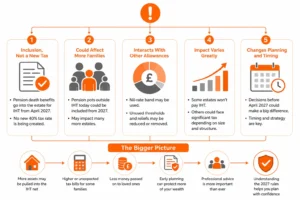
Calling the reform a “40% pension tax” gives an incomplete picture.
The normal IHT rate is 40%, but it generally applies only to the chargeable value remaining after relevant exemptions, reliefs and nil-rate bands have been considered.
How the position changes:
| Issue | Before 6 April 2027 | Death On or After 6 April 2027 |
| Most discretionary unused pensions | Generally outside the estate | Usually included in the IHT calculation |
| Standard nil-rate band | £325,000 | £325,000 |
| Qualifying spouse/civil partner transfer | Exempt | Exemption maintained |
| Qualifying death-in-service benefit | Generally outside IHT | Specifically excluded |
| Trustee discretion | Important to IHT treatment | No longer decides whether most pension wealth is in scope |
The £325,000 nil-rate band remains relevant, while qualifying estates may also use the residence nil-rate band. Transfers between spouses and civil partners can preserve important exemptions.
Charitable planning can also alter the effective rate. Where the statutory conditions are met and at least 10% of the relevant estate component passes to qualifying charities, the IHT rate on that component can reduce from 40% to 36%.
Therefore, pension inclusion increases the estate value used in the calculation; it does not automatically mean 40% is deducted from every pension pot.
Which Pension Funds and Death Benefits Could Fall Within IHT From April 2027?
The legislation reaches further than untouched personal pension pots. It can apply across money purchase arrangements and certain death benefits arising from other pension structures.
Defined Contribution Pensions and Unused Pension Wealth
Relevant money purchase arrangements can include personal pensions, SIPPs and workplace defined contribution schemes, including unused funds held in drawdown.
Specialist arrangements such as SSASs and qualifying non-UK pension schemes may also require consideration depending on the circumstances.
The calculation focuses on property available immediately before death to provide benefits following the member’s death. That means an already-accessed pension can still contain value that becomes relevant.
Defined Benefit and Other Pension Death Benefits
Defined benefit schemes are not subject to one blanket rule. Relevant lump-sum death benefits and some guaranteed continuing payments may enter the calculation, while qualifying dependants’ scheme pensions are excluded.
Guarantee payments can matter where a pension or annuity continues after death under a guarantee period.
The legislation therefore distinguishes between capital-like death benefits and qualifying survivor income rather than simply classifying every defined benefit pension as taxable or exempt.
How Will Pension Values Be Identified After Death?
Pension administrators will normally establish the open-market value at the date of death.
If a final value cannot be provided within 28 days of a request, an estimated figure and its basis must be supplied, followed by the final valuation when available.
The detailed valuation, scope and beneficiary rules are set out in the technical pension inheritance tax rules.
This valuation process makes accurate pension records increasingly important because personal representatives may have to trace several historic schemes before completing the estate’s IHT position.
Which Pension Benefits Could Still Remain Outside Inheritance Tax?
Several important exclusions prevent the 2027 reform from treating every pension-related payment identically.
Benefits that may remain excluded include:
- Qualifying dependants’ scheme pensions paid after the member’s death.
- Trivial commutation benefits representing an otherwise excluded dependant pension.
- Qualifying dependant or nominee annuities purchased together with the member’s lifetime annuity.
- Qualifying death-in-service benefits linked to employment or other qualifying work immediately before death.
- Certain qualifying charitable pension death benefits.
Death-in-service protection needs particular care. A payment linked to the member’s current employment can qualify, while a separate payment from an old deferred pension arrangement may not satisfy the same exclusion.
There is also a difference between an excluded benefit and an exempt beneficiary.
A qualifying spouse or civil partner benefit may still be included when pension property is valued, with the appropriate IHT exemption then claimed so that tax is not charged on that value.
That distinction is important because “included in the estate calculation” does not always mean “subject to an IHT bill”.
How Could the Pension IHT Rule Changes 2027 Affect Tax Allowances and £2 Million Estates?

Including pension wealth can change more than the amount sitting above the standard £325,000 nil-rate band. It may also affect access to the residence nil-rate band for larger estates.
Residence Nil-Rate Band Taper
The residence nil-rate band is currently £175,000 where a qualifying residence passes to direct descendants.
Together with the standard £325,000 nil-rate band, this can provide a £500,000 allowance for a qualifying individual, while transferable unused bands can potentially take a qualifying married couple or civil partnership to £1 million.
However, the residence nil-rate band starts tapering once the estate exceeds £2 million, reducing by £1 for every £2 above that threshold. The relevant bands and taper are frozen at current levels through 2030–31.
The current figures can be checked in the official inheritance tax thresholds.
Why Larger Pension Pots May Have a Wider Tax Effect?
An unused pension could move an estate above £2 million even when the non-pension assets were previously below it.
In that situation, pension inclusion may increase the taxable estate while simultaneously reducing the available residence nil-rate band.
Key thresholds:
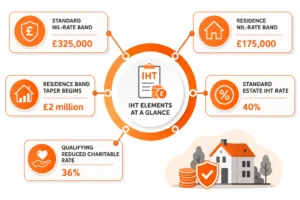
| IHT Element | Current Figure |
| Standard nil-rate band | £325,000 |
| Residence nil-rate band | £175,000 |
| Residence band taper begins | £2 million |
| Standard estate IHT rate | 40% |
| Qualifying reduced charitable rate | 36% |
The interaction between these thresholds means pension wealth should be assessed as part of the entire estate rather than viewed as a separate tax calculation.
Will Beneficiaries Face Both Inheritance Tax and Income Tax on Pension Benefits?
Some beneficiaries can encounter both tax systems, but describing the result as straightforward double taxation on the same gross pension amount would be misleading.
Existing Income Tax rules continue to matter. Where a member dies before age 75, qualifying death benefits can often be paid without Income Tax subject to the relevant pension rules and lump-sum death benefit allowance.
Where the member dies aged 75 or older, beneficiary withdrawals are generally taxable as pension income at the recipient’s applicable Income Tax rate.
From April 2027, IHT can additionally arise because pension wealth forms part of the estate. However, legislation provides an adjustment where IHT is paid from or attributable to pension death benefits.
Where a payment notice is used, pension benefits are reduced by the IHT paid and Income Tax is then charged on the pension amount net of that IHT.
If a beneficiary pays IHT another way after taking taxable benefits, the rules provide for the taxable pension income to be adjusted, although further detailed guidance is expected.
Age 75 therefore remains significant after the 2027 IHT reform because it continues to influence the separate Income Tax treatment of inherited pension benefits.
Who Will Deal With Pension IHT After Someone Dies?

The new regime creates a coordinated process involving personal representatives, pension administrators, beneficiaries and tax authorities rather than shifting all responsibility to pension providers.
Personal Representatives and Estate Reporting
Personal representatives will generally be responsible for identifying pension schemes, obtaining values, reporting the estate and paying IHT.
Tax on notional pension property is normally due by the end of the sixth month after death, after which late-payment interest can arise.
They may also need to amend an IHT account if a previously unknown pension is discovered later.
Pension Scheme Administrators and Information Sharing
Administrators will have to provide pension values and beneficiary information within specified timescales.
Valuation information is generally due within 28 days of request, while some beneficiary information is due by the later of 28 days from request or 14 days after beneficiaries are determined.
Draft requirements are available through the official pension information sharing rules.
The planned system is designed to allow information to move before probate is granted, which is significant because pension values may be needed to establish the IHT position before the grant.
How Can IHT Be Paid From Pension Funds?
The Pensions Direct Payment Scheme will allow a valid notice to instruct a registered pension scheme to pay pension-related IHT directly. A valid payment generally has to be made within 35 days of receipt.
Where IHT may be due, personal representatives can also use a withholding notice allowing up to 50% of relevant benefit entitlement to be retained, generally for up to 15 months.
This is not intended to be routine and does not apply in the same way to excluded benefits or exempt beneficiaries.
These mechanisms are intended to reduce the risk that the estate’s other assets have to fund tax attributable to pension benefits.
How Many UK Estates Could Actually Be Affected by the 2027 Change?
The government’s impact assessment indicates a noticeable increase in affected estates, although most estates are still expected to have no IHT liability.
Published estimates include:
- Around 213,000 estates are expected to contain inheritable pension wealth in 2027–28.
- About 10,500 estates may become liable for IHT where they previously would not.
- Around 38,500 estates may pay more IHT than under the previous rules.
- The average additional IHT liability among affected estates is estimated at around £34,000.
- Forecast Exchequer receipts are £640 million in 2027–28, £1.34 billion in 2028–29 and £1.46 billion in 2029–30.
- Around 75% of IHT400 forms are currently submitted by agents and 25% by non-professional personal representatives.
- One-off business transition costs are estimated at £60 million, with ongoing costs of about £5 million a year and a net annual administrative burden of £5 million.
The assessment also notes that 81% of IHT is paid by estates of people aged 75 or over.
It cites UK life expectancy data for 2020–22 showing female life expectancy at birth about four years longer than male life expectancy, partly explaining differences observed in estate data.
These projections are described as static estimates and can change if pension holders alter withdrawals, gifting or other financial behaviour before 2027.
What Should Pension Holders Review Before the Rules Start on 6 April 2027?

The reform gives pension holders a reason to reassess pensions alongside property, savings, investments, wills and beneficiary arrangements rather than treating pensions as a separate inheritance vehicle.
Areas worth reviewing include:
- Record every pension arrangement so personal representatives can identify schemes quickly.
- Review pension beneficiary nominations and expression-of-wish forms.
- Recalculate the estate including unused pension wealth.
- Check whether pension inclusion could move the estate above £325,000, £500,000, £1 million or the £2 million residence-band taper threshold.
- Consider retirement withdrawals in the context of lifetime income needs and Income Tax rather than withdrawing solely to avoid IHT.
- Review lifetime gifting, including potentially exempt transfers and the normal-expenditure-out-of-income exemption where its conditions are genuinely met.
- Consider charitable giving where it matches the person’s intentions and tax position.
Withdrawing pension funds is not automatically an IHT solution. A withdrawal may create an Income Tax charge, and money retained afterwards can simply become another asset inside the estate.
For charitable giving, qualifying legacy arrangements can reduce the estate and, where the statutory 10% test is satisfied, can reduce the relevant IHT rate from 40% to 36%.
Some pension income may also support lifetime charitable giving through Payroll Giving where the payer participates, while eligible taxed donations may qualify for Gift Aid.
The strongest approach is therefore to review the whole estate before changing how pension savings are used.
Conclusion
The pension IHT rule changes 2027 represent a major change in how pensions interact with UK estate planning.
For deaths on or after 6 April 2027, most unused pension funds and pension death benefits will be considered alongside the rest of the estate when IHT is calculated.
The reform is now legislated, but important exclusions remain for qualifying benefits and existing exemptions can protect transfers to spouses, civil partners and qualifying charities.
Pension inclusion may also affect the £2 million residence nil-rate-band taper, while separate Income Tax rules continue to apply to inherited pension benefits.
Families therefore need to look beyond the headline 40% rate and consider pension type, estate value, beneficiary status, allowances and administration together. Further operational guidance and supporting tools are expected before the rules take effect.
FAQs
Does the 2027 Rule Apply if Someone Dies on 5 April 2027?
No. The new pension IHT treatment applies to deaths on or after 6 April 2027, so a death on 5 April 2027 remains subject to the existing rules.
Does It Matter if a Pension Payment Is Made After 6 April 2027?
The payment date does not by itself determine which IHT regime applies. If the pension member died before 6 April 2027, the existing rules continue even when benefits are paid later.
Will Leaving a Pension to a Spouse Still Be Tax-Efficient?
Transfers to a qualifying surviving spouse or civil partner can continue to benefit from the normal IHT exemption. The inherited wealth may, however, become relevant when the surviving spouse or civil partner later dies.
Do Pension Beneficiary Nominations Still Matter After April 2027?
Yes, because trustees and administrators may still use nominations when deciding who should receive discretionary death benefits.
The nomination itself will no longer generally determine whether relevant pension wealth is inside or outside the IHT calculation.
Should Someone Withdraw Their Whole Pension Before the New Rules Begin?
A full withdrawal is not automatically tax-efficient because it may create Income Tax and leave the withdrawn cash inside the person’s estate.
Any withdrawal strategy therefore needs to consider retirement income requirements as well as IHT.
Could an Inherited Pension Still Be Income-Tax-Free After a Death Before 75?
Potentially, subject to the existing pension death-benefit rules and applicable allowances. From April 2027, that Income Tax treatment does not by itself prevent the pension value from being considered separately for IHT.
Will More Pension IHT Guidance Be Published Before April 2027?
Yes. Further regulations, guidance, templates and supporting tools are expected ahead of implementation, with detailed material scheduled for the period leading up to April 2027.
Note: The 2027 reform should not be described as merely a proposal.
Finance Act 2026 received Royal Assent on 18 March 2026, although secondary legislation and operational guidance remain part of the implementation process.
What is your reaction?