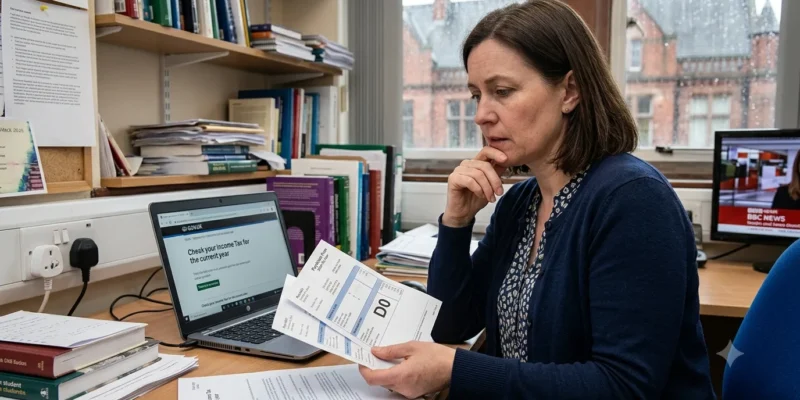
D0 Tax Code Explained (2026/27): Why You’re Taxed at 40% and How to Fix It?

Last Updated On – 21-09-2026
Seeing D0 on a payslip can be alarming because it means the income from that particular job or pension is being taxed at 40% from the first pound.
D0 does not mean someone is a non-taxpayer, and it has nothing to do with dividend tax, Capital Gains Tax or Inheritance Tax.
It is a PAYE tax code commonly used where a person has more than one job or pension and HMRC expects all the income from one source to fall within the higher-rate band.
For the 2026/27 tax year, the standard Personal Allowance remains £12,570. For taxpayers in England and Northern Ireland, the higher rate is 40%.
Wales currently has the same 20%, 40% and 45% headline rates, although Welsh tax codes use a C prefix. Scotland has separate bands and different tax-code equivalents.
What Does the D0 Tax Code Mean in 2026/27?
A D0 tax code tells payroll to deduct Income Tax at the higher rate of 40% from all taxable pay from that particular job or pension.
If a second job pays £1,000 in a month and D0 applies, the Income Tax deduction attributable to D0 would normally be £400.
There is no Personal Allowance within the D0 code itself. The person’s Personal Allowance may already be allocated to another employment or pension.
This is very different from the standard 1257L tax code, which usually gives an eligible taxpayer £12,570 of tax-free income through the employment or pension to which the code applies.
D0 also differs from the BR tax code. BR taxes all income from that source at 20%, whereas D0 taxes it at 40%. If someone’s income is expected to fall entirely within the additional-rate band, HMRC may instead use the D1 tax code, which applies 45% outside Scotland.
Importantly, D0 concerns PAYE Income Tax only. It does not determine National Insurance, pension contributions, student loan deductions, dividend tax, Capital Gains Tax or Inheritance Tax.
Why Might You Have a D0 Tax Code?
The most common reason is that HMRC believes the income from one job or pension should all be taxed at the higher rate.
| Situation | Why D0 might appear |
| Second job | Your Personal Allowance may already be used against your main job, and HMRC expects the additional earnings to fall in the 40% band |
| Occupational or private pension | Your main employment may use your allowance while pension income is treated as a secondary PAYE source |
| Pay rise | HMRC’s estimate of your total annual income may move you into the higher-rate band |
| New employment | HMRC may temporarily have two employments recorded or may not yet have complete information |
| Old employer still shown as active | HMRC may believe you have more sources of income than you actually do |
| Incorrect estimated income | HMRC may be working from an annual income estimate that is too high |
| Multiple pensions | One pension may use an allowance-based code while another receives D0 |
| Employment changes during the year | Overlapping payroll records can cause HMRC to redistribute tax codes |
HMRC confirmed in 2026 guidance that someone with more than one job normally receives a separate tax code for each employment. One source might receive 1257L while another receives BR, D0 or D1 depending on the person’s expected total income.
A change to D0 is therefore worth checking, but it is not automatically an HMRC error. Anyone surprised by a new code can also check the common reasons why a tax code has changed.
How Does HMRC Decide Whether to Use D0?
HMRC does not normally decide the correct tax treatment by looking at each job in isolation. It considers information supplied by employers, pension providers and the taxpayer to estimate the person’s overall PAYE position.
Allocating the Personal Allowance
A person normally has one Personal Allowance for the tax year, not a separate £12,570 allowance for every job.
Where somebody has several jobs, the allowance will usually be allocated to the main or highest-paying employment. Secondary income may then be taxed using another code.
If the main employment uses the entire Personal Allowance, a second employment might receive BR, D0 or D1 depending on the individual’s estimated total income.
Where the main job does not use the whole Personal Allowance, HMRC can sometimes allocate some of the unused allowance to another job.
GOV.UK’s multiple-jobs guidance specifically confirms that taxpayers can contact HMRC to ask whether their allowance can be split.
Choosing Between BR, D0 and D1
For most taxpayers outside Scotland, the basic principle is straightforward.
BR applies 20% to the whole income source, D0 applies 40%, and D1 applies 45%.
However, the correct code depends on where the additional income sits once income from all sources is considered.
This is why applying D0 blindly to every second job can be wrong. A person’s second job might straddle the basic-rate and higher-rate bands rather than falling entirely into one rate.
HMRC’s own PAYE manual recognises situations where a secondary source crosses rate bands and explains that coding adjustments may be needed rather than simply applying a single flat-rate code.
When Is D0 Correct and When Could It Be Wrong?
A useful way to judge a D0 code is to calculate the tax on all relevant income together and compare it with the tax already being collected from the main income source.
The examples below use 2026/27 England and Northern Ireland rates, assume the standard £12,570 Personal Allowance and ignore National Insurance, pension contributions, benefits and other tax-code adjustments.
Example 1: D0 Could Cause an Overpayment
Suppose someone earns:
| Income source | Annual income | Tax code |
| Main job | £45,000 | 1257L |
| Second job | £10,000 | D0 |
| Total | £55,000 |
On £55,000 of total income, £12,570 is covered by the standard Personal Allowance.
That leaves £42,430 taxable.
The first £37,700 of taxable income falls within the basic-rate band:
£37,700 × 20% = £7,540
The remaining £4,730 falls within the higher-rate band:
£4,730 × 40% = £1,892
Total Income Tax is therefore approximately:
£9,432
Tax attributable to the £45,000 main job on its own would be approximately £6,486.
The second £10,000 therefore increases the correct overall tax bill by around:
£9,432 − £6,486 = £2,946
But D0 would deduct:
£10,000 × 40% = £4,000
That produces an illustrative overpayment of approximately:
£4,000 − £2,946 = £1,054
The reason is simple: only £4,730 of the extra £10,000 actually falls into the 40% band. The rest should effectively be taxed at 20%.
Example 2: D0 Can Be Correct
Now suppose the person earns:
| Income source | Annual income | Tax code |
| Main job | £60,000 | Allowance-based code |
| Second job | £5,000 | D0 |
| Total | £65,000 |
At £60,000, the taxpayer is already above the higher-rate threshold.
Adding another £5,000 means the whole second-job income remains within the 40% band.
D0 therefore deducts:
£5,000 × 40% = £2,000
In this simplified example, that is the correct additional Income Tax generated by the second job.
These examples show why the appearance of D0 alone does not tell someone whether they are overpaying. The important figure is the person’s combined taxable income.
How Does D0 Compare With BR, D1, 0T, NT and Regional Tax Codes?
This comparison is particularly useful where someone has more than one job or pension.
| Tax code | Rate or treatment | What it generally means |
| 1257L | Normal tax bands | Standard £12,570 Personal Allowance normally available |
| BR | 20% | All income from that job or pension taxed at the basic rate |
| D0 | 40% | All income from that source taxed at the higher rate |
| D1 | 45% | All income from that source taxed at the additional rate |
| 0T | Normal tax bands, no allowance | No Personal Allowance is allocated to that income source |
| NT | No Income Tax | No Income Tax deducted from that source |
| SBR | 20% | Scottish basic-rate code |
| SD0 | 21% | Scottish intermediate-rate code |
| SD1 | 42% | Scottish higher-rate code |
| SD2 | 45% | Scottish advanced-rate code |
| SD3 | 48% | Scottish top-rate code |
| CBR | 20% | Welsh basic-rate code |
| CD0 | 40% | Welsh higher-rate code |
| CD1 | 45% | Welsh additional-rate code |
One important point is that Scottish SD0 is not the Scottish version of 40% D0. For 2026/27, SD0 corresponds to Scotland’s 21% intermediate rate. Scottish higher-rate income uses SD1 at 42%, while SD2 and SD3 cover the 45% advanced and 48% top rates respectively.
Welsh taxpayers use a C prefix. The 2026/27 Welsh rates remain 20%, 40% and 45%, so CD0 applies the Welsh higher rate of 40%.
Can D0 Be Correct on a Second Job?
Yes. D0 is commonly used on a second job where HMRC expects all earnings from that job to fall within the 40% higher-rate band.
For example, someone already earning well above the higher-rate threshold in their main employment could reasonably have D0 applied to another PAYE employment.
However, having a second job does not automatically mean D0 is correct.
Someone whose combined earnings remain within the basic-rate band may instead require BR. Someone whose second-job income crosses from the 20% band into the 40% band may need a more tailored coding arrangement.
The reverse problem matters as well. If BR is applied to a second income when that income should be taxed at 40%, the employee could pay too little tax during the year and face an underpayment later.
Can D0 Apply to Pension Income?
Yes. Private and occupational pensions are generally capable of being taxed through PAYE, so someone who works while drawing a pension can receive different tax codes for their salary and pension.
For example, a person’s main employment might use their Personal Allowance while an occupational pension receives D0 because HMRC expects all of that pension income to fall within the higher-rate band.
Problems can arise when HMRC has the wrong estimated pension amount or allocates the Personal Allowance to a less suitable income source.
Someone receiving both employment income and pensions should therefore check which source is using the Personal Allowance and whether HMRC’s annual estimates match what they realistically expect to receive.
What Do D0 M1, D0 W1, D0 X, D0 Cumul and D0 Noncum Mean?
D0 itself determines the tax rate applied to the income source. W1, M1, X and NONCUM concern how payroll treats the tax calculation across pay periods.
GOV.UK states that W1, M1, X and NONCUM identify emergency or non-cumulative treatment.
D0 M1 and D0 W1
D0 M1 means D0 is being operated on a Month 1 basis.
D0 W1 means it is being operated on a Week 1 basis.
Payroll looks at the current pay period rather than using the person’s complete year-to-date PAYE position.
The underlying D0 rate is still 40%.
Anyone wanting more detail about the payroll basis can read how the W1 tax code works.
D0 X and D0 NONCUM
An X marker is used where pay dates vary, while some payroll systems show NONCUM.
Both indicate non-cumulative or emergency treatment.
The site’s detailed explanation of a non-cumulative tax code covers why this matters when employment circumstances change.
D0 Cumulative
D0 can also be operated cumulatively.
HMRC’s PAYE manual confirms that D0 can be issued on either a cumulative or Week 1/Month 1 basis.
With cumulative treatment, payroll can take account of relevant year-to-date tax information and, where appropriate, make adjustments.
Because D0 applies a flat 40% rate to that particular source, the distinction between cumulative and non-cumulative treatment can be less noticeable than it is with an allowance-based code such as 1257L.
It can still matter where previous deductions need correcting.
Is D0 an Emergency Tax Code?
D0 on its own is not automatically an emergency tax code.
GOV.UK identifies emergency treatment through markers such as W1, M1, X or NONCUM. Therefore, D0 M1 or D0 W1 can be operated on an emergency/non-cumulative basis, while plain D0 can be cumulative.
This distinction is important because D0 should not be confused with the standard 2026/27 emergency codes such as 1257L W1, 1257L M1 and 1257L X.
What Happens to Your Personal Allowance if You Earn More Than £100,000?
The standard Personal Allowance is £12,570 in 2026/27, but it begins to reduce once adjusted net income exceeds £100,000.
The allowance falls by £1 for every £2 of income above £100,000 and can fall to zero. Someone with income of £125,140 or more will normally have no standard Personal Allowance remaining.
That does not mean D0 automatically becomes the correct code.
HMRC may make adjustments to the person’s main tax code while also applying BR, D0, D1 or another code to secondary income.
For England, Wales and Northern Ireland, the additional rate of 45% applies above £125,140 in 2026/27. If HMRC expects an entire secondary income source to fall within that band, D1 or CD1 may be appropriate instead of D0.
Scottish taxpayers have different bands and should use the Scottish codes and rates rather than assuming D0 and D1 equivalents apply.
How Can You Check Whether Your D0 Tax Code Is Correct?
The quickest starting point is to compare the tax code shown on the payslip with the information held by HMRC.
HMRC’s current-year Income Tax service allows taxpayers to see their tax code, estimated income from jobs and pensions, Personal Allowance and employment records. Estimated income can also be updated online.
The site’s broader explanation of how to check whether a tax code is correct can also help identify mismatches between a payslip and HMRC’s records.
Someone checking D0 should pay particular attention to annual pay from every job, pension income, old employments still appearing as active, which income source receives the Personal Allowance and whether HMRC’s estimates are realistic.
A D0 code that looks strange may simply be based on an incorrect annual income estimate rather than the rate itself being misunderstood.
How Can You Fix an Incorrect D0 Tax Code?
HMRC says the fastest route is normally to use its online Income Tax service and check the employment, pension, estimated taxable income, benefits and expenses information it holds.
If something is missing or wrong, update it.
Where a previous employer is still showing as active, tell HMRC that the employment has ended. Where estimated pay is inaccurate, update the expected figure. Where a new employer needs previous pay and tax information, providing a P45 can help.
If the online service cannot be used, the Income Tax helpline is 0300 200 3300, Monday to Friday, 8am to 6pm, excluding bank holidays. HMRC advises callers to have their National Insurance number available.
HMRC says that where a code needs changing, it should normally send the revised code to the taxpayer and employer within 15 working days.
For monthly-paid employees it should normally appear on the next or following payslip; weekly-paid employees should normally see it by their third payslip.
For someone who has only just started a new job, HMRC says employment information can take time to arrive and advises waiting 35 days before contacting it specifically about an incorrect new-job code.
Can HMRC Split Your Personal Allowance Between Two Jobs?

Yes, in suitable circumstances.
This is particularly relevant where the main employment earns less than the available Personal Allowance.
Suppose one job pays £8,000 and another pays £7,000. Applying the whole £12,570 allowance to the first job would leave unused allowance while the second employment could still initially be taxed.
HMRC’s 2026 multiple-jobs guidance explains that unused allowance may be allocated to another employment and says taxpayers can contact HMRC to ask whether their Personal Allowance can be split.
Splitting the allowance is not automatically appropriate for everyone. If income is irregular or changes significantly, the allocation can still result in too much or too little PAYE being deducted.
How Can You Get a Refund if D0 Has Taken Too Much Tax?
If HMRC changes an incorrect code during the tax year and already has the required income information, it will normally calculate the difference between the tax paid and the tax that should have been paid.
HMRC can then instruct the employer or pension provider to repay the overpayment through payroll when the revised code is used.
If the tax year has ended, HMRC may carry out an annual reconciliation.
Employees and pension recipients who have paid the wrong amount may receive a P800 tax calculation. Someone registered for Self Assessment will normally have the position dealt with through their tax return rather than receiving a P800.
Where a P800 confirms a refund, the taxpayer may be able to request payment through their Personal Tax Account, the HMRC app or HMRC’s online repayment service.
The same process can work in reverse. If an incorrect code such as BR has collected too little tax from someone whose extra income should have been taxed at 40%, HMRC may adjust a later code or issue a tax calculation for the underpayment.
FAQs About the D0 Tax Code
What percentage is D0 tax code?
For taxpayers using the ordinary D0 code in England and Northern Ireland, D0 taxes all income from that job or pension at 40%. Welsh taxpayers use CD0 for the Welsh 40% higher rate. Scotland has different codes and rates.
Does D0 mean no tax is due?
No. It means the opposite: all income from that PAYE source is taxed at the higher rate. NT is the code that generally means no Income Tax is deducted.
Is D0 the basic-rate tax code?
No. BR is the basic-rate code and normally deducts 20%. D0 deducts 40%, while D1 deducts 45%.
Why is my second job on D0?
HMRC may expect the entire income from the second job to fall within the higher-rate band because your allowance and lower tax bands are being used by your main income. Check your combined annual income to see whether that assumption makes sense.
Can D0 be wrong even if I am a higher-rate taxpayer?
Yes. If only part of the second income actually falls within the higher-rate band, taxing the entire second job at 40% can collect too much tax. HMRC may need to adjust how the tax bands are allocated.
What does D0 M1 mean?
D0 means the income source is taxed at 40%. M1 means payroll operates the code on a Month 1, non-cumulative basis rather than using the full tax-year position.
Can D0 appear on a pension?
Yes. An occupational or private pension can receive D0 where HMRC expects all pension income from that source to fall into the higher-rate band.
Does D0 affect National Insurance?
No. A PAYE tax code controls Income Tax deductions. National Insurance is calculated under separate rules.
What is your reaction?