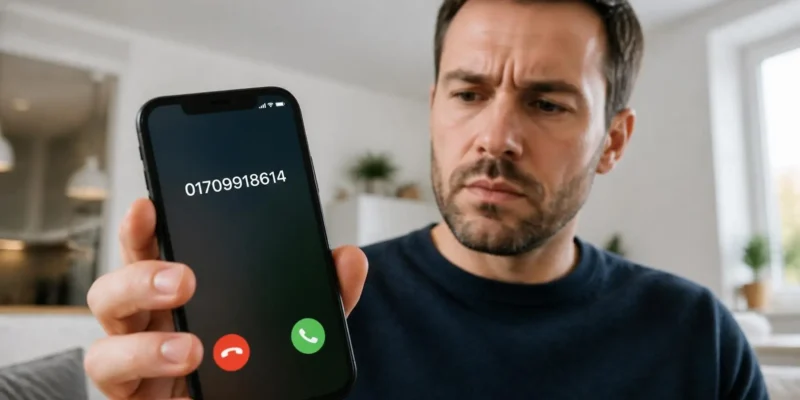
01709918614: Who Called Me, and Is This Number Safe?

Historical caller reports commonly associate 01709918614 with Vodafone customer-retention or telemarketing activity.
Several people said the call arrived after they had requested a PAC code, cancelled a contract or indicated that they planned to switch networks.
However, these reports do not confirm who currently operates the number or prove that every call displaying 01709 918614 is genuine.
Public phone-number databases contain user-submitted experiences, and caller ID can be altered, so you should verify an unexpected caller before discussing your account or disclosing personal information.
Key Highlights:
| Key Point | What You Need to Know |
| Reported caller | Historically associated with Vodafone retention or marketing calls |
| Number format | UK geographic number written as 01709 918614 |
| International format | +44 1709 918614 |
| Area code | 01709 is associated with Rotherham |
| Current ownership | Not established by the supplied community reports |
| Safest response | End the call and contact Vodafone independently |
The available evidence supports a historical association, not a guarantee about the identity or safety of a call you receive today.
What Is Known About 01709918614?
The number can appear as 01709918614, 01709 918614 or +44 1709 918614. The first two are domestic UK formats, while the third uses the United Kingdom’s +44 international dialling code.
The strongest recurring claim is that the number was used for Vodafone customer-retention calls.
One supplied reporting page displays 23 ratings, including 19 reports naming Vodafone and 14 classifying the calls as telemarketing.
Its detailed comments include reports from 2016 to 2019, which makes them useful historical evidence but not proof of current ownership.
No supplied source provides an official, current ownership record for the number. It would therefore be inaccurate to describe 01709918614 as definitely genuine, definitely fraudulent or permanently controlled by one organisation.
Why Has 01709918614 Been Linked to Vodafone Retention Calls?
The historical reports show a repeated pattern: customers said they received calls after taking an action that suggested they intended to leave Vodafone.
This is consistent with customer-retention activity, where a provider contacts a departing customer to discuss alternatives or make another offer.
Reported Call Triggers
- Requesting a PAC code to move your number
- Cancelling or attempting to cancel a contract
- Rejecting an earlier renewal or upgrade offer
- Comparing Vodafone’s price with another provider
- Indicating that you intended to switch networks
Multiple comments describe offers being made only after the customer had cancelled or requested a PAC code. Similar retention-related descriptions appear across all three supplied reporting pages.
Even so, timing is not authentication. A caller knowing that you recently requested a PAC code may make the contact appear plausible, but you should still confirm the call through an independently obtained channel.
How Reliable Are the Reports About 01709918614?
The reports are useful for identifying a recurring historical pattern, but they are not equivalent to an official telephone-number ownership record.
Their reliability depends on when they were posted, what evidence the contributor had and whether the displayed number accurately identified the caller.
Historical Reporting Pattern
The supplied pages broadly agree that the number was associated with retention, sales or telemarketing calls connected with Vodafone.
The most detailed source shows numerous users describing calls after cancellations and PAC-code requests, although its classifications are not entirely uniform.
Evidence Assessment
| Evidence | What It Suggests | Main Limitation |
| Repeated Vodafone reports | A credible historical association | Reports were submitted by users |
| PAC-code comments | Possible customer-retention purpose | Timing does not verify identity |
| Telemarketer classifications | Calls were often sales-related | Categories reflect personal judgement |
| Reports across three platforms | A recurring pattern rather than one isolated claim | Platforms may repeat similar experiences |
| Official lookup facility | A stronger route for current verification | A result must be checked for the individual call |
The repeated reports increase confidence in the historical pattern, but they cannot establish that the same organisation controls the number now.
What Limits the Accuracy of Caller-Reporting Websites?
A contributor may identify a caller only from what was said during the conversation. Reports can also become outdated, contain mistakes or fail to distinguish between legitimate use and caller ID spoofing.
Vodafone provides an official caller verification checker that says: “We’ll let you know if it’s really us, and the reason we called.” That live verification route is more suitable for checking a present-day call than relying solely on comments posted several years ago.
Does the 01709 Area Code Reveal Who Is Calling?
The 01709 area code is associated with Rotherham, according to the UK telephone area-code register. This explains why lookup services may describe 01709918614 as a Rotherham number.
The area code does not reveal the caller’s personal identity, employer or physical location during the call.
Businesses can use geographic numbers through call centres, internet-based telephone systems and third-party service providers.
A Rotherham number on your screen also does not prove that the call originated in Rotherham. The number format is one piece of context, not an identity check.
Could a Call From 01709918614 Be Genuine, Unwanted or Spoofed?
Yes. A call displaying 01709918614 could be consistent with genuine retention activity, experienced as unwanted marketing or made by someone disguising their real caller ID.
You should judge the behaviour during the call and verify the organisation independently.
A Potentially Genuine Retention Call
A recent PAC code request, cancellation enquiry or contract discussion may explain why a retention team contacts you.
A genuine caller may wish to discuss your reason for leaving, an alternative tariff or an account-related offer.
Those circumstances make the call plausible, but not automatically trustworthy. Do not rely solely on the caller knowing your name, network provider or recent account activity.
When the Call Becomes Unwanted Marketing?
A sales call may become unwanted when it is unsolicited, repeatedly made or continued after you have clearly objected.
UK guidance distinguishes live marketing calls from automated recorded messages and allows people to report nuisance marketing that continues.
Registering with the Telephone Preference Service can reduce unsolicited marketing calls, although a company may still contact you where valid consent or an existing permission applies.
You can also tell the organisation directly that you do not want further marketing contact.
Could the Displayed Number Have Been Spoofed?
Caller ID spoofing happens when someone changes the number shown on your screen. A call may therefore appear to come from a recognised company, government body or UK landline even when the real caller is elsewhere.
The official number spoofing guidance confirms that scammers can alter caller ID to impersonate a trusted organisation and seek passwords, personal details or money.
It advises ending an unexpected call and contacting the organisation through a number obtained from its official website.
Should You Answer or Call Back 01709918614?
You are not required to answer an unexpected call from 01709918614. Allowing it to go to voicemail gives you time to consider whether you were expecting contact and whether the caller leaves a meaningful message.
Answering an unknown call is not automatically harmful, but you should end the conversation if the caller pressures you, asks for sensitive details or objects to independent verification.
Official consumer guidance says a genuine caller should give you time rather than force an immediate decision.
Rather than calling back using the displayed number, open your provider’s app, sign in to your account or use customer-service details obtained independently. This avoids depending on information supplied by the unexpected caller.
What Information Should You Never Share With an Unexpected Caller?
Do not disclose security or payment information merely because the caller claims to represent Vodafone.
Fraudsters may already know basic details such as your name, address or mobile provider, but that knowledge does not authenticate them.
Sensitive Details and Behaviours to Avoid
- Sharing your account password or PIN
- Reading out a one-time security code
- Giving the complete card or bank details
- Revealing full security answers
- Installing software or granting remote access
- Transferring money to a supposedly secure account
- Approving an unexpected SIM, tariff or account change
- Acting immediately because of threats or artificial urgency
Unexpected requests for passwords, PINs, bank information or urgent payment are recognised warning signs.
You should end the call and contact the organisation independently rather than trying to challenge or investigate the caller yourself.
How Can You Verify, Block or Report 01709918614?
The safest process is to separate yourself from the original call, verify the claimed organisation independently and report the contact through the route that matches what happened.
Official Verification Steps
Verification Checklist:
- End the unexpected call before checking anything.
- Open the official provider website yourself rather than following a link.
- Enter 01709918614 into the official caller-checking facility.
- Sign in through your usual app or account portal.
- Ask whether a genuine call, offer or account action is recorded.
- Contact your provider through its published support details when uncertain.
An unrecognised result does not prove fraud by itself, but it is a strong reason not to disclose information or continue an account discussion.
The verification process is complete only when you have independently contacted the organisation.
How Do You Block and Report the Number?
On most phones, you can open the recent-calls list, select the number and choose the block or report-spam option. The exact wording varies between iPhone models, Android versions and manufacturers.
A suspected scam-call number can be forwarded to 7726 free of charge, allowing your mobile provider to investigate and potentially block it.
Continued sales or recorded marketing calls can also be submitted through the form to report unwanted marketing calls.
Blocking stops or limits further contact on your device, while reporting may help providers and regulators identify a wider pattern.
What Should You Do If You Already Shared Information?
Contact your bank or card provider immediately if you disclosed payment information or sent money.
Use the number printed on your card or your bank’s official app, rather than any contact details supplied during the call.
Change exposed passwords, contact Vodafone through an official channel and check your account for unauthorised changes.
Preserve screenshots, call logs, messages and payment records; scams should be reported to Report Fraud in England, Wales and Northern Ireland, or to Police Scotland in Scotland.
Conclusion
Historical reports create a credible association between 01709918614 and Vodafone customer-retention or telemarketing calls, particularly following PAC-code requests and cancellations.
They do not prove the number’s current ownership or guarantee that a call displaying it is genuine.
Treat the reports as a useful lead rather than final verification.
Do not share sensitive information during an unexpected call; end the conversation and contact Vodafone through an official channel before discussing your account, changing your contract or accepting an offer.
Frequently Asked Questions
What Does +44 1709 918614 Mean?
It is the international format of 01709 918614, with the UK country code replacing the initial zero. Both formats refer to the same underlying telephone number.
Why Might the Call Arrive After a PAC-Code Request?
Requesting a PAC code signals that you may be preparing to move your number to another provider, which can trigger retention activity. The timing may explain a genuine call, but it does not verify the person speaking to you.
Does a Caller Knowing Your Name Prove They Are Genuine?
No, because names and basic contact details may be obtained from earlier business interactions, marketing records or compromised data. Verify the caller through an official channel before confirming further information.
Can a Missed Call From This Number Cost You Money?
Receiving or missing the call does not itself create a telephone charge. Returning it may use inclusive minutes or incur the geographic-call rate specified by your provider and tariff.
Will Blocking the Number Stop Voicemail Messages?
This depends on your handset, network and voicemail configuration. Some blocked callers may still leave a voicemail even though your phone does not ring normally.
How Long Should You Keep Evidence of a Suspicious Call?
Keep relevant call logs, screenshots, messages and transaction records while your provider, bank or reporting service may need them. Do not delete evidence until any related account-security or fraud report has been resolved.
Can Your Mobile Provider Investigate Repeated Calls?
Your provider may offer call-screening tools, identify patterns and investigate reports submitted through 7726. Its ability to identify the real caller can be limited when the displayed number has been spoofed.
Note: Tellows, Who Called and WhoCallsMe publish reports submitted by members of the public. These reports can indicate historical calling patterns, but they do not provide verified evidence of the number’s current owner, location or legitimacy.
What is your reaction?