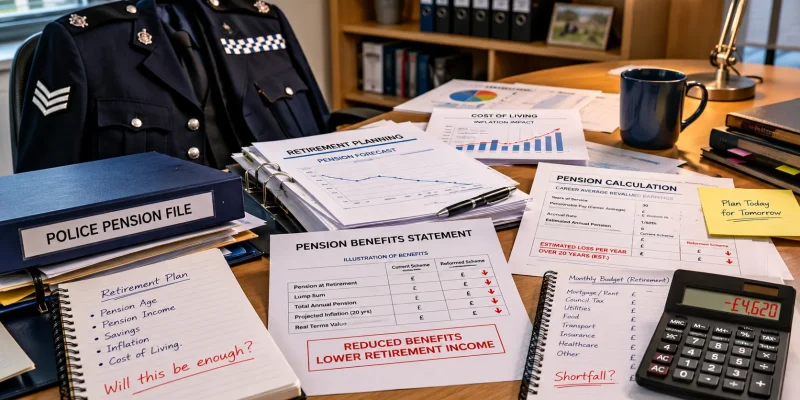
Police Pension Lump Sum Cuts: Officers Face Thousands Less in Retirement

Police pension lump sum cuts are reducing the amount of retirement cash available to officers in the 1987 Police Pension Scheme, with those retiring under the newly introduced commutation factors receiving almost 5% less lump sum for the same amount of pension surrendered.
The changes follow a Treasury decision to increase the SCAPE discount rate, resulting in immediate adjustments that could cost some retiring officers thousands of pounds.
The timing has also raised concerns, as some officers had recently received retirement quotations based on the previous factors and may have already made financial plans using those figures.
Key Takeaways:
- Police pension lump sums have been reduced following changes to commutation factors.
- The revisions were introduced after an increase in the SCAPE discount rate.
- Officers retiring now could receive nearly 5% less cash than those who retired recently.
- The reduction may result in losses worth thousands of pounds for some retirees.
- Recent retirement quotations may no longer reflect final lump-sum payments.
- The Police Federation is investigating the impact and seeking independent advice.
- Officers approaching retirement should review updated pension figures and retirement plans carefully.
What Are the New Police Pension Lump Sum Cuts and Why Are Officers Concerned?

Police officers retiring under the 1987 Police Pension Scheme are now facing an immediate reduction in the lump sums available to them when they retire.
The change stems from revised commutation factors introduced following a Treasury decision to increase the SCAPE discount rate.
The Immediate Reduction in Retirement Lump Sums
Commutation factors determine how much tax-free cash an officer receives when they choose to exchange part of their annual pension for a lump sum at retirement.
Under the newly introduced factors, officers retiring from the implementation date onwards will receive almost 5% less lump sum for the same amount of pension surrendered.
Although the percentage reduction may appear relatively small, it can translate into thousands of pounds in lost retirement income for many officers.
Which Officers Are Most Affected by the Changes?
The changes primarily affect members of the 1987 Police Pension Scheme who are approaching retirement and planning to commute part of their pension into a lump sum.
Officers who received retirement projections or benefit illustrations before the changes may be particularly affected, especially if they have already made financial commitments based on previous estimates.
How Do Commutation Factors Affect Police Pension Lump Sums?
Commutation factors play a critical role in determining the balance between ongoing pension income and the cash lump sum available at retirement.
Understanding the Relationship Between Pension and Lump Sum
When officers retire, they can choose to surrender part of their annual pension in exchange for a larger tax-free lump sum. The amount of cash received depends on the commutation factor applied at the time of retirement.
A higher commutation factor provides more cash for every pound of pension given up. Conversely, a lower factor results in a smaller lump sum.
The recent revisions mean officers now receive less cash despite surrendering the same amount of pension income.
Examples of How Commutation Works in Practice
For example, an officer may choose to give up a portion of their annual pension to increase their tax-free retirement payment. Under previous factors, that exchange could have generated a higher lump sum than is available today.
As a result, two officers with identical service records and pension entitlements may receive noticeably different lump sums simply because they retired on different dates.
A police pensions adviser with experience supporting retiring officers explained the issue clearly:
“I often work with officers who spend months planning their retirement finances. When commutation factors change without significant notice, the impact can be considerable because people may already have based major financial decisions on earlier projections.”
This concern highlights why many officers are questioning both the timing and implementation of the revised factors.
Why Has the Treasury Increased the SCAPE Discount Rate?

The reduction in police pension lump sums is linked to changes in the SCAPE discount rate.
SCAPE, which stands for Superannuation Contributions Adjusted for Past Experience, is used by the Government to assess the long-term cost of public sector pension schemes.
When the discount rate changes, it can influence the assumptions used to calculate pension-related benefits, including commutation factors.
The Treasury periodically reviews the rate to reflect economic conditions and long-term financial expectations. Following the latest review, revised commutation factors were introduced for affected public sector pension schemes.
While the change is intended to reflect updated financial assumptions, critics argue that the immediate implementation has created difficulties for officers nearing retirement.
How Much Could Retiring Police Officers Lose Under the New Factors?
The exact financial impact will vary depending on an officer’s pension entitlement, retirement date and commutation choices. However, the reported reduction of nearly 5% means many officers could lose several thousand pounds from their expected lump-sum payments.
Comparison Between Previous and Current Commutation Factors
The following example illustrates how reductions may affect retirement benefits. These figures are for demonstration purposes only and actual outcomes will vary.
| Pension Surrendered | Approximate Lump Sum Before Change | Approximate Lump Sum After Change | Estimated Difference |
| £5,000 per year | £60,000 | £57,000 | £3,000 |
| £7,500 per year | £90,000 | £85,500 | £4,500 |
| £10,000 per year | £120,000 | £114,000 | £6,000 |
| £12,500 per year | £150,000 | £142,500 | £7,500 |
These examples demonstrate how even a modest percentage adjustment can have a substantial effect on retirement finances.
Why Are Officers Receiving Less Than Those Who Retired Just Weeks Earlier?
One of the most controversial aspects of the police pension lump sum cuts is the timing.
The revised factors were implemented immediately, creating a clear distinction between officers who retired before the change and those retiring afterwards.
As a result, two officers with identical careers, pensionable service and retirement plans may receive significantly different lump sums simply because one retired earlier.
This has fuelled concerns among officers who believe they had insufficient notice to adjust their retirement planning.
The situation has become particularly difficult for individuals who had already arranged financial commitments, such as mortgage repayments, home improvements or debt settlements, based on previously issued retirement projections.
What Concerns Has the Police Federation Raised About the Pension Changes?

The Police Federation has expressed serious concerns regarding both the impact of the changes and the manner in which they were introduced.
According to the Federation, some officers received retirement quotations only weeks before the revised factors were implemented. Those officers may have relied on those figures when making important financial decisions.
National Secretary John Partington criticised the move, stating:
“After decades of service, the ‘thanks’ retiring officers get is this: government quietly shaving cash off a hard-earned retirement overnight. It’s a blatant case of picking the pockets of police pensioners, and we will not let it stand.”
Statements From John Partington
The Federation’s leadership has questioned whether officers were given adequate notice and whether the impact on retirement planning was properly considered.
The organisation has also confirmed that it is seeking independent advice regarding the scale of the reduction and its justification.
Concerns Raised by Local Federation Representatives
Dyfed Powys Police Federation Chair Delme Rees confirmed that discussions had taken place with the force pension team regarding the issue.
He also highlighted plans for Federation representatives to visit stations and provide members with opportunities to better understand how the changes may affect their individual circumstances.
A pension consultant specialising in public sector retirement planning described the uncertainty facing officers:
“In my experience, retirement decisions are rarely made overnight. Officers often spend considerable time reviewing projections and planning around them. Any significant change to expected benefits can have wider financial consequences that extend beyond the pension itself.”
Could Police Officers Have Grounds for Legal Action?
The possibility of legal action has emerged as one of the key issues surrounding the police pension lump sum cuts.
The Police Federation has confirmed that it is exploring whether officers who received retirement quotations under previous factors may have experienced financial detriment.
Financial detriment generally refers to a situation where an individual suffers a measurable financial loss after relying on information that subsequently changes.
Whether legal action becomes a realistic option will depend on various factors, including the nature of previous quotations, the timing of decisions made by officers and the legal framework governing pension scheme administration.
At present, independent advice is being sought before any conclusions are reached.
How Are Recent Retirement Quotations Being Affected?
Many officers approaching retirement receive detailed benefit illustrations to help them plan their finances.
These quotations often provide estimates of pension income, lump-sum payments and retirement options.
The concern arises because some officers may have received calculations based on the previous commutation factors only weeks before the new factors took effect.
This creates a situation where retirement expectations and actual outcomes differ significantly.
Officers affected by this issue may wish to review any recent pension documentation and seek clarification from their pension administrators regarding updated figures.
What Does This Mean for Members of the 1987 Police Pension Scheme?

Members of the 1987 Police Pension Scheme are currently the group most directly affected by the revised commutation factors.
The scheme remains highly valued because of its generous retirement provisions compared with many modern pension arrangements.
However, the latest changes demonstrate that retirement outcomes can still be influenced by broader government policy decisions and actuarial assumptions.
For officers nearing retirement, the reduction in lump-sum payments may alter plans relating to debt repayment, investments, property purchases or general retirement spending.
Understanding the revised calculations is therefore essential for informed retirement planning.
What Steps Should Police Officers Take Before Retirement?
Although the changes cannot be avoided by officers retiring under the revised factors, there are several practical steps individuals can take.
These include:
- Requesting updated pension benefit statements.
- Reviewing retirement projections carefully.
- Seeking professional financial advice where appropriate.
- Contacting pension administrators for clarification.
- Monitoring updates from the Police Federation.
- Assessing how revised lump-sum figures affect broader retirement plans.
Taking these actions can help officers make informed decisions and minimise unexpected financial surprises.
Will Further Changes to Police Pension Benefits Follow?
Public sector pension schemes are regularly reviewed to ensure they remain sustainable and aligned with economic conditions.
While there is currently no confirmation of additional changes to police pension lump sums, future adjustments cannot be ruled out.
Officers should remain informed about developments affecting police pensions, particularly changes linked to government reviews, actuarial assessments and Treasury policies.
Staying updated through official guidance and Federation communications can help officers prepare for any future developments that may affect retirement benefits.
Conclusion
The recent police pension lump sum cuts represent a significant change for officers retiring under the 1987 Police Pension Scheme.
Following revised commutation factors linked to an increase in the SCAPE discount rate, many retiring officers are now receiving almost 5% less lump sum for the same pension surrendered.
For some individuals, the impact could amount to several thousand pounds, particularly where retirement plans were based on earlier benefit projections.
The Police Federation has raised concerns about the speed of implementation and is exploring whether affected officers may have experienced financial detriment.
As the situation develops, officers approaching retirement should carefully review their pension calculations, seek professional guidance where necessary and stay informed through official pension and Federation updates.
FAQs
How do commutation factors influence police pension benefits?
Commutation factors determine how much tax-free cash an officer receives when exchanging part of their annual pension for a lump sum. Lower factors result in smaller lump-sum payments.
Are all police pension schemes affected by the latest changes?
The current concerns focus primarily on members of the 1987 Police Pension Scheme, although pension reforms and actuarial reviews can affect different schemes in different ways.
Can officers reverse retirement decisions after commutation factor changes?
This will depend on individual circumstances and pension scheme rules. Officers should seek guidance from their pension administrator before making any decisions.
What is the SCAPE discount rate and why does it matter?
The SCAPE discount rate is a Treasury measure used to assess public sector pension costs. Changes to the rate can influence pension calculations and related benefits.
How often are police pension commutation factors reviewed?
There is no fixed review schedule. Factors may be updated following actuarial assessments, policy changes or Treasury reviews.
Will future retirees face additional pension lump sum reductions?
There is currently no confirmation of further reductions, but pension calculations may change in the future depending on economic and policy developments.
Where can police officers obtain official pension guidance?
Officers can obtain guidance from their force pension administrator, the Police Federation, official Government pension resources and qualified financial advisers.
What is your reaction?