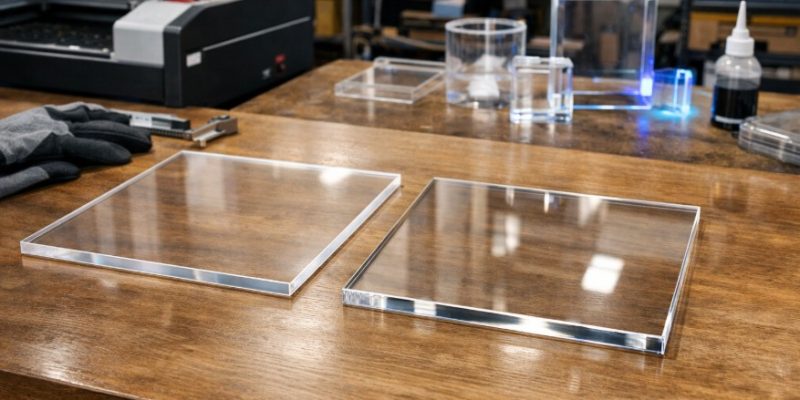
Extruded Acrylic vs Cast Acrylic: What’s the Difference?

An acrylic sheet is one of the most versatile materials around. It’s lightweight, durable, and works well for everything from display cases to DIY home projects.
But when you start shopping for it, you’ll quickly notice there are two main types: extruded acrylic and cast acrylic. They might look almost identical, but they behave quite differently depending on how you use them.
Knowing which type to choose will save you time, money, and frustration. Stay with us until the end to find out which one will work best for your project.
How Each Type Is Made?

The difference between extruded and cast acrylic starts with how they’re manufactured.
Extruded acrylic is made by pushing molten acrylic through a die, producing a continuous sheet at high speed. It’s a fast and cost-efficient process, which is why extruded sheets tend to be cheaper.
Cast acrylic, by contrast, is made by pouring liquid acrylic between two glass moulds and allowing it to set slowly.
This slower process results in a denser, more consistent sheet. If you need a precision finish, a cut-to-size clear acrylic sheet in cast grade will give you noticeably higher optical clarity than extruded.
Key Differences in Properties
The manufacturing method directly affects how each type performs.
Here’s a quick summary of the main differences:
- Optical clarity: Cast acrylic has superior clarity and is less likely to have surface distortions.
- Thickness consistency: Cast acrylic tends to be more uniform in thickness, making it better suited to precision work.
- Machinability: Cast acrylic cuts, engraves, and laser-cuts more cleanly.
- Heat resistance: Cast acrylic can handle higher temperatures before it starts to deform.
- Cost: Extruded acrylic is the more budget-friendly option.
- Chemical resistance: Extruded acrylic offers better resistance to certain solvents.
Which Projects Suit Each Type?
Extruded acrylic is a practical choice for general-purpose work where cost matters more than precision.
You’ll find it used for protective covers, simple display panels, and basic DIY builds. It’s also easier to shape using heat, so it’s a popular option for line bending projects.
Cast acrylic is better suited to projects where appearance and accuracy are priorities. Sign-making, engraving, display stands, and anything that requires a polished edge will benefit from cast acrylic’s properties.
It’s also the preferred choice for laser cutting, as it produces clean, smooth edges without chipping. If you’re working with professional or decorative finishes, cast acrylic will consistently deliver better results.
Cost and Availability
Extruded acrylic is widely available and typically costs less per sheet. If you’re working on a large project with a tight budget, it’s a sensible choice. It’s also easy to source in a wide range of standard sizes and thicknesses.
Cast acrylic does cost more, but the quality difference often justifies it. For applications where the finish matters, the extra spend will generally pay off.
Both types are available in a range of colours and thicknesses, so you’ll have plenty of options while deciding which direction to go.
All in All
There’s no single right answer, as it depends on what you’re making and how much you want to spend. Extruded acrylic will handle straightforward, everyday projects well.
Cast acrylic is the stronger option when you need better clarity, cleaner cuts, or a more refined finish.
Think about what the finished piece needs to look and perform like, and that should point you in the right direction fairly quickly.
What is your reaction?