
How Does Tax-Free Childcare Work in 2026?

Last Updated: 28.09.2026
Tax-Free Childcare is a UK government scheme that helps eligible working families reduce the amount they spend on approved childcare.
Instead of claiming childcare costs back through the tax system, parents use an online childcare account.
For every £8 paid into the account, the government adds £2, helping cover 20% of eligible childcare costs up to the scheme limits.
The scheme can be used for approved childcare such as nurseries, registered childminders, nannies, breakfast clubs, after-school clubs and holiday clubs.
Parents can receive up to £2,000 in government support per child each year, or up to £4,000 for an eligible disabled child.
How Does The Tax-Free Childcare Scheme Work In Practice?
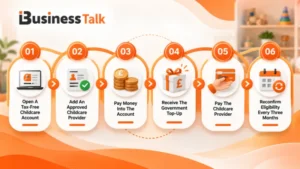
Tax-Free Childcare works through an online childcare account. Parents add their own money, the government adds a top-up and the combined amount is then used to pay an approved childcare provider.
Step 1: Open A Tax-Free Childcare Account
Eligible parents first need to create an online childcare account. The application is used to check whether the parent, their partner and their child meet the scheme requirements.
Parents normally need information including their National Insurance number, their partner’s details where applicable, their child’s information and a Unique Taxpayer Reference if they are self-employed.
Step 2: Add An Approved Childcare Provider
Parents can search for their childcare provider through their account.
The provider must be registered and signed up to Tax-Free Childcare. If a provider has not joined the scheme, parents may be able to send them a notification encouraging them to register.
Step 3: Pay Money Into The Account
Parents can add money using methods such as:
- Bank Transfer
- Standing Order
- Direct Debit
Money normally appears in the childcare account within one working day.
Step 4: Receive The Government Top-Up
For every £8 a parent pays into their childcare account, the government adds £2.
For example, if a childcare bill is £500, the parent could pay £400 into the account and the government would add £100, provided the quarterly top-up limit has not already been reached.
Step 5: Pay The Childcare Provider
Once the money and government top-up are available, parents can use the balance to pay their approved childcare provider directly through the childcare account.
Step 6: Reconfirm Eligibility Every Three Months
Parents must sign in and confirm that they are still eligible every three months.
This is important because Tax-Free Childcare support can stop if eligibility is not reconfirmed.
When Was Tax-Free Childcare Introduced And How Has The Scheme Changed?
Tax-Free Childcare was officially launched in April 2017 as part of government plans to reduce childcare costs for working families.
It initially opened to families with younger children and eligible disabled children before being gradually extended to other qualifying families.
When Tax-Free Childcare Was Introduced?
The scheme began on 21 April 2017, initially allowing qualifying families with younger children to apply.
The government then gradually expanded access during 2017 and 2018 so that families with older eligible children could also participate.
How The Scheme Has Developed Over Time?
Although the basic £8 plus £2 structure remains in place, Tax-Free Childcare has become part of a wider childcare support system.
In England, funded childcare support has expanded significantly.
Fifteen funded hours were extended to younger age groups during 2024, while eligible working parents of younger children became able to access 30 funded hours from September 2025.
Parents may therefore be able to use funded childcare hours for part of their childcare and Tax-Free Childcare for eligible additional costs.
How Tax-Free Childcare Is Working In 2026?
Tax-Free Childcare remains active in 2026 and continues to provide a £2 government top-up for every £8 contributed by eligible families.
HMRC statistics show that the scheme continues to be widely used alongside the expanded funded-hours system.
HMRC reported that around 826,000 families used Tax-Free Childcare for more than one million children during 2024 to 2025.
Are There Any Future Changes Planned For Tax-Free Childcare?
As of September 2026, official guidance continues to show the same main Tax-Free Childcare structure, including the 20% top-up and annual support limits.
The wider direction of government childcare policy is focused on making childcare schemes easier to use together and reducing administrative barriers.
Government policy documents have also emphasised improving access to childcare support and helping more parents remain in or return to employment.
Parents should therefore check current eligibility rules regularly because childcare support policies and related funded-hour schemes can change.
How Much Can You Get Through Tax-Free Childcare?
The government contribution is limited for each child.
Parents can receive:
- Up To £500 Every Three Months Per Child
- Up To £2,000 Per Child Each Year
- Up To £1,000 Every Three Months For An Eligible Disabled Child
- Up To £4,000 Per Year For An Eligible Disabled Child
The following examples show how the normal 20% top-up works before the quarterly maximum is reached.
| Childcare Cost | Parent Pays | Government Adds |
| £100 | £80 | £20 |
| £250 | £200 | £50 |
| £500 | £400 | £100 |
| £1,000 | £800 | £200 |
Families with larger childcare bills need to remember that the top-up is capped. The government will not continue adding 20% once the maximum top-up for that three-month entitlement period has been reached.
Who Is Eligible For Tax-Free Childcare In 2026?
Eligibility depends on several factors, including the child’s age, employment status, income and immigration circumstances.
A child is normally eligible until 1 September after their 11th birthday. An eligible disabled child may remain covered until 1 September after their 16th birthday.
Parents and their partners, where applicable, normally need to be working or meet one of the recognised exceptions.
In 2026, each working adult normally needs to expect to earn at least the equivalent of 16 hours per week at the applicable National Minimum Wage or National Living Wage.
Current minimum expected earnings over three months include:
- Age 21 Or Over: At least £2,643.68
- Age 18 To 20: At least £2,256.80
- Under 18 Or An Apprentice: At least £1,664
A parent or their partner will normally be ineligible if their expected adjusted net income is above £100,000 for the current tax year.
How Does Tax-Free Childcare Work For Self-Employed Parents?
Self-employed parents can qualify for Tax-Free Childcare if they meet the general eligibility rules.
One important exception applies to people who recently started a business. If someone became self-employed less than 12 months ago, the normal minimum earnings requirement does not apply in the same way.
They may still qualify even if their new business has not yet reached the normal income threshold.
Self-employed applicants may need their Unique Taxpayer Reference when applying.
People with irregular earnings can sometimes use their expected average income across the current tax year rather than relying only on the next three months.
Parents who are both employed and self-employed may also be able to use their self-employed income when determining eligibility.
What Childcare Can You Pay For With Tax-Free Childcare?
Tax-Free Childcare can only be used with approved childcare providers.
Eligible childcare may include:
- Registered Nurseries
- Registered Childminders
- Registered Nannies
- Breakfast Clubs
- After-School Clubs
- Holiday Clubs
- Registered Schools Providing Eligible Childcare
- Certain Registered Home-Care Arrangements
Some additional costs can also qualify when they form part of the childcare supplied by the provider.
These can include:
- Meals
- Nappies
- Trips
- Certain Childcare-Related Extras
Parents should confirm with the childcare provider that both the provider and the costs qualify before making payments through the account.
How Do You Apply For Tax-Free Childcare?
Applications are completed through the government’s childcare service.
Parents normally need:
- National Insurance Number
- Partner’s National Insurance Number Where Applicable
- Unique Taxpayer Reference If Self-Employed
- Child’s UK Birth Certificate Reference If Available
- Employment Start Or Return Date
The application itself usually takes around 20 minutes.
Parents returning to work should also pay attention to when they apply. The permitted application period depends on their expected work start date.
For example:
| Starting Or Returning To Work | Application Can Normally Start |
| 1 May To 30 September | From 1 April |
| 1 October To 31 January | From 1 September |
| 1 February To 30 April | From 1 January |
How Do Tax-Free Childcare Payments Work?
Parents decide how much money they want to place into their childcare account based on their childcare bills.
There is no requirement to make exactly the same payment every month.
Families with varying childcare costs may choose to build up money in the account ahead of school holidays or other periods when their childcare bills increase.
When money is deposited, the government contribution is normally added at the same time. Deposits usually appear within one working day.
Parents can then select their childcare provider and make the payment through the online account.
Why Do You Need To Reconfirm Tax-Free Childcare Every Three Months?
Tax-Free Childcare is not approved permanently after the first application.
Parents must reconfirm their circumstances every three months so HMRC can check that they continue to meet the requirements.
The process normally involves confirming information about:
- Employment
- Income
- Partner Circumstances
- Child Details
- Other Relevant Eligibility Information
Failure to reconfirm can result in government top-ups stopping.
Parents should also update their account if their circumstances change instead of waiting until the next reconfirmation period.
Can You Withdraw Unused Money From A Tax-Free Childcare Account?
Parents do not have to spend the full balance immediately.
Money can remain in the account until it is needed for qualifying childcare.
Parents can also withdraw their own money from the account. However, the corresponding government contribution is removed when money is withdrawn for purposes other than eligible childcare.
HMRC’s guidance confirms that families lose the government top-up attached to money that is taken out.
This makes it useful to estimate upcoming childcare costs before depositing unusually large amounts.
Can Tax-Free Childcare Be Used With Free Childcare Hours?
Tax-Free Childcare and funded childcare hours are separate forms of support.
Eligible families may be able to use both.
For example, parents in England may use funded childcare hours for part of their weekly childcare and then use Tax-Free Childcare towards qualifying additional childcare costs outside those funded hours.
The expansion of funded childcare means eligible working parents can now receive up to 30 funded hours for qualifying younger children under the current England scheme.
Combining the two schemes can therefore reduce the amount families have to pay themselves.
Tax-Free Childcare Vs Universal Credit Childcare: What Is The Difference?

Tax-Free Childcare and Universal Credit childcare support work differently.
Tax-Free Childcare normally covers 20% of eligible childcare costs within the scheme limits because the government adds £2 for every £8 contributed.
Universal Credit childcare support can cover a much larger proportion of eligible childcare costs for qualifying households.
The key difference is that families generally cannot receive Universal Credit childcare support and Tax-Free Childcare at the same time.
Which arrangement provides more support depends on household income, employment circumstances, childcare costs and Universal Credit eligibility.
Parents should compare the amount they could receive under each system before switching.
How Does Tax-Free Childcare Work For Separated Parents?
Separated or divorced parents cannot both create separate Tax-Free Childcare accounts for the same child.
Only one account can be registered for that child.
Parents who share childcare responsibilities should therefore agree who will manage the Tax-Free Childcare account.
The account holder can then use the money and government top-up to pay approved childcare costs for the child.
What Happens To Childcare Vouchers When Using Tax-Free Childcare?
Childcare vouchers and Tax-Free Childcare are different systems.
Childcare voucher schemes closed to new applicants in October 2018, although some employees who joined before the closure may still use them.
Parents cannot normally claim Tax-Free Childcare while continuing to receive childcare vouchers.
Anyone considering switching should compare the financial value of their existing voucher arrangement with Tax-Free Childcare before leaving the old scheme because they may not be able to rejoin it later.
Conclusion
Tax-Free Childcare remains an important source of childcare support for working families in 2026.
The scheme works by adding £2 for every £8 an eligible parent pays into an online childcare account, providing up to £2,000 per child each year or £4,000 for an eligible disabled child.
Understanding the income rules, child age limits, quarterly top-up caps and three-month reconfirmation requirement can help families avoid interruptions to their support.
Parents may also be able to combine Tax-Free Childcare with funded childcare hours, making it worthwhile to review all available childcare schemes rather than relying on one form of support alone.
FAQs
How Does The 20% Tax-Free Childcare Top-Up Work?
For every £8 an eligible parent deposits, the government adds £2. This effectively means the government contributes 20% of the total amount available for childcare, subject to the scheme limits.
How Much Should I Pay Into My Tax-Free Childcare Account?
There is no fixed amount. Parents can calculate their contribution based on upcoming childcare bills. For a £500 bill, for example, £400 from the parent plus a £100 government top-up could cover the full amount.
Can I Pay More Than £8,000 A Year Into The Account?
Parents can deposit additional money, but the government top-up is capped at £2,000 per child per year under the standard scheme.
Does Tax-Free Childcare Work With 30 Free Childcare Hours?
Yes. Eligible parents can use Tax-Free Childcare alongside funded childcare hours and use the account to help cover qualifying childcare costs outside the funded entitlement.
How Long Does A Tax-Free Childcare Payment Take?
Money deposited into the childcare account normally appears within one working day, with the government top-up added at the same time.
Can Grandparents Pay Into A Tax-Free Childcare Account?
Other people can contribute money towards childcare, but the payment must be made through the eligible child’s Tax-Free Childcare account for the government top-up rules to apply.
What Happens If I Earn More Than £100,000?
If either the applicant or their partner expects adjusted net income above £100,000 during the current tax year, the household will normally not qualify for Tax-Free Childcare.
Do I Have To Repay Tax-Free Childcare If My Circumstances Change?
Not automatically. However, parents should update their account when circumstances change and must reconfirm eligibility every three months. Government top-ups may stop if the household no longer meets the eligibility rules.
What is your reaction?