
How to Claim Tax Back From HMRC: Eligibility, Refund Methods and Processing Times

Last Updated: 03.11.2026
You can claim tax back from HM Revenue & Customs (HMRC) when you have paid more Income Tax than you actually owed.
This can happen because you were put on the wrong tax code, stopped working partway through the tax year, changed jobs, paid eligible work expenses yourself, overpaid through Self Assessment or had too much tax deducted from a pension payment.
Employees, pensioners, people who have stopped working and Self Assessment taxpayers can all potentially receive a tax refund. The correct way to claim depends on why the overpayment happened.
For the 2026/27 tax year, the standard Personal Allowance is £12,570, although the amount available can be reduced for people with higher incomes.
Common reasons you could be due tax back include:
- Wrong Tax Code: Too much Income Tax may have been deducted from your salary or pension
- Emergency Tax: A temporary tax code may have resulted in excessive deductions
- Leaving A Job: You may have stopped earning before using your full annual Personal Allowance
- Changing Jobs: PAYE information may not have been transferred correctly
- Work Expenses: You may have personally paid qualifying employment expenses
- Self Assessment Overpayment: Payments made to HMRC may exceed the final amount due
- Pension Withdrawal: Emergency tax can sometimes result in too much tax being deducted
- Redundancy: The tax taken from parts of a termination payment may need checking
- Savings Interest: HMRC may have collected more Income Tax than was ultimately due
HMRC provides different repayment routes depending on the source of the overpayment.
How To Check If You Are Owed A Tax Refund?
Before submitting a claim, check how much income you received and how much Income Tax was deducted.
Your payslips are a useful starting point. Compare your gross income, tax code and Income Tax deductions throughout the year.
At the end of employment, your P45 shows your taxable pay and tax deductions up to the point you left the job.
Your P60 provides the equivalent annual figures if you remained employed at the end of the tax year.
You should also check your Personal Tax Account or HMRC app. These can show information about your employment income, tax code and tax already paid.
Tax codes are particularly important. If HMRC has incorrect information about your income, benefits or allowances, your employer may deduct too much tax through PAYE.
Benefits provided by an employer can also affect an employee’s tax position.
Taxable benefits may be reported through payroll or forms such as P11D, so understanding how P11D reporting affects employees and payroll can help when checking why a tax code has changed.
HMRC calculates Income Tax after the tax year and can issue a P800 tax calculation to an employee or pensioner who has paid the wrong amount.
HMRC says P800 and Simple Assessment letters are generally issued between June and March following the relevant tax year.
How To Claim Tax Back From HMRC?
There is no single tax refund form covering every situation. The claim route depends on the reason you overpaid.
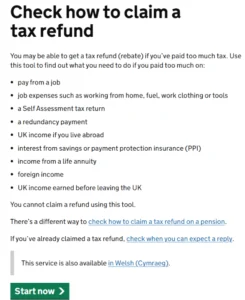
HMRC’s official tax refund checker lists the main circumstances in which taxpayers may be able to reclaim overpaid tax.
PAYE And P800 Refunds
If HMRC has reviewed your PAYE record and decided you paid too much tax, it may send you a P800 tax calculation letter.
Read the letter carefully because it explains whether you need to claim your refund or whether HMRC will send it automatically.
If the P800 says you can claim online, you can use HMRC’s online bank transfer service.
You can also claim through your Personal Tax Account or HMRC app where available.
To make an online P800 claim, HMRC says you will normally need:
- P800 Reference Number: The reference shown on your tax calculation
- National Insurance Number: Used to identify your tax record
- Bank Details: Needed when requesting repayment directly to an eligible account
If HMRC states that a cheque will be sent automatically, you normally do not need to submit a separate claim.
P50 After Leaving A Job
Stopping work partway through a tax year can result in an Income Tax overpayment because PAYE normally assumes your annual earnings will continue throughout the year.
You may be able to use form P50 if you have stopped working and meet HMRC’s conditions.
HMRC says a P50 claim may be possible where you have been unemployed for at least four weeks and are not receiving taxable state benefits, have retired without receiving a pension from your previous employer, do not expect to return to work, or have returned to full-time study.
You should wait until you have received your final pay before claiming.
A P50 is not appropriate in every situation. For example, HMRC says people who are still registered with an employment agency should normally contact that agency so their final pay and tax details can be reported.
Work Expense Claims
Employees can sometimes receive tax relief when they personally pay qualifying expenses that are necessary for their job and their employer does not reimburse them.
Potential claims can include:
- Uniforms And Work Clothing: Eligible costs of maintaining or replacing qualifying specialist clothing
- Tools: Certain tools required to carry out your employment
- Professional Subscriptions: Fees to approved professional organisations where the conditions are met
- Business Travel: Qualifying travel to temporary workplaces rather than ordinary commuting
- Equipment: Certain equipment purchased solely for work where HMRC’s rules are satisfied
HMRC says postal P87 expense claims can generally be made where total expenses are £2,500 or less for each relevant tax year.
Where the expense claim exceeds £2,500 for a tax year, the claim normally has to be made through Self Assessment.
You may also need evidence such as receipts, travel records or proof that an expense was required for your employment.
There has been an important change to working-from-home relief. From 6 April 2026, employees can no longer make new HMRC deductions for unreimbursed additional household costs incurred from working from home.
Eligible claims relating to the previous four tax years may still be possible.
Self Assessment Refunds
If you complete a Self Assessment tax return and your final calculation shows that you paid too much tax, you may be able to request a repayment through your tax account.
Self-employed taxpayers should make sure all income, allowable expenses and tax already paid have been entered correctly before requesting money back.
Someone new to self-employment may also need to understand the tax and record-keeping obligations that come with registering as a sole trader.
Accessing HMRC services may require the appropriate online sign-in details. Understanding how the Government Gateway works for Self Assessment can make it easier to review returns, tax calculations and account information.
HMRC warns that a Self Assessment repayment may not be paid directly if another tax payment is due within the next 45 days. In that situation, the overpayment may instead be set against the tax you owe.
Pension Tax Refunds
Taking money from a pension can sometimes lead to too much tax being deducted, particularly where the pension provider initially uses an emergency tax code.
HMRC has different refund routes according to how the pension was accessed.
These include:
- P55: For certain overpayments after flexibly accessing part of a pension
- P53: For tax deducted from certain small pension lump sums
- P53Z: Where all of a pension has been flexibly accessed
- P50Z: Where you have stopped working and flexibly accessed all of a pension
Using the correct form matters because HMRC states that an incorrect pension refund form can delay repayment.
You will normally need details including your National Insurance number, pension payment, tax deducted and other taxable income you expect to receive.
For business owners managing more complex retirement arrangements, pension tax rules can extend well beyond refunds.
For example, SSAS pension investment rules involve separate HMRC requirements around how pension assets can be invested.
What Documents Do You Need To Claim Tax Back?
The exact documents depend on the type of refund, but keeping accurate tax records will make the process much easier.
You may need:
- National Insurance Number: Used by HMRC to identify your tax record
- P45: Shows pay and tax when you leave employment
- P60: Shows annual pay and Income Tax deducted
- Payslips: Useful for checking PAYE deductions and tax codes
- P800: Required for certain HMRC tax calculation refunds
- Expense Receipts: Needed for some job-expense claims
- Mileage Records: Useful when claiming eligible business mileage
- Pension Statements: Needed when checking tax deducted from pension withdrawals
- Bank Details: Required for certain direct repayments
- UTR: Relevant to taxpayers using Self Assessment
- Professional Fee Records: Evidence of qualifying subscriptions or fees
Keep original information until you are satisfied that your refund and tax records are correct.
Checking your P60 and payslips can also identify deductions unrelated to Income Tax.
For example, employees repaying education borrowing can use their payslips and P60 when checking their student loan plan and deductions.
How Much Tax Can You Claim Back?
There is no standard amount that everyone receives.
Your refund depends on the difference between the amount of Income Tax you actually owed and the amount already deducted or paid.
Factors that can affect the calculation include:
- Total Taxable Income: Higher income can result in more tax being due
- Personal Allowance: The standard allowance is £12,570 in 2026/27
- Tax Band: Different rates apply depending on taxable income and where you live
- Tax Already Paid: The refund cannot normally exceed the relevant overpayment
- Allowable Expenses: Eligible tax relief can reduce taxable income
- Other Income: Pensions, savings and additional jobs can affect the calculation
- Benefits In Kind: Taxable employment benefits can affect the amount owed
For example, suppose an employee in England, Wales or Northern Ireland had an eligible £500 employment expense and was entitled to relief at the 20% basic rate.
The tax benefit would normally be £100 rather than a £500 cash refund.
A PAYE overpayment works differently. If your correct Income Tax bill was £1,500 but £1,850 had already been deducted, the potential overpayment would be £350, subject to HMRC confirming the figures.
The standard Personal Allowance is £12,570 in the 2026/27 tax year. Income Tax rates differ in Scotland.
How Far Back Can You Claim Tax Back?
Many tax refund and tax relief claims are subject to time limits, so you should not assume that an old overpayment can be reclaimed indefinitely.
A common HMRC limit is four years from the end of the tax year concerned, although the exact deadline depends on the type of claim.
For example, HMRC states that job-expense claims made using the relevant P87 route must be within four years from the end of the tax year being claimed.
The same four-year limit applies when reclaiming certain previous-year overpayments on savings interest.
Check the rules for your specific refund rather than waiting until the deadline approaches.
How Long Does A Tax Refund Take?
The time needed to receive tax back depends on how the refund is being processed.
For a P800 where HMRC allows an online claim, HMRC says the payment should be sent within five working days. If you ask HMRC to issue a cheque, it can take up to six weeks.
If the P800 states that HMRC will automatically send a cheque, it should normally arrive within 14 days of the date on the letter.
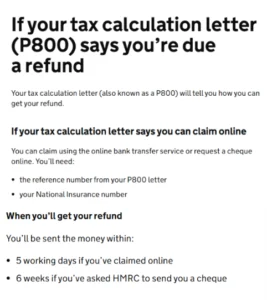
HMRC’s official P800 refund page confirms the repayment times for online claims and cheque payments.
Other refund types can take longer, particularly where HMRC needs to check supporting evidence or confirm information with an employer.
A Self Assessment refund can also show as pending in your tax account. HMRC explains that this means the repayment has been created but still needs approval and payment.
Avoid submitting duplicate claims simply because a repayment has not arrived immediately.
What Happens After You Claim Tax Back?
What happens next depends on the refund route.
HMRC may:
- Pay Your Bank Account: Some refunds are made directly by bank transfer
- Send A Cheque: Certain repayments are issued by post
- Change Your Tax Code: A current-year overpayment can sometimes be corrected through PAYE
- Refund Through Payroll: Your employer or pension provider may repay tax after HMRC changes your code
- Offset Other Tax: An overpayment can sometimes be used against another amount you owe
- Request Evidence: HMRC may ask for receipts or further information before approving the claim
- Run Security Checks: Repayments can be reviewed before being released
If HMRC corrects an estimated amount of savings income during the current tax year, for example, it can change the tax code and ask the employer or pension provider to refund the difference through pay or pension.
Keep copies of everything submitted until the claim has been completed.
What If Your Tax Refund Claim Is Cancelled Or Rejected?
A refund is not guaranteed simply because a claim has been submitted.
HMRC may decide that no repayment is due if the information shows that you paid the correct amount of tax, have already received the relevant relief, did not pay enough tax to receive the requested relief or have not provided sufficient evidence.
A repayment can also be delayed or stopped while HMRC carries out checks. Self Assessment repayment records can have statuses including pending, rejected or cancelled at different stages of HMRC’s internal repayment process.
If your refund does not proceed:
- Check The Reason: Review your HMRC account, letter or other communication
- Check Your Figures: Confirm income, tax deductions and claimed expenses
- Provide Missing Evidence: Send additional information if HMRC requests it
- Contact HMRC: Ask for clarification when the reason is unclear
- Challenge A Decision Where Appropriate: Follow the instructions in the formal decision letter
HMRC says certain Income Tax and tax-relief decisions can be challenged. A decision letter normally explains what to do, with a typical deadline of 30 days for an appeal or review option.
A rejected claim and a delayed refund are not necessarily the same thing, so confirm the status before submitting anything again.
How To Avoid Tax Refund Scams And Rebate Company Fees?
You do not normally need to pay a commercial tax refund company simply to make an ordinary claim that you can submit directly to HMRC.
Some repayment agents charge a percentage of the refund or other fees. Read the terms carefully before giving an agent authority to act for you.
You should also be cautious about unexpected messages promising a tax refund.
HMRC confirmed in its October 2026 guidance that it may send a text saying a P800 refund is available after a letter has already been issued, but that text will not ask for personal or financial information and will not contain website links.
Protect yourself by following these basic precautions:
- Use GOV.UK: Start tax refund claims through official government services
- Check Unexpected Messages: Do not assume a refund email or text is genuine
- Protect Bank Details: Do not send financial information in response to suspicious messages
- Check Agent Fees: Understand exactly how much of your refund a company will keep
- Read Authorisations Carefully: Know what permission you are giving a tax agent
- Keep Claim Records: Save copies of forms, calculations and supporting evidence
You remain responsible for ensuring the information submitted to HMRC on your behalf is accurate.
Conclusion
Claiming tax back from HMRC starts with identifying why you have overpaid and using the correct refund route.
PAYE taxpayers may receive a P800, people who stop working may qualify to claim through P50, employees can claim eligible work expenses, Self Assessment taxpayers can request repayments through their tax account and pension savers have dedicated HMRC refund routes.
Check your tax code, payslips, P45, P60 and HMRC account before making a claim. Keep supporting documents and pay close attention to time limits.
Most importantly, use the route that matches your circumstances rather than submitting a generic refund request.
This can reduce delays and make it easier for HMRC to calculate what, if anything, you are owed.
FAQs
Can I Claim Tax Back If I Am Still Working?
Yes. You may still be due tax back if too much Income Tax has been deducted through PAYE or you qualify for eligible tax relief. HMRC may correct the position through your tax code or issue a refund.
Can I Claim Tax Back Without A P60?
Potentially. The documents required depend on the claim type. Payslips, a P45, P800 and information held in your HMRC account may also be relevant.
Can I Claim Tax Back From Previous Years?
Yes, in many situations, but deadlines apply. A common limit for tax-relief claims is four years from the end of the relevant tax year.
How Do I Know If HMRC Owes Me Money?
Check your Personal Tax Account, tax code, payslips, P45 and P60. HMRC may also send a P800 after the tax year if its calculation shows that you overpaid Income Tax.
How Long Does HMRC Take To Pay A Refund?
It depends on the claim. HMRC says an eligible P800 refund claimed online is normally sent within five working days, while a requested cheque can take up to six weeks.
Can I Claim Tax Back Directly From HMRC For Free?
Yes. HMRC provides official services for checking and claiming eligible tax refunds, so you do not normally need a repayment company simply to submit a standard claim.
What Should I Do If My Tax Refund Does Not Arrive?
Check the status of the claim and confirm that HMRC has the correct details. If the expected processing period has passed, contact HMRC rather than immediately submitting a duplicate claim.
What is your reaction?