How to Choose the Right Sliding Door System for Commercial Settings?

Commercial environments demand door solutions that balance space efficiency, durability, and safety. Choosing the appropriate system influences workflow, cost, and compliance over a facility’s lifespan. This article outlines practical considerations and decision points for selecting sliding door systems in business settings.
Making the right selection of a sliding door kit is essential for businesses looking to address spatial restrictions, meet regulatory standards, and ensure reliable performance in high-traffic areas.
The decision process goes beyond initial installation, with long-term maintenance, operational flexibility, and total cost of ownership all playing critical roles.
Facilities managers and contractors prioritise risk management, adaptability, and user safety as central to specifying the right solution.
Specification Factors Affecting Business Environments

Door specification directly affects traffic flow, operational safety, and space use in commercial spaces. With restricted floorplans common in offices, hospitality venues, and retail back-of-house zones, selecting a system that maximises usable area is crucial.
Careful choice can mitigate bottlenecks and facilitate smooth movement for staff and visitors. Durability and lifecycle cost are also key priorities.
High-traffic facilities benefit from robust hardware and resilient mechanisms, minimising maintenance interruptions and costly replacements. Aligning the chosen system with actual site use protects long-term budgets and ensures consistent daily operation.
Environmental conditions within commercial premises also influence specification decisions significantly. Temperature fluctuations, humidity levels, and exposure to cleaning chemicals or food preparation areas all affect material longevity and hardware performance.
Facilities in coastal regions or areas with extreme weather patterns require corrosion-resistant finishes and weatherproof seals to maintain operational integrity.
Understanding the specific environmental stressors present in each location allows for informed material selection that prevents premature degradation and ensures consistent functionality throughout the system’s intended service life.
Integration with existing building management systems represents another critical specification factor for modern commercial facilities.
Smart building technologies increasingly require door systems that can interface with access control platforms, occupancy sensors, and automated climate control networks.
Facilities planning future expansions or technology upgrades benefit from selecting sliding door systems with compatible connectivity options and standardised mounting configurations.
This forward-thinking approach reduces integration costs during subsequent refurbishments and ensures the door hardware remains compatible with evolving security protocols and energy management strategies across the building’s operational timeline.
Varied Applications and Hardware Component Choices
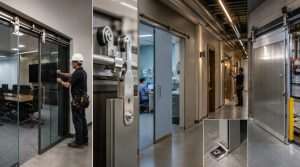
Sliding door systems serve a wide range of professional settings. In offices, corridors, or healthcare administration areas, a well-chosen solution enhances access and supports privacy, while in light industrial environments, space-saving designs enable more efficient layout and workflow.
Several key components demand scrutiny during selection. Track type and mounting impact installation options and durability, while rollers and soft-close mechanisms influence user safety and noise levels.
Options like french door locks and fitted door guides determine practical security and smooth closing, meeting site-specific requirements for privacy or risk mitigation.
Material, Load, and Operational Performance Concerns
Businesses must evaluate the types of door materials, such as glass, timber, or metal, based on intended use, durability, and design considerations.
The weight, width, and frequency of door operation will influence not only the choice of track and rollers but also the specific grade of hardware needed for reliable performance in intensive settings.
Acoustic demands and privacy requirements feature heavily in facilities such as clinics, offices, and meeting rooms. Some contexts call for enhanced fire safety or compliance features, adding further layers to the product decision.
Manual, assisted, and automated systems each present distinct operational benefits and must be weighed according to staff and visitor needs.
Compliance, Risk, and Selection Workflow for Managers

Regulatory expectations require facilities managers and contractors to prioritise accessibility and safe operation in all high-traffic environments.
This means specifying components that facilitate easy opening, secure closure, and low resistance, supporting universal access and ensuring compliance documentation is thorough and traceable.
When assessing options, cost of ownership analysis should factor in initial price, anticipated lifespan, and likelihood of unplanned downtime.
Maintenance intervals, hardware availability, and warranty terms are essential considerations for facilities seeking predictable performance across years of operation.
A structured workflow helps managers align user needs with correct hardware configuration, avoiding costly retrofits or compliance issues later in the building’s life cycle.
What is your reaction?