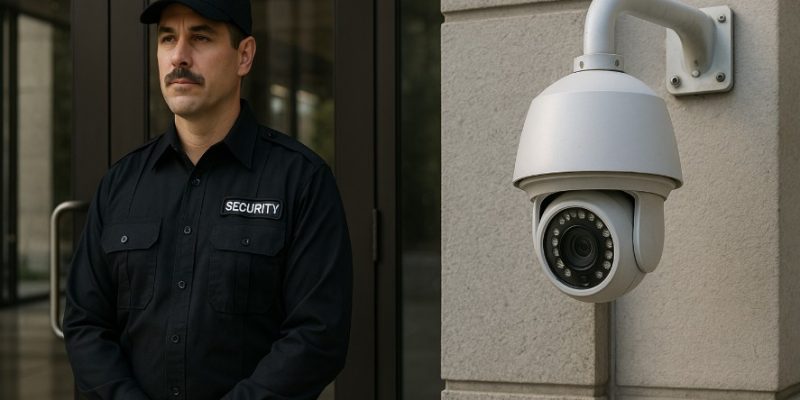
Security Guards vs CCTV: A Guide for UK Businesses

Protecting your business premises is non-negotiable. Whether you run a bustling retail store, manage a quiet office block, or oversee a sprawling construction site, security is paramount.
But when it comes to choosing the right measures, the options can be overwhelming. The classic debate often comes down to two choices: traditional security guards or modern CCTV systems.
This isn’t just about catching intruders, it’s about deterring crime, ensuring staff safety, and protecting your assets around the clock. Making the wrong choice can be costly, both financially and in terms of security breaches.
This guide will provide unbiased, practical advice to help you decide what your business really needs. We’ll compare the pros and cons of security guards and CCTV, look at the costs, and explore whether a hybrid approach might be the best solution for you.
The Case for Security Guards
There’s a reason security guards have been a mainstay for decades. The human element provides a level of deterrence and response that technology alone often can’t match.
Advantages of Security Guards
- Visible Deterrence: The physical presence of a uniformed guard is a powerful deterrent. Potential criminals are often less likely to target a property that is clearly protected by on-site personnel. A camera might record a crime, but a guard can prevent it from happening in the first place.
- Immediate Response: In the event of an incident, a security guard can intervene immediately. They can confront intruders, manage situations, contact emergency services, and provide first aid if necessary. This rapid response can be crucial in minimising damage, loss, or harm.
- Adaptability and Judgement: Guards can use their judgement to assess situations in a way technology cannot. They can distinguish between a real threat and a false alarm (like a cat triggering a sensor), handle unexpected events, and adapt their patrols based on suspicious activity. They can also assist customers, guide visitors, and perform other helpful tasks.
- Physical Checks: A guard can physically check that doors are locked, windows are secure, and that there are no signs of tampering. This is particularly important for large premises like warehouses or construction site security, where valuable equipment and materials are often left vulnerable.
The Case for CCTV
CCTV (Closed-Circuit Television) has become increasingly sophisticated and affordable, making it an attractive option for businesses of all sizes.
Advantages of CCTV
- Continuous Monitoring: CCTV systems can monitor and record multiple areas simultaneously, 24/7, without getting tired or distracted. This provides comprehensive coverage that a human guard cannot replicate.
- Cost-Effectiveness: While there is an initial investment for hardware and installation, the long-term running costs of a CCTV system are generally much lower than employing guards. There are no ongoing wages, and modern systems are energy-efficient.
- Evidence Collection: High-definition video footage provides indisputable evidence in the event of a crime. This is invaluable for police investigations and insurance claims.
- Remote Access: Many modern CCTV systems allow you to monitor your premises remotely via a smartphone or computer. This gives business owners peace of mind and the ability to check in from anywhere, at any time.
A Hybrid Approach: The Best of Both Worlds?
For many businesses, the most effective security strategy isn’t a case of choosing one or the other, but combining the two. A hybrid approach leverages the strengths of both systems while mitigating their weaknesses.
CCTV can provide constant surveillance over a wide area, with security guards using the system to monitor the site from a central location. This allows them to spot potential issues in real-time and respond efficiently. The guards can then conduct targeted patrols based on what the cameras show, rather than walking a fixed route.
This integrated system is particularly effective for larger sites. For example, in construction site security, cameras can monitor the entire perimeter, while a guard can be stationed at the entrance to control access and respond to any alerts from the system.
In a retail environment, cameras can watch over the shop floor, while a guard provides a reassuring presence and deals with any incidents of shoplifting or anti-social behaviour.
Finding the Right Fit for Your Business

Ultimately, the best security solution depends on your specific needs, budget, and risk profile.
Ask yourself:
- What are you trying to protect? High-value goods may require the immediate response of a guard, whereas monitoring staff productivity might only need CCTV.
- What is your budget? If funds are tight, a high-quality CCTV system may be a more realistic starting point than 24/7 manned guarding.
- What is the risk level? A business in a high-crime area or one that holds sensitive data or materials will have different needs than a small office in a quiet business park.
By carefully considering these factors, you can create a robust security plan that protects your premises, your people, and your bottom line.
What is your reaction?