Do I Need to Declare Cash Gifts to HMRC UK?

Navigating the rules around cash gifts and HMRC can be confusing, particularly when it comes to tax obligations and legal reporting.
Whether you’re giving or receiving a financial gift, it’s important to understand how UK tax law applies and what exemptions may be available.
While recipients usually don’t need to declare gifts, there are specific circumstances where tax may become relevant.
This guide explains the key considerations, including inheritance tax, personal allowances, and HMRC’s expectations for record-keeping.
What Are HMRC’s Rules on Cash Gifts in the UK?

In the UK, cash gifts given from one individual to another are generally not subject to income tax or capital gains tax.
HMRC does not treat a genuine gift of cash between individuals as taxable income for the recipient.
This means that the money received is considered outside the scope of income taxation as long as it is a genuine, voluntary transfer with no exchange of goods or services.
The donor, or the person giving the gift, is the one whose estate may be impacted for inheritance tax purposes, depending on the value of the gift and how long they live after giving it.
HMRC focuses its interest on gifts made during an individual’s lifetime that could potentially reduce the value of their estate, especially if the donor passes away within seven years of the transfer.
One of the reasons HMRC does not tax the recipient of a cash gift is that it wants to avoid double taxation.
Since the money being given has typically already been taxed through income or capital gains when it was earned or realised by the giver, taxing the recipient again would be duplicative.
That said, once the recipient uses the money in a way that generates income or capital gains, it becomes subject to the usual tax rules associated with those activities.
Does the Recipient Ever Need to Report a Gift?
In ordinary circumstances, recipients do not need to notify HMRC when they receive a cash gift.
There is no gift tax in the UK in the same way there is in some other countries like the United States.
However, if the cash is subsequently used in ways that produce taxable income or gains, such as investing it in a savings account or using it to purchase a rental property, the resulting income or gains are liable for tax and must be declared.
The tax treatment is therefore less about the initial gift and more about what happens next.
The distinction is important because while the act of receiving a gift is tax-free, the utilisation of that gift may create taxable events depending on the financial products or assets it is used for.
Who Is Responsible for Inheritance Tax?
The potential liability for inheritance tax rests with the giver, not the recipient. Specifically, if the person who gave the gift dies within seven years of making it, the value of the gift may be added back into their estate to calculate whether inheritance tax is due.
The responsibility for calculating and paying inheritance tax lies with the executor or personal representative of the deceased’s estate.
The recipient may only become liable for tax if the estate does not have sufficient funds to cover the inheritance tax due on the gift. In practice, this situation is rare, but not impossible.
Executors must carefully examine financial records to identify any large gifts made during the seven years before death.
If the total value of gifts, combined with the rest of the estate, exceeds the nil-rate band of £325,000, inheritance tax may be charged at 40 percent, subject to taper relief.
When Must a Recipient Declare Income or Gains from a Cash Gift?

Although receiving a cash gift is not taxable, the financial return from investing or saving the gifted money may be.
The moment the cash starts to work to produce income, the tax position changes. HMRC treats this income just like any other and expects it to be declared if it exceeds your annual allowances.
What If the Gift Earns Bank Interest?
If the gifted money is deposited into a bank or building society account and earns interest, that interest could be taxable.
The UK tax system allows for a Personal Savings Allowance (PSA), which gives individuals a certain amount of interest income they can receive each year tax-free. The amount depends on their income tax band.
| Taxpayer Type | Personal Savings Allowance |
| Basic rate (20%) | £1,000 |
| Higher rate (40%) | £500 |
| Additional rate (45%) | £0 |
Interest earned above your PSA must be declared to HMRC via a Self Assessment tax return or will be taxed through your PAYE tax code if you are employed.
For example, if you receive a cash gift of £50,000 and deposit it in an account with a 3% annual interest rate, it will generate £1,500 in interest.
If you are a basic rate taxpayer, £500 of that interest will be subject to income tax.
Do Investments from Gifted Money Attract Tax?
If you invest the gifted money into assets like stocks, bonds, or mutual funds, any dividends received from those investments are subject to tax if they exceed the Dividend Allowance, which is currently £500 per year for the 2025/26 tax year.
Dividends above this threshold are taxed at:
- 8.75% for basic rate taxpayers
- 33.75% for higher rate taxpayers
- 39.35% for additional rate taxpayers
If you use the money to purchase a buy-to-let property, any rental income will also be taxed.
This income must be reported on a Self Assessment tax return, and you can deduct certain allowable expenses, such as maintenance costs and letting agent fees, before calculating your taxable income.
Is Capital Gains Tax Ever Applicable?
Capital Gains Tax (CGT) comes into play when an asset bought using the gifted cash is later sold for a profit.
This tax is not triggered by the gift itself but by the subsequent sale of an asset acquired with the gift.
Every individual has an annual CGT exemption, currently £3,000. If your total gains for the tax year are below this amount, no CGT is due.
If your gains exceed the allowance, the following rates apply depending on your income:
| Asset Type | Basic Rate CGT | Higher/Additional Rate CGT |
| Most assets (shares) | 10% | 20% |
| Property (not main home) | 18% | 28% |
So, if you use a cash gift to buy shares worth £10,000 and later sell them for £15,000, the £5,000 gain will be subject to CGT on the amount exceeding your £3,000 exemption.
Are There Tax Rules for Parents Gifting to Children?
Gifting to children, particularly minors, has its own set of tax rules. If a parent gifts money to a child under the age of 18, and that money produces income over £100 per year, the parent will be taxed on the entire amount of income, not just the portion above the threshold.
This rule exists to prevent tax avoidance by transferring income-generating assets to children in a lower or zero tax bracket.
If the gift produces less than £100 in income annually, the income is considered to belong to the child and is taxed accordingly, typically at a lower rate.
Importantly, this rule does not apply to gifts from grandparents, other relatives, or family friends.
Nor does it apply to funds placed in Junior ISAs, which offer tax-free returns regardless of the contribution source.
This restriction can complicate financial planning for families hoping to build savings for their children.
In many cases, it may be more tax-efficient for grandparents to gift money for children’s savings or to make use of tax-advantaged accounts such as Junior ISAs and premium bonds.
What Is the Seven-Year Rule for Inheritance Tax?
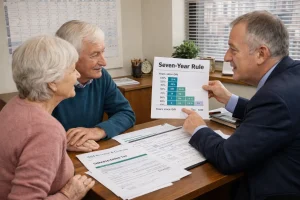
However, if they pass away within seven years, the value of the gift is counted toward their estate.
If the combined value of gifts and estate exceeds the nil-rate band (currently £325,000), inheritance tax may be due.
In cases where the gift is made more than three years before death, taper relief may reduce the amount of IHT due.
Taper relief only reduces the rate of tax, not the value of the gift that counts toward the estate. Here is how taper relief is applied:
| Time Between Gift and Death | Tax Payable on the Gift |
| 0–3 years | 40% |
| 3–4 years | 32% |
| 4–5 years | 24% |
| 5–6 years | 16% |
| 6–7 years | 8% |
| 7+ years | 0% (gift is exempt) |
This system encourages early gifting as part of estate planning. However, for taper relief to apply, the gift must exceed the nil-rate band.
If the total value of the donor’s estate, including the gift, is below £325,000, no tax is charged, regardless of the timing.
When Is a Gift Considered a Potentially Exempt Transfer (PET)?
A Potentially Exempt Transfer (PET) is a gift that is exempt from IHT only if the donor lives for seven years.
If the donor dies within seven years and the total value of gifts (including the PET) exceeds the nil-rate band, the PET becomes chargeable to tax.
This differs from gifts covered by exemptions such as:
- The £3,000 annual exemption
- Small gifts of up to £250 per person
- Wedding gift exemptions
PETs are typically large, one-off gifts that fall outside the usual tax-free allowances. They can be gifts of cash, property, shares, or other assets. As long as the donor survives seven years after making the gift, it becomes fully exempt from IHT, regardless of the amount.
This makes PETs a vital tool for people undertaking long-term estate planning. However, they must be carefully documented and monitored to avoid surprises for the executor or tax consequences for the recipient.
Who Declares the Gift to HMRC if the Giver Passes Away?
If the donor dies within seven years of giving a PET or any large gift, the executor or personal representative of the estate must include the gift in the IHT calculations.
The recipient of the gift may also be asked for documentation, especially if the estate does not have enough funds to cover the tax.
The executor is required to:
- Identify all gifts made in the seven years before death
- Determine if taper relief applies
- Calculate any tax owed
- File the appropriate IHT forms with HMRC
If HMRC deems the gift taxable and the estate is insufficient to pay, the tax liability can fall to the recipient.
This underlines the importance of communication and record-keeping among family members, particularly in cases where large lifetime gifts have been made.
What Records Should You Keep for a Cash Gift?

Good record-keeping can avoid future complications. Although there is no legal obligation to report most gifts at the time they are given or received, having a clear record helps in the event of:
- An inheritance tax investigation
- A bank’s anti-money laundering checks
- Proving the source of funds for major purchases such as property
Important records to keep include:
- A letter from the giver confirming the nature and value of the gift
- Bank statements showing the transfer
- Documentation of how the money was used
- The giver’s contact details and relationship to the recipient
These records may not need to be shown to HMRC immediately but will be helpful for executors managing the donor’s estate in future.
Are There Any Exceptions or Special Situations to Consider?
While the rules are generally straightforward, certain circumstances can introduce complications. Some gifts may not qualify for exemptions and may raise concerns for HMRC or other institutions.
For example, giving a large sum of money while in poor health can raise questions about the intent of the gift and the donor’s mental capacity.
Gifts given with an expectation of receiving something in return might not be considered genuine gifts and could be treated as payments for services or loans.
Banks and building societies are also required to flag large transactions as part of anti-money laundering regulations.
If you receive a large sum of money as a gift, you may be asked to show documentation proving the source and nature of the funds.
In summary, while most cash gifts are straightforward, edge cases do exist where tax, legal, or financial implications must be considered and managed with care.
Conclusion
In most situations, you do not need to declare a cash gift to HMRC if you are the recipient. The gift itself is not taxed, but you must report any income or gains it generates.
For the person giving the gift, Inheritance Tax rules may apply, particularly if they pass away within seven years.
Therefore, careful record-keeping and understanding of HMRC’s exemptions can prevent issues later on.
FAQs
Can HMRC investigate large cash gifts?
Yes, HMRC can investigate large bank transfers, especially if they suspect the money is part of a taxable estate or if no IHT was reported following a death.
What is the best way to document a cash gift?
A simple letter signed by the giver, along with a copy of the bank transfer, is often enough. This can help in the event of an HMRC review or legal query.
Is there a limit to how much cash you can gift in the UK?
There’s no legal cap on how much you can gift, but gifts over the tax-free allowances may be subject to IHT if the donor dies within seven years.
Are gifts between spouses taxable?
No, transfers between spouses or civil partners are usually exempt from tax, regardless of amount, as long as both parties are UK domiciled.
What happens if the recipient uses the gift to purchase property?
The purchase itself isn’t taxed, but any rental income or capital gain from the property will be subject to normal tax rules.
Can HMRC question gifts made years ago?
Yes, especially if they are part of an estate and the donor died within seven years. Executors are required to declare these under IHT rules.
Do I need to declare a gift on my tax return?
Only if the gift generates income or capital gains that exceed your tax-free allowances.
What is your reaction?