
4 Mistakes Small Businesses Make With Their IT Setup

Ever spoken to someone who runs a small company and asked how they handle their tech? The answers can be… revealing.
One business owner a colleague knows was still running Windows 7 on two office machines last year. Not out of nostalgia. Just because nobody had gotten round to updating them.
Silly example? Maybe. But ask anyone who works in IT support and they’ll tell you its weirdly normal. Companies like Mustard IT have probably walked into worse. The thing is, nobody sets out to neglect their tech.
It just… drifts. There’s always something more urgent. A client deadline, a hire to make, a lease to sort out. The computers keep working (mostly) so they stay at the bottom of the list.
And then one Tuesday morning something breaks and suddenly its a crisis. That’s the pattern. Most IT mistakes in small businesses aren’t dramatic failures. They’re slow ones.
So here are four that come up again and again.
What Are the Most Expensive Small Business IT Mistakes to Avoid?

Assuming the Free Tools Will Always Be Enough
There’s nothing wrong with free software. Google Workspace’s free tier, free antivirus, the default Windows firewall. If someone’s running a business on their own out of a spare bedroom, that’s probably all they need.
The trouble starts when the team grows to four or five people and everyone’s still cobbling things together with whatever was lying around.
By that point the migration becomes a proper headache. Someone’s got client files in a personal Gmail. Someone’s got spreadsheets saved to a desktop that nobody else can access.
Half the passwords are in a notebook somewhere, maybe. Getting from that state to something organised and secure usually ends up costing way more than doing it right would have in the first place.
Which, fair enough, hindsight is easy.
Not Having a Real Backup Strategy
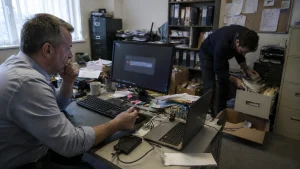
This one’s arguably the scariest. There are businesses out there with no proper backup plan whatsoever, or a plan that amounts to “someone copies everything onto a USB stick on Fridays.”
That might sound dramatic but a Vodafone Business report on SME cyber security found that almost a third of UK SMEs had no cyber security protections in place at all. None. Not even the basics.
A proper backup strategy means automated, offsite, and tested regularly. Not “we think Dave’s laptop has a copy.” And yet.
Some businesses only discover how bad their backup setup is after something goes wrong. A ransomware hit, a corrupted drive, an accidental deletion that nobody noticed for three weeks. The recovery process is where the real damage shows up.
Ignoring Cyber Security Until Something Happens
Look, everyone knows this one already. Or thinks they do.
“We’re too small to be worth hacking.” Heard it a hundred times. Its one of those things that sounds reasonable until you actually look at how these attacks happen.
Nobody is hand-picking targets. Thats not how it works anymore. The British Chambers of Commerce highlighted that SMEs across the UK are going digital faster than ever, adopting cloud tools, remote setups, the lot.
But the security side? Still lagging behind. So what happens is you get thousands of small firms with more online exposure than they realise and not much standing between them and an automated bot scanning for unpatched software.
A recruitment agency in Leeds with an old WordPress install gets hit the same way a logistics company in Bristol does. There’s no selection process.
The annoying part is that sorting it out isn’t even expensive. Multi-factor authentication takes about ten minutes to set up. Software updates are free. A half-day phishing awareness session for staff costs less than a decent office chair. People just don’t get round to it.
Treating IT as a Cost, Not Infrastructure

This is the one that’s a bit harder to pin down but probably matters most. A lot of small business owners see IT spending as an overhead. Something to minimise. And in a tight budget that instinct makes total sense.
But there’s a difference between spending wisely and spending as little as possible. Businesses that invest thought into their hosting choices, their network setup, their day-to-day tools, they tend to have fewer emergencies.
Fewer lost afternoons waiting for the broadband to sort itself out. Fewer panicked calls when someone clicks something they shouldn’t have.
It doesn’t require a massive budget either. It just requires treating tech decisions with the same seriousness as, say, choosing an accountant or a solicitor.
Anyway. None of these mistakes are unusual, and none of them are unfixable. The pattern is just that most small businesses don’t think about IT until something breaks, and by then the options are more limited and more expensive. There is probably a lesson in there somewhere.
What is your reaction?