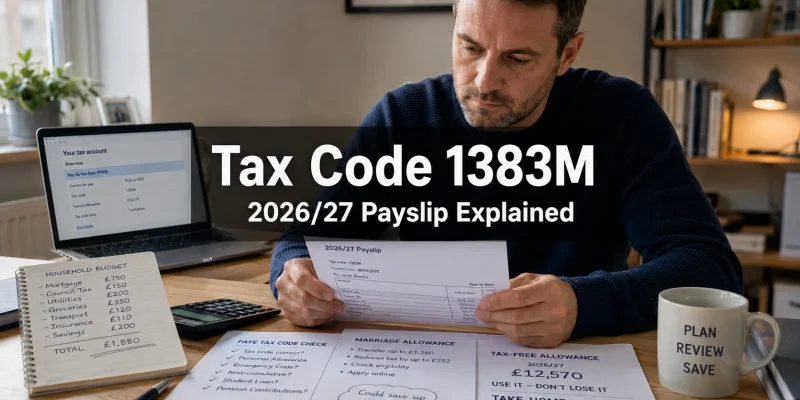
Tax Code 1383M: What It Means for Your 2026/27 Payslip?

Last Updated On – 27-05-2026
Tax code 1383M means the employee is receiving Marriage Allowance from their spouse or civil partner.
It usually shows that 10% of one partner’s tax-free Personal Allowance has been transferred to the other, increasing the recipient’s tax-free income to around £13,830 before income tax applies.
For a UK employee, this can slightly improve take-home pay through PAYE, but it should still be checked against HMRC records and current eligibility.
Key takeaways:
- 1383 usually represents a tax-free allowance of about £13,830.
- M means the employee is receiving Marriage Allowance.
- The other partner may have an N tax code.
- The code can reduce income tax for a basic-rate taxpayer.
- Employees should check payslips, HMRC records, and eligibility regularly.
What Does Tax Code 1383M Mean?

Tax code 1383M is a UK PAYE tax code that normally shows an employee is receiving Marriage Allowance from their spouse or civil partner.
It means HMRC has increased the employee’s tax-free allowance because their partner has transferred part of their own Personal Allowance to them.
In most cases, the code can be understood by separating the number from the letter.
The number 1383 usually points to a tax-free allowance of around £13,830. The letter M shows that the person is receiving Marriage Allowance.
This is different from the standard tax code 1257L, which usually reflects the standard Personal Allowance of £12,570.
When Marriage Allowance is added, the receiving partner’s tax code may increase to 1383M, depending on the tax year and HMRC’s calculation.
The Meaning of 1383 in a UK Tax Code
The number in a tax code is usually linked to the amount of tax-free income the person can receive in the tax year.
HMRC normally removes the final zero from the allowance figure when creating a tax code. So, 1383 broadly represents £13,830 of tax-free income.
This figure is commonly made up of the standard Personal Allowance plus the Marriage Allowance transfer.
| Tax Code Part | What It Means | Approximate Amount |
| 1257 | Standard Personal Allowance | £12,570 |
| Extra allowance | Marriage Allowance transfer | £1,260 |
| 1383 | Total tax-free allowance reflected in the code | £13,830 |
| M | Receiving Marriage Allowance from a spouse or civil partner | Applies to the recipient |
This does not mean the person receives £13,830 as a payment. It means they may earn up to around that amount before income tax is applied, provided there are no other adjustments in the code.
The Meaning of the M Letter in Tax Code 1383M
The M letter is important because it explains why the allowance has increased. It shows that the employee is receiving Marriage Allowance.
The partner who transfers part of their allowance will usually have a tax code ending in N. This means one partner receives extra allowance, while the other gives up part of theirs.
For example:
| Partner | Possible Tax Code | Meaning |
| Partner receiving the allowance | 1383M | Receives part of their partner’s Personal Allowance |
| Partner transferring the allowance | 1131N or similar | Transfers part of their Personal Allowance |
| Employee with no Marriage Allowance | 1257L | Receives the standard Personal Allowance |
| Employee on emergency code | 1257L W1, M1 or X | Tax is calculated on a temporary basis |
The M code can be beneficial, but it should still be checked. If the employee is no longer eligible, the code may result in too little tax being paid.
Why Might Tax Code 1383M Appear on a Payslip?
Tax code 1383M may appear on a payslip because HMRC has told the employer to apply Marriage Allowance through PAYE.
Employers usually do not decide this code themselves. They use the code sent by HMRC.
The code may appear after a Marriage Allowance claim has been approved. It may also appear at the start of a new tax year if the claim is continuing from a previous year.
In some cases, the employee may notice it after HMRC updates their income estimate or corrects their tax record.
A payroll adviser described the confusion clearly:
“I often see employees worry when their tax code changes from 1257L to 1383M. In many cases, I explain that this simply means HMRC has applied Marriage Allowance, but I always recommend checking the HMRC Personal Tax Account to make sure the details are right.”
There are several common reasons why this code may show on a payslip:
- The employee or their partner has successfully claimed Marriage Allowance.
- HMRC has carried forward an existing Marriage Allowance claim.
- The employer has received a new tax code notice from HMRC.
- The employee has changed jobs and the updated tax code has followed them.
- HMRC has corrected a previous PAYE calculation.
The code may appear suddenly, but that does not automatically mean there is a problem. However, the employee should check whether the Marriage Allowance claim still matches their circumstances.
How Does Tax Code 1383M Affect Take-Home Pay?

Tax code 1383M can increase take-home pay because it raises the amount of income that can be earned before income tax is deducted. This usually means the employee pays slightly less income tax across the tax year.
For a basic-rate taxpayer, Marriage Allowance can reduce tax because part of their income that would have been taxed becomes covered by the extra allowance. The benefit is usually spread through weekly or monthly wages, depending on the payroll cycle.
How the Extra Marriage Allowance Changes Tax-Free Income?
A standard tax code such as 1257L usually gives £12,570 of tax-free income. With tax code 1383M, the tax-free amount may rise to around £13,830.
This means the employee may have an extra £1,260 of income protected from income tax. The saving depends on the income tax rate that would otherwise apply to that income.
| Example Item | Standard Code 1257L | Tax Code 1383M |
| Annual salary | £25,000 | £25,000 |
| Tax-free allowance | £12,570 | £13,830 |
| Approximate taxable income | £12,430 | £11,170 |
| Difference in taxable income | £0 | £1,260 less taxable income |
| Possible tax saving at 20% | £0 | Around £252 |
The employee does not receive the transferred allowance as cash. Instead, they may pay less income tax because a larger part of their income is tax-free.
Example of How 1383M Can Affect Monthly Pay
If the employee is paid monthly, the tax benefit is usually spread across the year. Rather than receiving one large payment, the person may notice a small increase in monthly take-home pay.
| Monthly Payroll Example | Standard Code 1257L | Tax Code 1383M |
| Approximate annual tax-free allowance | £12,570 | £13,830 |
| Approximate monthly tax-free allowance | £1,047.50 | £1,152.50 |
| Extra monthly tax-free amount | £0 | £105 |
| Approximate monthly tax saving at 20% | £0 | Around £21 |
This example is simplified and does not include pension deductions, benefits in kind, student loans, salary sacrifice, or other adjustments.
However, it shows why tax code 1383M can make a small but useful difference to monthly pay.
Who Is Eligible for Tax Code 1383M?
A person may be eligible for tax code 1383M if they are receiving Marriage Allowance through PAYE. This usually applies where one spouse or civil partner has unused Personal Allowance and transfers part of it to the other partner.
The receiving partner must usually be a basic-rate taxpayer. The transferring partner often has income below the Personal Allowance, meaning they do not need all of their tax-free allowance.
The usual eligibility points include:
- The couple must be married or in a civil partnership.
- One partner must have unused Personal Allowance.
- The receiving partner must usually pay income tax at the basic rate.
- The couple must have made a Marriage Allowance claim.
- The claim must still match their current income and relationship status.
Marriage Allowance is not normally available to unmarried partners. Living together for many years does not usually qualify unless the couple is legally married or in a civil partnership.
It is also important to understand that eligibility can change. A person may qualify one year but not the next. If either partner’s income changes, the tax code should be reviewed.
What Is the Link Between Tax Code 1383M and Marriage Allowance?

The link between tax code 1383M and Marriage Allowance is direct. The tax code is one of the ways HMRC applies the Marriage Allowance benefit through PAYE.
Marriage Allowance allows one spouse or civil partner to transfer 10% of their Personal Allowance to the other.
The receiving partner may then pay less income tax. The transferring partner gives up part of their allowance, so their own tax code may reduce.
When One Partner Receives the M Code?
The partner receiving the transferred allowance usually has a code ending in M. This is why tax code 1383M may appear on the employee’s payslip.
The M code tells payroll that the employee’s tax-free allowance has been increased because of Marriage Allowance. Payroll then uses this code to calculate PAYE tax.
A tax consultant explained the point clearly:
“When I see an M code, I first check whether the person is actually receiving Marriage Allowance. I then check whether their income is still within the basic-rate band, because the code can become unsuitable if their income has increased.”
This type of check is useful because the tax code might look correct but still be based on old information.
When the Other Partner Receives the N Code?
The partner transferring the allowance usually has a code ending in N. This shows that they have transferred part of their Personal Allowance away.
For example, one partner may have 1383M, while the other may have a code ending in N. This is normal where Marriage Allowance has been applied correctly.
The N code can sometimes surprise the transferring partner because their own tax-free allowance has reduced. However, if they earn below the Personal Allowance, this may not cause them to pay tax.
How Can Employees Check Whether Tax Code 1383M Is Correct?
Employees can check whether tax code 1383M is correct by reviewing their payslip, HMRC account, and personal circumstances. The aim is to confirm that the code matches the Marriage Allowance claim and the employee’s current income.
The first step is to look at the latest payslip. The tax code is usually shown near the taxable pay and tax deducted section. The employee should compare this with any HMRC coding notice they have received.
The next step is to check the HMRC Personal Tax Account or HMRC app. This can show the current tax code, employer details, estimated income, Marriage Allowance status, and any adjustments included in the calculation.
| What to Check | Why It Matters |
| Tax code on payslip | Confirms which code payroll is using |
| HMRC Personal Tax Account | Shows the official tax code and income estimate |
| Marriage Allowance status | Confirms whether the claim is active |
| Estimated annual income | Helps identify whether the employee remains eligible |
| Employer details | Prevents tax errors caused by duplicate or old employments |
| Previous underpayments | May explain why a code has been adjusted |
A professional payroll reviewer described the process in a practical way:
“I always tell employees not to stop at the tax code alone. I check the income estimate, benefits, employer record and Marriage Allowance details together because one wrong detail can change the whole PAYE calculation.”
This is especially important for employees who have changed jobs, started receiving benefits, taken on a second income, or moved into a higher tax band.
What Should Someone Do If Tax Code 1383M Is Wrong?

If tax code 1383M appears to be wrong, the employee should contact HMRC or update their details through their Personal Tax Account. Payroll can explain how the code has affected pay, but HMRC is responsible for issuing or changing the code.
A wrong code can cause two main problems. The employee may pay too much tax and need a refund, or they may pay too little tax and face an underpayment later.
Checking the HMRC Personal Tax Account
The HMRC Personal Tax Account is often the best place to start. The employee should check whether the Marriage Allowance claim is active and whether the income details are correct.
They should review:
- Current PAYE tax code
- Estimated income for the tax year
- Employer or pension provider details
- Marriage Allowance claim status
- Taxable benefits from employment
- Any tax owed from previous years
- Any deductions included in the tax code
If any information is wrong, it should be corrected as soon as possible.
Speaking to HMRC or Payroll
Payroll can confirm which tax code has been used and whether HMRC sent it directly. However, payroll usually cannot remove tax code 1383M unless HMRC issues a new code.
HMRC can check the employee’s Marriage Allowance position and update the code if needed. If the employee is no longer eligible, HMRC may remove the M code and issue a different one.
It is sensible to act quickly. The longer an incorrect code stays in place, the more likely it is that the employee will need a later correction.
Can Tax Code 1383M Lead to a Tax Refund or Underpayment?
Yes, tax code 1383M can lead to a tax refund or underpayment if it has been applied late, removed late, or based on incorrect information.
A refund may happen if the employee was entitled to Marriage Allowance but did not receive it at the right time.
HMRC may then adjust the tax code so the employee pays less tax later in the year. In some cases, a repayment may be made after the tax year ends.
An underpayment may happen if the employee receives Marriage Allowance when they are no longer eligible.
For example, if the receiving partner becomes a higher-rate taxpayer, the Marriage Allowance benefit may no longer be valid. If the code remains unchanged, the employee may pay too little tax through PAYE.
| Situation | Possible Result |
| Marriage Allowance applied late | Employee may be due a refund |
| Marriage Allowance removed late | Employee may have underpaid tax |
| Income estimate too low | Tax deducted may be too low |
| Wrong employer record | PAYE calculation may be incorrect |
| Partner no longer eligible to transfer allowance | Tax code may need correction |
The best way to avoid surprises is to check the code early in the tax year and after any major change.
What Happens If Circumstances Change During the 2026/27 Tax Year?
If personal or financial circumstances change during the 2026/27 tax year, tax code 1383M may need to be reviewed. Marriage Allowance depends on both partners’ circumstances, so a change affecting either person can matter.
For example, the code may need to change if the receiving partner’s income increases and they become a higher-rate taxpayer. It may also need to change if the transferring partner starts earning enough to use their full Personal Allowance.
Other changes can also affect the code, including separation, divorce, death of a partner, retirement, a new job, a second job, or new taxable benefits.
Employees should not assume HMRC will always update everything immediately. Some information may arrive through payroll records, but other changes may need to be reported directly.
Important changes to report include:
- A significant pay rise
- Moving from basic-rate to higher-rate tax
- A partner returning to work
- A partner’s income increasing above the Personal Allowance
- Separation or divorce
- Starting or stopping pension income
- Receiving taxable workplace benefits
- Cancelling a Marriage Allowance claim
Checking the tax code after these changes can help prevent an unexpected tax bill later.
How Should Workers Read Tax Code 1383M on Their Payslip?

Workers should read tax code 1383M as a sign that their PAYE calculation includes Marriage Allowance. It is not usually an emergency tax code, and it does not automatically mean something is wrong.
The number shows the approximate tax-free allowance, while the letter explains the type of allowance adjustment. In this case, 1383 points to a higher allowance and M points to Marriage Allowance.
However, employees should look beyond the code itself. A payslip includes several figures that affect take-home pay.
| Payslip Detail | What It Shows |
| Gross pay | Total pay before deductions |
| Taxable pay | Pay subject to income tax |
| Tax code | The code used to calculate PAYE tax |
| Income tax deducted | Tax taken through payroll |
| National Insurance | Separate deduction from income tax |
| Pension contributions | Employee pension deductions |
| Net pay | Final take-home pay |
Someone with tax code 1383M should check whether the income tax deduction looks lower than it would under a standard code. If the code has changed recently, the difference may be visible in the net pay figure.
What Are the Common Mistakes People Make With Tax Code 1383M?
One common mistake is thinking tax code 1383M means HMRC will pay the employee an extra £1,260. That is not how the code works. The transferred allowance increases tax-free income, which can reduce tax, but it is not paid as a full cash amount.
Another mistake is assuming the code is always correct. HMRC may issue the code based on information that later becomes outdated. If income changes or the couple no longer qualifies, the code may need to be updated.
Some employees also assume that payroll can fix the issue directly. Payroll can explain the deduction, but HMRC must normally issue a new tax code.
Common mistakes include:
- Ignoring a tax code change on the payslip
- Thinking the transferred allowance is paid as cash
- Forgetting that the partner may receive an N code
- Assuming Marriage Allowance applies to unmarried couples
- Not checking eligibility after a pay rise
- Not updating HMRC after separation or divorce
- Believing the code will always update automatically
These mistakes can lead to confusion, especially when the employee sees a different net pay amount from one month to the next.
Why Is It Important to Review Tax Code 1383M Regularly?
It is important to review tax code 1383M regularly because tax codes directly affect how much income tax is deducted. If the code is correct, the employee may benefit from the right tax-free allowance. If it is wrong, the employee may pay too much or too little tax.
The code should be checked at the start of the tax year, after a change in pay, after a job change, and whenever a Marriage Allowance claim is made or cancelled.
A tax code review does not need to be complicated. The employee should compare the payslip code with the HMRC account and confirm that the Marriage Allowance claim still makes sense.
Regular checks are useful because PAYE is designed to collect tax during the year. If the wrong code is used for several months, the correction may affect later payslips.
What Should Be Remembered About Tax Code 1383M?
The main thing to remember is that tax code 1383M usually means the employee is receiving Marriage Allowance. It shows that their spouse or civil partner has transferred part of their Personal Allowance to them.
The number 1383 suggests a tax-free allowance of around £13,830, while the letter M confirms that the employee is the receiving partner.
The other partner may have an N tax code because they have transferred part of their allowance away.
For many basic-rate taxpayers, this code can reduce income tax and improve take-home pay slightly.
However, it should still be checked because eligibility depends on both partners’ income and circumstances.
Employees should review their payslip, check their HMRC Personal Tax Account, and contact HMRC if the code does not match their situation. This helps ensure the right amount of tax is paid during the 2026/27 tax year.
FAQs About Tax Code 1383M
Is tax code 1383M only for married couples?
Yes, tax code 1383M is normally linked to Marriage Allowance, which is available to married couples and civil partners. It is not usually available to unmarried couples, even if they live together or share finances.
Does tax code 1383M mean no tax will be paid at all?
No, it does not mean the employee will pay no tax at all. It means the employee has a higher tax-free allowance than the standard Personal Allowance. Income above that allowance may still be taxed through PAYE.
Can someone receive tax code 1383M if they are self-employed?
A self-employed person may benefit from Marriage Allowance, but tax code 1383M itself is usually seen in PAYE employment or pension income. Self-employed taxpayers normally deal with the allowance through Self Assessment or HMRC tax calculations.
Why would one partner have an N tax code?
An N tax code usually means that person has transferred part of their Personal Allowance to their spouse or civil partner. The receiving partner may then have an M code, such as tax code 1383M.
Can Marriage Allowance be backdated?
Marriage Allowance can usually be backdated for previous tax years if the couple was eligible during those years. The exact backdating rules and deadlines should be checked with HMRC before making a claim.
Will tax code 1383M change automatically if income increases?
It may change automatically if HMRC receives updated income details, but employees should not rely on this completely. If income increases and eligibility changes, HMRC should be informed to avoid an incorrect tax code.
Should an employee contact HMRC if tax code 1383M appears unexpectedly?
Yes, the employee should check their HMRC Personal Tax Account or contact HMRC if they do not understand why tax code 1383M has appeared. It may be correct, but it is better to confirm the reason early.
What is your reaction?