100% Inheritance Tax Debate: Breaking Down Lewis Goodall’s Argument

The proposal for a 100% inheritance tax, recently brought into public focus by broadcaster Lewis Goodall, challenges long-held assumptions about wealth, fairness, and taxation in the UK.
Rather than minor reforms or closing loopholes, Goodall advocates for a complete overhaul of how wealth is transferred across generations.
This article explores his argument in detail, examining the implications such a policy could have on inequality, meritocracy, and the overall structure of the British tax system.
What Is a 100% Inheritance Tax and Why Is It Being Discussed Now?

The concept of a 100% inheritance tax has entered public discussion in the UK largely due to a provocative argument made by political journalist Lewis Goodall.
His viewpoint suggests that the country should not only close inheritance tax loopholes but go as far as to eliminate the transfer of wealth through inheritance altogether.
This conversation was triggered by reports that the UK Chancellor may tighten regulations on tax-free gifts given before death.
These loopholes are commonly used by wealthy individuals to pass down assets without incurring tax.
Goodall critiques this discussion as a diversion driven by financial consultancies and wealth managers.
He argues that the debate has been shaped by those with vested interests, often presenting reforms as harmful to young families when in fact they protect the wealthy elite.
The core of his proposal is that inheritance should not be a right but a privilege subject to national redistribution.
He believes the UK needs to rethink its tax system, shifting the focus from taxing earned income to taxing unearned wealth that is simply passed down from one generation to the next.
Is Inherited Wealth a Threat to a Meritocratic Society?
Inherited wealth plays a critical role in preserving social and economic divisions.
According to Goodall, when large fortunes are passed on without being taxed or redistributed, they create a cycle where wealth and privilege become entrenched in certain families across generations.
This undermines the ideal of a meritocratic society, where individuals succeed based on ability, effort, and contribution rather than on the circumstances of their birth.
The concern is not only philosophical but practical. Those born into wealth often have immediate access to advantages such as:
- Private education
- Debt-free university attendance
- Homeownership through parental support
- Business investment opportunities
Meanwhile, individuals from average or low-income households must rely entirely on earned income, which is taxed at progressively higher rates. The current system, in effect, punishes labour while rewarding passive receipt of wealth.
Goodall’s argument posits that allowing people to inherit large estates without significant taxation results in a society where hard work is devalued, and privilege is perpetuated.
A 100% inheritance tax would, in theory, reset the economic playing field for each generation.
How Unequal Is Wealth Distribution in the UK Today?
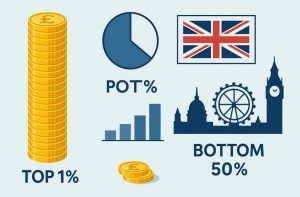
The UK is experiencing a growing gap in wealth distribution, which many analysts argue is more significant than income inequality.
While income differences can be moderated through policies such as minimum wage laws and income tax bands, wealth inequality is more persistent and harder to correct once it has been established.
The most recent data from the Office for National Statistics paints a stark picture of this imbalance:
| Wealth Group | Share of Total UK Wealth |
| Top 1% | Approximately 25% |
| Top 10% | Approximately 45% |
| Middle 40% | Around 30% |
| Bottom 50% | Less than 5% |
Wealth is not merely about assets such as homes or pensions but includes financial instruments, business ownership, and inheritances.
The disproportionate share of wealth held by the top 1% enables them to maintain influence and opportunity not available to the majority.
This trend signals a drift towards what economists call “rentier capitalism” – a system where the primary source of income comes from owning assets rather than producing goods or services.
Such a structure is reminiscent of the 19th-century Gilded Age, where vast wealth was held by a few families and passed on through inheritance, reinforcing social stratification.
Does the Current Tax System Penalise Earned Income?
A central component of Goodall’s critique is the way the UK tax system treats different types of income.
Earned income, such as salaries and wages, is taxed through Income Tax and National Insurance. Individuals who earn more are placed into higher tax brackets, with marginal tax rates reaching up to 45% for top earners.
In contrast, inherited wealth is often taxed at lower effective rates, especially when tax planning techniques are employed.
The current inheritance tax system includes numerous reliefs and allowances that can dramatically reduce or eliminate the tax liability for high-net-worth estates.
The disparity between how different types of income are taxed is illustrated in the following comparison:
| Income Source | Typical Tax Treatment | Observations |
| Earned Salary | Up to 45% income tax | High marginal rates, especially for top earners |
| Capital Gains | 10%-20% CGT | Often lower than income tax rates |
| Inherited Assets | 40% above £325,000 | Frequently reduced with planning |
| Dividends | 8.75%-39.35% | Separate rates, usually lower than salaries |
This taxation structure rewards those who derive their income from wealth, not work.
It discourages entrepreneurial or professional effort while benefiting those who receive unearned income.
Goodall’s argument is that this system not only erodes fairness but also creates economic inefficiency.
It distorts incentives and undermines productivity by shifting the focus from work and innovation to preservation of inherited capital.
Would a 100% Inheritance Tax Really Be Radical?

The idea of a 100% inheritance tax sounds extreme by modern standards, but historically the UK has employed high estate taxes to support national causes and promote equity.
During the early and mid-20th century, the UK government introduced estate duties that reached as high as 80% for large estates, especially during wartime.
These policies were designed to reduce aristocratic power and redistribute wealth more fairly.
They were not only accepted but seen as necessary to fund recovery and social investment following the world wars.
From an international perspective, while no country currently enforces a 100% inheritance tax, some have adopted inheritance regimes that are far more progressive than the UK’s. For example:
- In Japan, inheritance tax can go up to 55%
- In Belgium, certain regions tax inheritances up to 30% or more
- In France, large estates are taxed progressively and are less sheltered by exemptions
The historical and global context suggests that high taxation on inheritance is not without precedent.
The real question is whether the political and economic climate today could support such a shift.
Goodall positions the 100% tax not as a punitive measure but as a mechanism to fund public services, reduce tax on earned income, and equalise opportunity.
Rather than being a radical departure, it could be seen as a return to earlier principles that sought to dismantle inherited privilege.
What Are the Arguments For and Against a 100% Inheritance Tax?
The debate around a 100% inheritance tax is complex, with strong opinions on both sides.
Supporters argue that such a policy would dramatically reduce inequality and promote fairness, while critics raise concerns about practicality, legality, and morality.
Arguments in support:
- It eliminates dynastic wealth and promotes equal starting points
- It generates public revenue for services like education and healthcare
- It encourages productivity and innovation by focusing rewards on effort
- It aligns taxation with principles of fairness and meritocracy
Arguments against:
- It could disincentivise saving and investment
- It may force the breakup of family businesses or farms
- High net worth individuals could move assets abroad to avoid taxation
- It raises ethical questions about the right to pass on one’s wealth
While Goodall acknowledges some of these challenges, he argues that the trade-off is worth pursuing.
He proposes a model in which the state takes over inherited wealth, but simultaneously lowers taxes on earned income to incentivise contribution to society.
Could Lower Income Tax Be a Trade-Off for Higher Inheritance Tax?

One of the most thought-provoking aspects of Goodall’s proposal is the suggestion that a 100% inheritance tax could be paired with substantial cuts to income tax.
This would reverse the existing dynamic where earned income is heavily taxed and unearned wealth is lightly taxed.
The benefits of such a shift could include:
- Greater work incentives, particularly among low and middle-income earners
- Reduced tax burden on productive sectors of the economy
- Increased disposable income for working families
- Enhanced perception of fairness in the tax system
However, implementing this model would require rigorous economic planning.
The government would need to assess whether the revenue generated from a 100% inheritance tax could replace lost income tax revenues.
It would also require strong enforcement to prevent avoidance through trusts, offshore accounts, and early gifting.
There would need to be exceptions or transitional arrangements to avoid unintended consequences, particularly for dependants or small businesses.
Policymakers would have to strike a balance between principle and practicality to ensure such reforms benefit the broader public without creating economic disruption.
Conclusion
Lewis Goodall’s call for a 100% inheritance tax presents a bold reimagining of wealth redistribution in the UK.
While the proposal is contentious, it raises vital questions about fairness, opportunity, and the role of taxation in addressing structural inequality.
Whether or not it gains political traction, it has undoubtedly reignited a necessary debate about the concentration of wealth and how the tax system can evolve to support a more balanced and merit-based society.
Frequently Asked Questions (FAQs)
What is the current inheritance tax threshold in the UK?
The standard threshold is £325,000, above which a 40% tax is applied. Exemptions apply for spouses, charities, and specific types of assets.
Could a 100% inheritance tax harm family-owned businesses?
Yes, unless exemptions are made. Critics argue that such a tax could force sales or closures, affecting employment and economic continuity.
Has any country ever implemented a 100% inheritance tax?
No country currently imposes a 100% inheritance tax, but historical examples include high estate taxes in the UK and US during wartime periods.
What would a 100% inheritance tax mean for the average UK citizen?
Most estates in the UK fall below the current threshold. Therefore, only a small percentage of families would be directly affected, but the broader economic and policy impacts could be significant.
Are there alternatives to a full 100% inheritance tax?
Yes. Options include progressive inheritance tax rates, gift taxes, and wealth taxes on assets above certain thresholds.
What is Lewis Goodall’s main argument?
That inheritance entrenches inequality, and the UK should replace it with a system that rewards work, not birthright, potentially through a 100% inheritance tax.
How could tax reform improve generational fairness?
By taxing wealth transfers and easing the burden on earned income, reforms could promote greater access to education, housing, and opportunity for all.
What is your reaction?