Navigating the Future of Commercial Fit Out in a Remote Work Era

The rise of remote work has significantly influenced how businesses approach office design and commercial fit-outs.
As companies adapt to new working models, they face the challenge of creating spaces that meet evolving needs. This shift demands innovative design solutions that foster productivity and collaboration.
In recent years, the increasing adoption of remote work has reshaped traditional office environments. The Commercial Fit Out industry is witnessing a transformation as businesses rethink how their physical spaces should function.
This change is largely driven by the need to accommodate a workforce that splits its time between home and the office. To keep up with these developments, organisations are reimagining their offices to support flexible work arrangements and enhance employee experience.
Remote Work Trends Reshaping Office Spaces

The shift towards remote work has accelerated rapidly, with more companies adopting hybrid models that combine in-office and remote work. This trend has profound implications for office design, prompting businesses to reassess their space requirements.
As organisations reduce their reliance on large centralised offices, they are focusing on creating environments that encourage collaboration when employees are on-site.
The move towards hybrid work necessitates adaptable spaces that can serve multiple purposes, supporting both individual tasks and group activities.
Companies are increasingly recognising the need for spaces that promote interaction and innovation. The demand for open layouts and collaborative zones is growing as these designs facilitate spontaneous discussions and teamwork.
By integrating flexible furniture and modular setups, businesses can quickly transform areas to suit varying team sizes and project needs.This adaptability is essential in a world where the nature of work continues to evolve.
How Businesses Adapt Their Physical Environments?
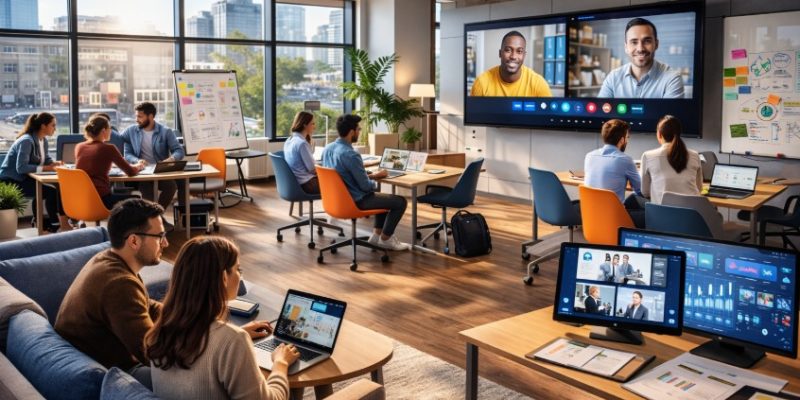
Adapting office spaces to suit remote work trends involves embracing technology and multifunctionality. Companies are investing in state-of-the-art communication tools that enable seamless interactions between in-office and remote team members.
Video conferencing facilities, smart whiteboards, and integrated digital platforms are becoming standard features in modern offices. These technologies ensure that all employees remain connected regardless of their location, facilitating effective collaboration across different settings.
Moreover, multifunctional areas are gaining popularity as they allow for diverse activities within the same space. Businesses are designing spaces that can transition from quiet zones for focused work to lively hubs for brainstorming sessions.
This flexibility maximises the utility of available square footage while supporting a variety of work styles. By prioritising agility in office design, companies can better accommodate the dynamic needs of today’s workforce.
Emerging Design Trends Supporting Hybrid Models
A key trend in future office design is the emphasis on wellness-focused spaces that prioritise employee well-being. Companies are incorporating natural elements like plants, sunlight, and ventilation systems to create healthier indoor environments.
These features not only enhance aesthetic appeal but also contribute to improved air quality and reduced stress levels among employees. Another trend is the creation of dedicated collaborative zones designed specifically for team activities.
These areas are equipped with resources that foster creativity and communication, such as writable surfaces and flexible seating arrangements.
Commercial Fit Out approaches now often include an emphasis on communal areas where employees can engage in informal interactions that build camaraderie and strengthen company culture.
Challenges in Redesigning Offices for the Future
While redesigning office spaces offers numerous benefits, it also presents challenges that businesses must navigate carefully. Cost considerations play a significant role in determining the extent of redesign efforts, as comprehensive overhauls require substantial investment.
Balancing budget constraints with the desire for modernised spaces can be complex but is crucial for long-term success. Additionally, addressing employee preferences is vital when planning office redesigns.
Organisations must consider varying opinions on workspace aesthetics and functionality to ensure widespread satisfaction among staff. Moreover, maintaining company culture in a hybrid environment remains a challenge as employees spend less time together physically.
Thoughtful design solutions can help bridge this gap by fostering connection through intentional layout choices.
What is your reaction?